
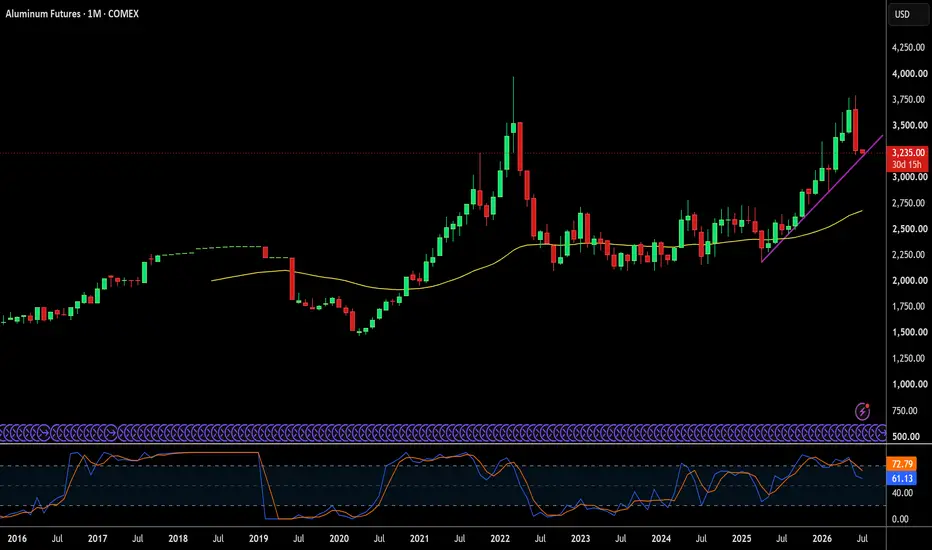
Aluminum just posted its worst month since 2008, falling 16% in June and erasing the entire March through May rally in one move. The trigger was geopolitical: a fragile but real de-escalation between the US and Iran that raised the prospect of Persian Gulf shipments resuming, a region that supplies nearly a tenth of global output. Markets moved fast on that expectation, flipping the futures curve into contango and collapsing physical premiums even before a single additional tonne actually reached the market. That gap, between priced-in relief and delivered supply, is the central tension in aluminum right now.
The macro backdrop compounded the move. The Fed held rates steady in June, but its updated projections show a majority of officials now leaning toward a hike later this year, a sharp reversal from the cutting bias priced in just months earlier. That hawkish pivot pushed the dollar higher, which mechanically pressures dollar-denominated commodities and gave sellers another reason to exit long positions built during the spring supply scare. Rising output from China and Indonesia added a second layer of supply-side pressure, reinforcing the same directional trade.
What the price action obscures is that physical tightness has not actually resolved. LME warehouse stocks kept falling through late June, down roughly 38% since the start of the year, even as prices dropped. That divergence, futures pricing in a supply recovery that hasn't yet shown up in inventories, is a bet on where Gulf shipments and Chinese output are headed, not a reflection of today's balance sheet. If the Iran truce falters, as it briefly appeared to in late June, or if the ramp from Gulf producers proves slower than the curve now assumes, the market has room to reprice sharply back higher.
Beneath the volatility, the structural story is intact and arguably underappreciated. Copper's price, still roughly four times aluminum's, keeps pushing high-tech manufacturers toward aluminum in EV wiring and grid infrastructure, a substitution trend that doesn't reverse on a one-month price swing. For producers, the near-term challenge is margin discipline in a sluggish spot market where buyers won't commit to inventory at current prices. For investors, the real question isn't whether June's crash was overdone; it's whether the market is correctly pricing a supply recovery that, as of today, exists mostly on paper.
The macro backdrop compounded the move. The Fed held rates steady in June, but its updated projections show a majority of officials now leaning toward a hike later this year, a sharp reversal from the cutting bias priced in just months earlier. That hawkish pivot pushed the dollar higher, which mechanically pressures dollar-denominated commodities and gave sellers another reason to exit long positions built during the spring supply scare. Rising output from China and Indonesia added a second layer of supply-side pressure, reinforcing the same directional trade.
What the price action obscures is that physical tightness has not actually resolved. LME warehouse stocks kept falling through late June, down roughly 38% since the start of the year, even as prices dropped. That divergence, futures pricing in a supply recovery that hasn't yet shown up in inventories, is a bet on where Gulf shipments and Chinese output are headed, not a reflection of today's balance sheet. If the Iran truce falters, as it briefly appeared to in late June, or if the ramp from Gulf producers proves slower than the curve now assumes, the market has room to reprice sharply back higher.
Beneath the volatility, the structural story is intact and arguably underappreciated. Copper's price, still roughly four times aluminum's, keeps pushing high-tech manufacturers toward aluminum in EV wiring and grid infrastructure, a substitution trend that doesn't reverse on a one-month price swing. For producers, the near-term challenge is margin discipline in a sluggish spot market where buyers won't commit to inventory at current prices. For investors, the real question isn't whether June's crash was overdone; it's whether the market is correctly pricing a supply recovery that, as of today, exists mostly on paper.

The5ers Funding Forex Traders & Growth Program. Get Funded with up to $2.56M
We Trade Forex - Come Join Us!
the5ers.com
We Trade Forex - Come Join Us!
the5ers.com
إخلاء المسؤولية
لا يُقصد بالمعلومات والمنشورات أن تكون، أو تشكل، أي نصيحة مالية أو استثمارية أو تجارية أو أنواع أخرى من النصائح أو التوصيات المقدمة أو المعتمدة من TradingView. اقرأ المزيد في شروط الاستخدام.
The5ers Funding Forex Traders & Growth Program. Get Funded with up to $2.56M
We Trade Forex - Come Join Us!
the5ers.com
We Trade Forex - Come Join Us!
the5ers.com
إخلاء المسؤولية
لا يُقصد بالمعلومات والمنشورات أن تكون، أو تشكل، أي نصيحة مالية أو استثمارية أو تجارية أو أنواع أخرى من النصائح أو التوصيات المقدمة أو المعتمدة من TradingView. اقرأ المزيد في شروط الاستخدام.