
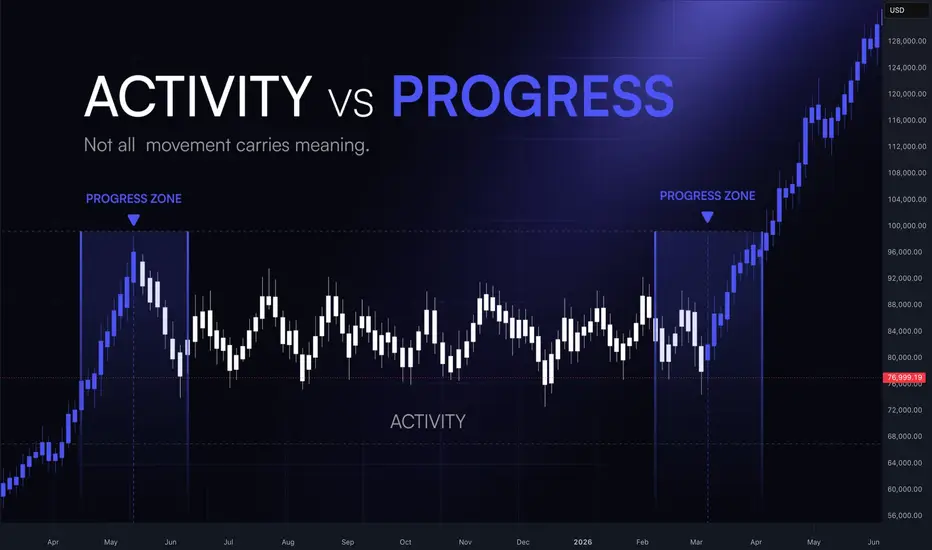
Trading platforms are designed to show constant activity. Charts move, candles print, and price updates continuously. This creates the impression that something meaningful is always happening.
Activity, however, is not the same as progress.
Progress occurs when the market moves from one meaningful location to another. It involves interaction with liquidity, shifts in structure, and sustained participation. Activity, on the other hand, can occur without any of these elements.
This distinction is important because many traders mistake movement for opportunity.
They see price fluctuating and assume that trades can be taken within those fluctuations. In reality, much of this movement occurs in areas where neither side has clear control. These are environments where probability is low and outcomes are inconsistent.
The result is overtrading.
Positions are opened based on short-term movement rather than structural significance. Some trades may work, but many will not, and the overall performance becomes unstable.
Progress is easier to identify when focus shifts to location and context.
When price approaches a key level, interaction becomes meaningful. Decisions are forced, and the market reveals intent. These moments provide information that can be used for structured execution.
Between these moments, activity may still exist, but it lacks direction.
Professional traders spend most of their time observing rather than acting. They recognize that progress happens in specific areas, not continuously across the chart.
This approach reduces noise.
Instead of reacting to every movement, the trader waits for conditions where movement carries meaning. Trades are taken less frequently, but with greater clarity and purpose.
The goal is not to engage with the market at all times.
It is to engage when the market is actually progressing.

One of the reasons traders struggle with this concept is because constant movement creates psychological pressure to participate. When candles are printing quickly and price appears active, inactivity can feel unproductive. The trader begins associating observation with hesitation and action with progress. In reality, many of the most damaging trades occur during periods where the market is active but structurally meaningless.
This is especially common in the middle of ranges or during low-conviction environments. Price moves continuously, but those movements fail to produce clean continuation or meaningful structural change. Buyers and sellers rotate control temporarily without establishing sustained direction. To an inexperienced trader, this still appears tradable because movement exists. To an experienced trader, it often represents noise rather than opportunity.
Markets do not create edge simply because price is fluctuating.
An edge appears when movement occurs in a meaningful context. A reaction at a major liquidity level carries more significance than random movement inside the center of a range. A structural shift after liquidity has been taken carries more importance than a temporary momentum spike occurring in isolation. Without context, movement becomes difficult to interpret because there is no framework separating important information from random fluctuation.
This is where many traders become trapped in constant engagement. Instead of waiting for meaningful interaction, they begin reacting to every short-term movement. Small candles feel significant, temporary momentum feels actionable, and every fluctuation appears capable of producing opportunity. Over time, this creates exhaustion because the trader is constantly making decisions inside environments that offer little actual clarity.
The problem with noise is not only financial. It is psychological.
Constant participation in low-quality conditions gradually reduces objectivity. Emotional fatigue increases, patience deteriorates, and the ability to recognize high-quality opportunities weakens because attention becomes consumed by meaningless activity. The trader begins treating the market as something that must always be traded rather than something that must first justify participation.
Professional traders operate differently because they understand that markets spend large amounts of time doing very little structurally. Price can remain active while accomplishing almost nothing in terms of meaningful progression. Liquidity has not been reached, structure has not shifted, and participation has not committed clearly in one direction. During these periods, movement exists, but the market is not actually progressing.
This is why experienced traders spend so much time waiting.
They understand that the most important moments usually occur around specific areas where the market is forced to make decisions. Previous highs, previous lows, major support and resistance zones, equal highs and lows, range boundaries, and areas of concentrated liquidity all create conditions where meaningful interaction can occur. When price approaches these locations, behavior begins carrying informational value because the market must reveal whether it accepts or rejects those prices.
Between these areas, much of the movement is simply transition.
The market rotates, balances, and searches for liquidity without providing clear directional intent. Traders who force participation during these phases often experience inconsistent outcomes because the market itself has not yet chosen a meaningful direction. Even when trades occasionally succeed, the process behind them lacks stability because the environment itself lacks structure.
This understanding changes the role of patience completely.
Patience is no longer about resisting the urge to trade emotionally. It becomes a structural decision based on whether the market is currently providing meaningful conditions. Traders stop measuring productivity through activity and start measuring it through quality of execution. Some sessions may produce no trades at all, and that becomes acceptable because the absence of opportunity is recognized rather than emotionally resisted.
This shift also improves clarity dramatically. When traders stop reacting to every fluctuation, the chart becomes easier to interpret. Important movements stand out more clearly because attention is no longer scattered across meaningless price activity. The trader begins focusing on where the market is, what liquidity exists nearby, and whether the current movement actually carries structural significance.
Over time, this creates a calmer relationship with the market.
The need to constantly participate fades because the trader no longer views every candle as important. Instead of chasing movement continuously, they wait for moments where structure, liquidity, and participation align clearly enough to justify risk. Execution becomes more selective, but also more intentional.
This is why professional trading often appears inactive from the outside. Much of the work happens through observation, preparation, and interpretation rather than constant execution. Traders are not waiting passively. They are filtering conditions carefully and refusing to engage unless the market is providing meaningful progression.
Because the market is always active.
But meaningful opportunity is not always present.
The goal is not to react to movement itself.
It is to recognize when movement actually represents progress and when it is simply noise occurring between meaningful decisions.
Activity, however, is not the same as progress.
Progress occurs when the market moves from one meaningful location to another. It involves interaction with liquidity, shifts in structure, and sustained participation. Activity, on the other hand, can occur without any of these elements.
This distinction is important because many traders mistake movement for opportunity.
They see price fluctuating and assume that trades can be taken within those fluctuations. In reality, much of this movement occurs in areas where neither side has clear control. These are environments where probability is low and outcomes are inconsistent.
The result is overtrading.
Positions are opened based on short-term movement rather than structural significance. Some trades may work, but many will not, and the overall performance becomes unstable.
Progress is easier to identify when focus shifts to location and context.
When price approaches a key level, interaction becomes meaningful. Decisions are forced, and the market reveals intent. These moments provide information that can be used for structured execution.
Between these moments, activity may still exist, but it lacks direction.
Professional traders spend most of their time observing rather than acting. They recognize that progress happens in specific areas, not continuously across the chart.
This approach reduces noise.
Instead of reacting to every movement, the trader waits for conditions where movement carries meaning. Trades are taken less frequently, but with greater clarity and purpose.
The goal is not to engage with the market at all times.
It is to engage when the market is actually progressing.
One of the reasons traders struggle with this concept is because constant movement creates psychological pressure to participate. When candles are printing quickly and price appears active, inactivity can feel unproductive. The trader begins associating observation with hesitation and action with progress. In reality, many of the most damaging trades occur during periods where the market is active but structurally meaningless.
This is especially common in the middle of ranges or during low-conviction environments. Price moves continuously, but those movements fail to produce clean continuation or meaningful structural change. Buyers and sellers rotate control temporarily without establishing sustained direction. To an inexperienced trader, this still appears tradable because movement exists. To an experienced trader, it often represents noise rather than opportunity.
Markets do not create edge simply because price is fluctuating.
An edge appears when movement occurs in a meaningful context. A reaction at a major liquidity level carries more significance than random movement inside the center of a range. A structural shift after liquidity has been taken carries more importance than a temporary momentum spike occurring in isolation. Without context, movement becomes difficult to interpret because there is no framework separating important information from random fluctuation.
This is where many traders become trapped in constant engagement. Instead of waiting for meaningful interaction, they begin reacting to every short-term movement. Small candles feel significant, temporary momentum feels actionable, and every fluctuation appears capable of producing opportunity. Over time, this creates exhaustion because the trader is constantly making decisions inside environments that offer little actual clarity.
The problem with noise is not only financial. It is psychological.
Constant participation in low-quality conditions gradually reduces objectivity. Emotional fatigue increases, patience deteriorates, and the ability to recognize high-quality opportunities weakens because attention becomes consumed by meaningless activity. The trader begins treating the market as something that must always be traded rather than something that must first justify participation.
Professional traders operate differently because they understand that markets spend large amounts of time doing very little structurally. Price can remain active while accomplishing almost nothing in terms of meaningful progression. Liquidity has not been reached, structure has not shifted, and participation has not committed clearly in one direction. During these periods, movement exists, but the market is not actually progressing.
This is why experienced traders spend so much time waiting.
They understand that the most important moments usually occur around specific areas where the market is forced to make decisions. Previous highs, previous lows, major support and resistance zones, equal highs and lows, range boundaries, and areas of concentrated liquidity all create conditions where meaningful interaction can occur. When price approaches these locations, behavior begins carrying informational value because the market must reveal whether it accepts or rejects those prices.
Between these areas, much of the movement is simply transition.
The market rotates, balances, and searches for liquidity without providing clear directional intent. Traders who force participation during these phases often experience inconsistent outcomes because the market itself has not yet chosen a meaningful direction. Even when trades occasionally succeed, the process behind them lacks stability because the environment itself lacks structure.
This understanding changes the role of patience completely.
Patience is no longer about resisting the urge to trade emotionally. It becomes a structural decision based on whether the market is currently providing meaningful conditions. Traders stop measuring productivity through activity and start measuring it through quality of execution. Some sessions may produce no trades at all, and that becomes acceptable because the absence of opportunity is recognized rather than emotionally resisted.
This shift also improves clarity dramatically. When traders stop reacting to every fluctuation, the chart becomes easier to interpret. Important movements stand out more clearly because attention is no longer scattered across meaningless price activity. The trader begins focusing on where the market is, what liquidity exists nearby, and whether the current movement actually carries structural significance.
Over time, this creates a calmer relationship with the market.
The need to constantly participate fades because the trader no longer views every candle as important. Instead of chasing movement continuously, they wait for moments where structure, liquidity, and participation align clearly enough to justify risk. Execution becomes more selective, but also more intentional.
This is why professional trading often appears inactive from the outside. Much of the work happens through observation, preparation, and interpretation rather than constant execution. Traders are not waiting passively. They are filtering conditions carefully and refusing to engage unless the market is providing meaningful progression.
Because the market is always active.
But meaningful opportunity is not always present.
The goal is not to react to movement itself.
It is to recognize when movement actually represents progress and when it is simply noise occurring between meaningful decisions.

منشورات ذات صلة
إخلاء المسؤولية
لا يُقصد بالمعلومات والمنشورات أن تكون، أو تشكل، أي نصيحة مالية أو استثمارية أو تجارية أو أنواع أخرى من النصائح أو التوصيات المقدمة أو المعتمدة من TradingView. اقرأ المزيد في شروط الاستخدام.
منشورات ذات صلة
إخلاء المسؤولية
لا يُقصد بالمعلومات والمنشورات أن تكون، أو تشكل، أي نصيحة مالية أو استثمارية أو تجارية أو أنواع أخرى من النصائح أو التوصيات المقدمة أو المعتمدة من TradingView. اقرأ المزيد في شروط الاستخدام.