
The Assumption: Defaults Are Good Enough
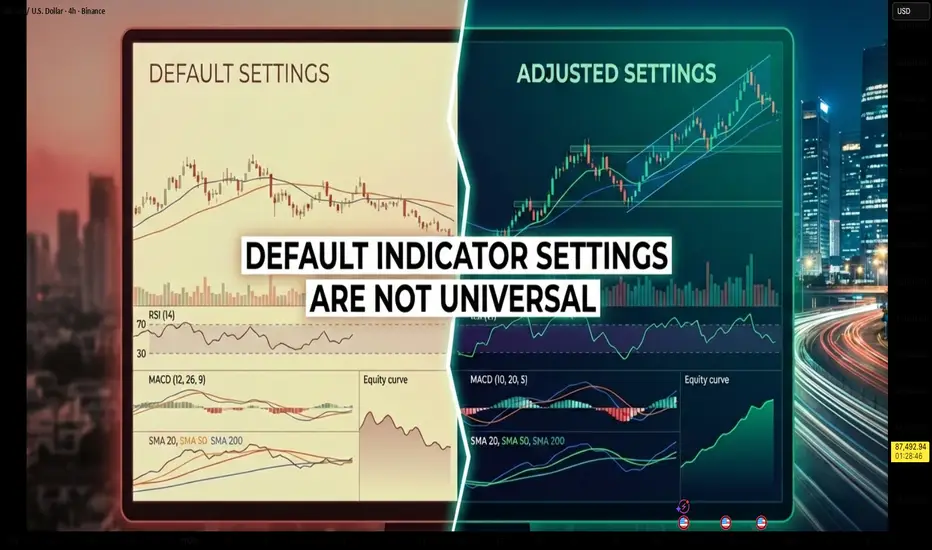
Most traders start with default indicator settings. RSI at 14. MACD at 12, 26, 9. Moving averages set to familiar values.
Defaults feel safe because they are familiar. They feel reasonable because they are widely used.
The problem: defaults are not designed to work across all symbols, timeframes, or market conditions.
The solution: instead of assuming defaults are acceptable, test how those settings behave when parameters are varied. Small changes often reveal whether a strategy is stable or dependent on coincidence.
The Assumption: If It Works on One Chart, It Should Work Elsewhere
A strategy looks clean on a single chart. Entries make sense. Losses feel explainable. Confidence builds.
The problem: one chart is not a market. Performance on a single symbol or timeframe says very little about robustness.
The solution: test the same logic across multiple symbols and timeframes. When behavior changes dramatically, it’s not failure, it’s information. Consistency across variation is what signals durability.
The Assumption: Indicator Logic Is the Edge
Traders often focus heavily on the logic behind indicators. Momentum, trend, mean reversion. The reasoning feels solid.
The problem: good logic does not guarantee good behavior. Two parameter sets can follow the same logic and produce completely different risk profiles.
The solution: explore how performance shifts as parameters move. Testing ranges, not single values, shows whether logic holds up under pressure or collapses when assumptions change.
The Assumption: Profit Tells the Full Story
Many traders judge strategies by net profit alone.
The problem: profit without context hides risk. Large drawdowns, unstable equity curves, or long stagnation periods often go unnoticed until they’re experienced live.
The solution: test for drawdown, consistency, and trade distribution alongside profit. Seeing how risk expands or contracts across parameter combinations changes how strategies are evaluated.
The Assumption: Defaults Fail Because Markets Changed
When defaults stop performing, traders often blame the market.
The problem: markets always change. A strategy that only works under narrow conditions was fragile from the start.
The solution: testing across broader conditions reveals whether a strategy is regime-dependent or structurally resilient. This allows expectations to adjust before capital is exposed.
What Testing Actually Replaces
Testing doesn’t replace strategy logic.
It replaces assumptions.
It replaces:
With:
Final Thought
Default settings are not wrong.
They are incomplete.
They are a starting point, not a conclusion.
The moment defaults are tested across parameters, symbols, and timeframes, they stop being assumptions and start becoming data. That shift is where real understanding begins.
Most traders start with default indicator settings. RSI at 14. MACD at 12, 26, 9. Moving averages set to familiar values.
Defaults feel safe because they are familiar. They feel reasonable because they are widely used.
The problem: defaults are not designed to work across all symbols, timeframes, or market conditions.
The solution: instead of assuming defaults are acceptable, test how those settings behave when parameters are varied. Small changes often reveal whether a strategy is stable or dependent on coincidence.
The Assumption: If It Works on One Chart, It Should Work Elsewhere
A strategy looks clean on a single chart. Entries make sense. Losses feel explainable. Confidence builds.
The problem: one chart is not a market. Performance on a single symbol or timeframe says very little about robustness.
The solution: test the same logic across multiple symbols and timeframes. When behavior changes dramatically, it’s not failure, it’s information. Consistency across variation is what signals durability.
The Assumption: Indicator Logic Is the Edge
Traders often focus heavily on the logic behind indicators. Momentum, trend, mean reversion. The reasoning feels solid.
The problem: good logic does not guarantee good behavior. Two parameter sets can follow the same logic and produce completely different risk profiles.
The solution: explore how performance shifts as parameters move. Testing ranges, not single values, shows whether logic holds up under pressure or collapses when assumptions change.
The Assumption: Profit Tells the Full Story
Many traders judge strategies by net profit alone.
The problem: profit without context hides risk. Large drawdowns, unstable equity curves, or long stagnation periods often go unnoticed until they’re experienced live.
The solution: test for drawdown, consistency, and trade distribution alongside profit. Seeing how risk expands or contracts across parameter combinations changes how strategies are evaluated.
The Assumption: Defaults Fail Because Markets Changed
When defaults stop performing, traders often blame the market.
The problem: markets always change. A strategy that only works under narrow conditions was fragile from the start.
The solution: testing across broader conditions reveals whether a strategy is regime-dependent or structurally resilient. This allows expectations to adjust before capital is exposed.
What Testing Actually Replaces
Testing doesn’t replace strategy logic.
It replaces assumptions.
It replaces:
- “This should work”
- “This looks reasonable”
- “Everyone uses this”
With:
- “This is how it behaves”
- “This is where it struggles”
- “This is how sensitive it is”
Final Thought
Default settings are not wrong.
They are incomplete.
They are a starting point, not a conclusion.
The moment defaults are tested across parameters, symbols, and timeframes, they stop being assumptions and start becoming data. That shift is where real understanding begins.

Strategy Builder • Explorer • Optimizer
Create strategies, explore thousands of TradingView ideas, & backtest at scale across symbols, timeframes, & parameters.
🌐 quanttradingpro.com
💬 Research & discussion: discord.gg/2systG9frc
Create strategies, explore thousands of TradingView ideas, & backtest at scale across symbols, timeframes, & parameters.
🌐 quanttradingpro.com
💬 Research & discussion: discord.gg/2systG9frc
إخلاء المسؤولية
لا يُقصد بالمعلومات والمنشورات أن تكون، أو تشكل، أي نصيحة مالية أو استثمارية أو تجارية أو أنواع أخرى من النصائح أو التوصيات المقدمة أو المعتمدة من TradingView. اقرأ المزيد في شروط الاستخدام.
Strategy Builder • Explorer • Optimizer
Create strategies, explore thousands of TradingView ideas, & backtest at scale across symbols, timeframes, & parameters.
🌐 quanttradingpro.com
💬 Research & discussion: discord.gg/2systG9frc
Create strategies, explore thousands of TradingView ideas, & backtest at scale across symbols, timeframes, & parameters.
🌐 quanttradingpro.com
💬 Research & discussion: discord.gg/2systG9frc
إخلاء المسؤولية
لا يُقصد بالمعلومات والمنشورات أن تكون، أو تشكل، أي نصيحة مالية أو استثمارية أو تجارية أو أنواع أخرى من النصائح أو التوصيات المقدمة أو المعتمدة من TradingView. اقرأ المزيد في شروط الاستخدام.