
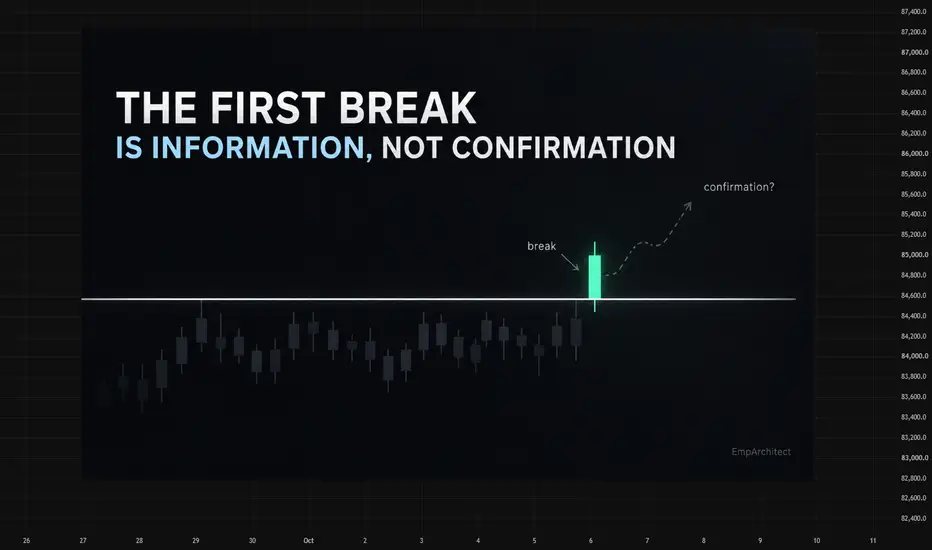
The first move through a level is easy to notice. Price leaves a range, pushes through resistance or support, and the chart suddenly looks different. That matters because something has changed, but it does not prove that the market has accepted the new area or that continuation is now established.
A break is useful information. It is not the full conclusion.
────────────────────────────
THE FIRST BREAK CHANGES THE QUESTION
────────────────────────────
Before a level breaks, the main question is whether price can move through it. Once that happens, the question changes. Now the more useful thing to study is what price does after the break: does it remain outside the range, begin building structure at the new location, hold the old boundary on a return, or simply get absorbed back into the previous area?
The first break creates a new condition. The behaviour afterward tells us whether that condition survives.
────────────────────────────
A BREAK IS AN EVENT, NOT A VERDICT
────────────────────────────
Suppose price has spent several sessions beneath a clear range high and eventually trades through it. We now know something objective: price crossed a boundary that had previously contained the market.
What we do not know yet is whether buyers can maintain control beyond that level, whether the market will continue doing business there, or whether the move will be rejected back into the old range. Those conclusions require more evidence.
This is where analysis often becomes too aggressive. The breakout candle is usually the most visually dramatic part of the sequence, so it is easy to treat the event itself as confirmation. But moving through a level and remaining beyond it are two different things.
────────────────────────────
FOLLOW-THROUGH ADDS THE MISSING INFORMATION
────────────────────────────
The next phase begins answering the questions the breakout cannot. If price continues trading beyond the old boundary, holds pullbacks and develops new structure there, the initial break gains context. The market is no longer simply visiting a new area; it is beginning to operate from it.
If price quickly loses the level and falls back into the previous range, the interpretation changes just as clearly. The break still happened, but the market failed to maintain the new location.
That is why follow-through matters. The first move tells us that something changed. What happens next tells us more about the quality and persistence of that change.
────────────────────────────
ACCEPTANCE TAKES TIME
────────────────────────────
Acceptance is difficult to judge from one candle because it is inherently about persistence. A single bar can cross a level aggressively and still be completely rejected shortly afterward. A smaller break followed by several periods of stable trade beyond the boundary can eventually provide stronger evidence than the initial impulse itself.
There is no universal number of candles that suddenly makes a breakout “confirmed.” The useful distinction is simpler: acceptance is a process, not a single print.
Price has to show that the new area can function as part of the market rather than as a temporary excursion.
────────────────────────────
THE RETURN CAN MATTER MORE THAN THE BREAK
────────────────────────────
One of the most informative moments often comes when price revisits the boundary it just crossed. If former resistance begins holding as support, or former support begins capping price from below, the market is giving us new information about how that level is being treated.
If the level fails immediately and price becomes accepted back inside the old range, that is useful information too. Either outcome tells us something that did not exist at the moment of the breakout.
This is why I increasingly treat the first break as the start of the investigation, not the end of it.
────────────────────────────
WHAT THE FIRST BREAK ACTUALLY ESTABLISHES
────────────────────────────
A lot of weak analysis comes from turning the first visible event into a complete story. Breakout becomes continuation, sweep becomes reversal, large candle becomes conviction, CHoCH becomes trend change.
Sometimes those interpretations eventually prove correct, but the first event usually establishes less than the finished chart makes it seem.
A cleaner way to think about it is to separate what has already happened from what still needs to be demonstrated. For a breakout, what has happened is clear: price crossed the level. What remains unresolved is whether price can hold, build and continue from the new location.
────────────────────────────
THE QUESTION I FIND MORE USEFUL
────────────────────────────
Instead of asking only “Did price break the level?”, I find it more useful to ask “What happened after the break?”
Did price hold beyond it? Did structure continue developing there? Did the old boundary change role? Or did price simply return to the previous range?
That keeps the first break in its proper place:
The first break is information. Confirmation comes from what happens next.
Structure observations, not signals.

إخلاء المسؤولية
لا يُقصد بالمعلومات والمنشورات أن تكون، أو تشكل، أي نصيحة مالية أو استثمارية أو تجارية أو أنواع أخرى من النصائح أو التوصيات المقدمة أو المعتمدة من TradingView. اقرأ المزيد في شروط الاستخدام.
إخلاء المسؤولية
لا يُقصد بالمعلومات والمنشورات أن تكون، أو تشكل، أي نصيحة مالية أو استثمارية أو تجارية أو أنواع أخرى من النصائح أو التوصيات المقدمة أو المعتمدة من TradingView. اقرأ المزيد في شروط الاستخدام.