
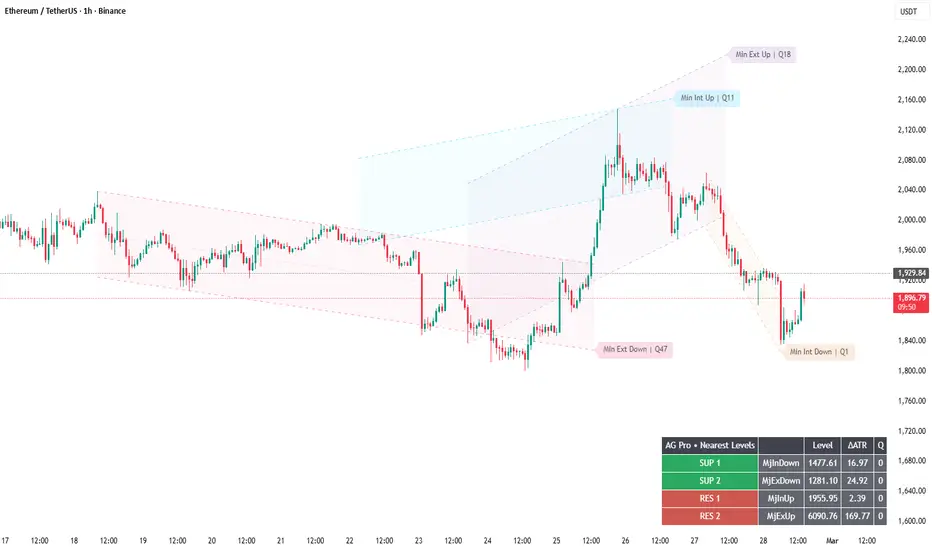
Breakout vs Reaction - Deterministic Alert Semantics for Cleaner Decisions
Most “alert spam” comes from unclear definitions.
If you don’t define what counts as a break, you will overreact to wicks.
AG Pro Dynamic Channels Elite uses deterministic alert semantics centered on the channel BASE line:
- Breakout: a confirmed violation of the base (typically by candle close).
- Reaction: a probe through the base (wick) followed by a close back into structure.
This separation matters:
- Breakout is a “structure invalidation” event → reassess context.
- Reaction is a “structure respect” event → observe continuation vs failure.
Alert hygiene controls (the real upgrade):
1) Confirm Mode
- Auto (follows message frequency)
- Intrabar (faster, noisier)
- Close (cleanest, recommended for most workflows)
2) Trigger Buffer
Off / ATR / Ticks
Buffers reduce micro-wick triggers in choppy regimes.
3) Cooldown (bars)
Prevents repeated alerts from the same channel family in a short window.
This reduces emotional churn and decision fatigue.
4) Payload Mode (Text vs JSON)
Text for human reading; JSON for webhook workflows (clean single-line payload).
Professional tip:
Alerts should automate attention, not execution.
When an alert fires, your job is to open the chart and evaluate risk, regime, and invalidation.
Risk disclosure:
Educational content only. Not financial advice. Breaks and reactions can fail; overshoots are normal in volatility expansion.
Most “alert spam” comes from unclear definitions.
If you don’t define what counts as a break, you will overreact to wicks.
AG Pro Dynamic Channels Elite uses deterministic alert semantics centered on the channel BASE line:
- Breakout: a confirmed violation of the base (typically by candle close).
- Reaction: a probe through the base (wick) followed by a close back into structure.
This separation matters:
- Breakout is a “structure invalidation” event → reassess context.
- Reaction is a “structure respect” event → observe continuation vs failure.
Alert hygiene controls (the real upgrade):
1) Confirm Mode
- Auto (follows message frequency)
- Intrabar (faster, noisier)
- Close (cleanest, recommended for most workflows)
2) Trigger Buffer
Off / ATR / Ticks
Buffers reduce micro-wick triggers in choppy regimes.
3) Cooldown (bars)
Prevents repeated alerts from the same channel family in a short window.
This reduces emotional churn and decision fatigue.
4) Payload Mode (Text vs JSON)
Text for human reading; JSON for webhook workflows (clean single-line payload).
Professional tip:
Alerts should automate attention, not execution.
When an alert fires, your job is to open the chart and evaluate risk, regime, and invalidation.
Risk disclosure:
Educational content only. Not financial advice. Breaks and reactions can fail; overshoots are normal in volatility expansion.

Trading Suite | Flagship Workflow :
tradingview.com/script/XJmX3p98-Trading-Suite-AGPro-Series/
Crypto Setup Planner | Multi-Symbol Analysis :
tradingview.com/script/LgVRo7Ql-Crypto-Setup-Planner-AGPro-Series/
tradingview.com/script/XJmX3p98-Trading-Suite-AGPro-Series/
Crypto Setup Planner | Multi-Symbol Analysis :
tradingview.com/script/LgVRo7Ql-Crypto-Setup-Planner-AGPro-Series/
إخلاء المسؤولية
لا يُقصد بالمعلومات والمنشورات أن تكون، أو تشكل، أي نصيحة مالية أو استثمارية أو تجارية أو أنواع أخرى من النصائح أو التوصيات المقدمة أو المعتمدة من TradingView. اقرأ المزيد في شروط الاستخدام.
Trading Suite | Flagship Workflow :
tradingview.com/script/XJmX3p98-Trading-Suite-AGPro-Series/
Crypto Setup Planner | Multi-Symbol Analysis :
tradingview.com/script/LgVRo7Ql-Crypto-Setup-Planner-AGPro-Series/
tradingview.com/script/XJmX3p98-Trading-Suite-AGPro-Series/
Crypto Setup Planner | Multi-Symbol Analysis :
tradingview.com/script/LgVRo7Ql-Crypto-Setup-Planner-AGPro-Series/
إخلاء المسؤولية
لا يُقصد بالمعلومات والمنشورات أن تكون، أو تشكل، أي نصيحة مالية أو استثمارية أو تجارية أو أنواع أخرى من النصائح أو التوصيات المقدمة أو المعتمدة من TradingView. اقرأ المزيد في شروط الاستخدام.