
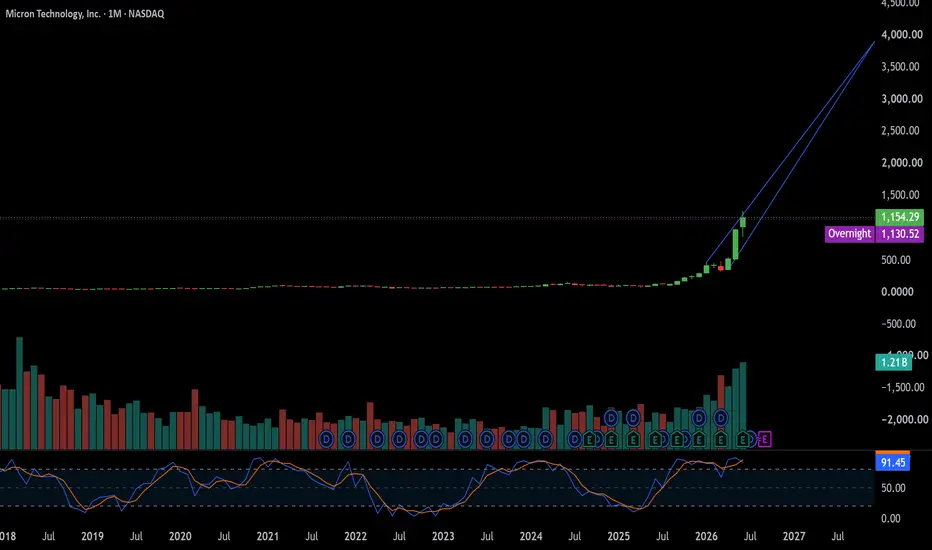
Micron's climb past a $1 trillion market cap is not simple momentum; it reflects how AI has restructured the memory business. High bandwidth memory has become the bottleneck component in AI servers, and Micron is one of only three companies worldwide, alongside Samsung and SK Hynix, capable of producing it at scale. Demand for its HBM3E and HBM4 products is now fully booked through calendar 2027 and extends into 2028, a level of forward visibility the memory industry has never had.
The fiscal Q3 numbers support that valuation. Revenue reached $41.46 billion, GAAP net income hit $28.24 billion (up roughly 15-fold year over year), and GAAP gross margin expanded to 84.6%. Those are not typical memory industry figures. Memory has historically traded on thin, cyclical margins, so a sustained move into the mid-80s signals a real shift in pricing power, not a one-quarter spike.
Three developments support the case that this cycle behaves differently than past ones. Micron has locked in 16 multi-year strategic customer agreements with take-or-pay terms, worth roughly $22 billion in cash and commitments, replacing the industry's historically volatile spot pricing with contracted revenue. Its agreement with Anthropic bundles a supply contract, joint technical work on memory performance, and an equity stake, tying Micron's HBM roadmap directly to one of the largest AI compute buyers. Continued fab investment in Idaho and New York, paired with a $250 million commitment to the federal Trump Accounts program, further cements Micron's position as the preferred domestic supplier in a market increasingly shaped by industrial policy.
The risk to this thesis is capacity, not demand. Samsung and SK Hynix are running comparably large capital programs, and new supply from all three producers, including Micron's own New York campus, is expected to arrive around 2027 to 2028, the same window when today's contracts begin rolling off. Memory has swung between shortage and glut for decades, and a coordinated capacity wave could compress the pricing power now driving Micron's margins. Whether AI has permanently changed memory economics, or simply delayed the next downturn, is the question that will decide whether this valuation holds.
The fiscal Q3 numbers support that valuation. Revenue reached $41.46 billion, GAAP net income hit $28.24 billion (up roughly 15-fold year over year), and GAAP gross margin expanded to 84.6%. Those are not typical memory industry figures. Memory has historically traded on thin, cyclical margins, so a sustained move into the mid-80s signals a real shift in pricing power, not a one-quarter spike.
Three developments support the case that this cycle behaves differently than past ones. Micron has locked in 16 multi-year strategic customer agreements with take-or-pay terms, worth roughly $22 billion in cash and commitments, replacing the industry's historically volatile spot pricing with contracted revenue. Its agreement with Anthropic bundles a supply contract, joint technical work on memory performance, and an equity stake, tying Micron's HBM roadmap directly to one of the largest AI compute buyers. Continued fab investment in Idaho and New York, paired with a $250 million commitment to the federal Trump Accounts program, further cements Micron's position as the preferred domestic supplier in a market increasingly shaped by industrial policy.
The risk to this thesis is capacity, not demand. Samsung and SK Hynix are running comparably large capital programs, and new supply from all three producers, including Micron's own New York campus, is expected to arrive around 2027 to 2028, the same window when today's contracts begin rolling off. Memory has swung between shortage and glut for decades, and a coordinated capacity wave could compress the pricing power now driving Micron's margins. Whether AI has permanently changed memory economics, or simply delayed the next downturn, is the question that will decide whether this valuation holds.

إخلاء المسؤولية
لا يُقصد بالمعلومات والمنشورات أن تكون، أو تشكل، أي نصيحة مالية أو استثمارية أو تجارية أو أنواع أخرى من النصائح أو التوصيات المقدمة أو المعتمدة من TradingView. اقرأ المزيد في شروط الاستخدام.
إخلاء المسؤولية
لا يُقصد بالمعلومات والمنشورات أن تكون، أو تشكل، أي نصيحة مالية أو استثمارية أو تجارية أو أنواع أخرى من النصائح أو التوصيات المقدمة أو المعتمدة من TradingView. اقرأ المزيد في شروط الاستخدام.