
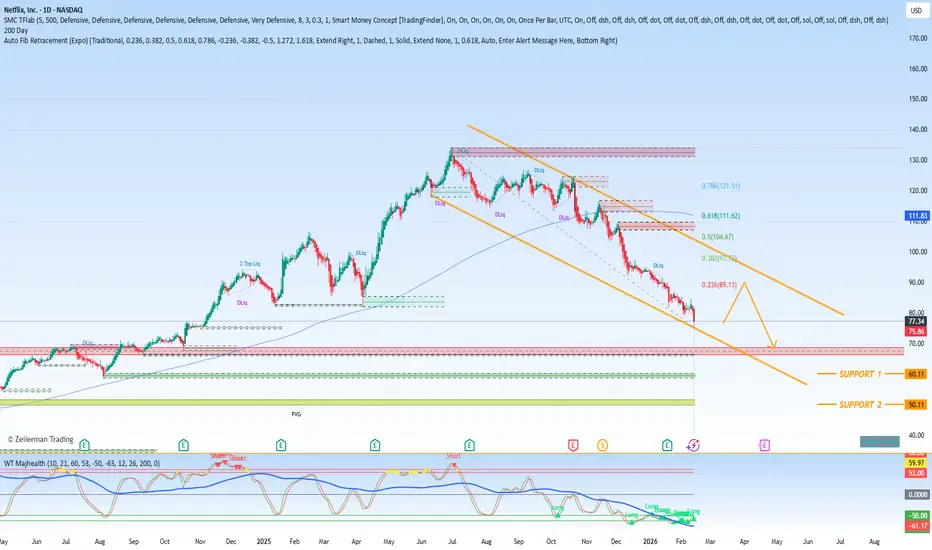
Netflix Inc. finds itself in an unusual position. The company remains the undisputed global leader in subscription streaming, commands nearly 325 million paid memberships, and continues to generate double-digit revenue growth. Yet its stock has been conspicuously out of favor. Over the past 12 months, Netflix shares have declined approximately 20%, a stark divergence from the S&P 500’s 14% gain during the same period. The stock currently trades roughly 39% below its 52-week high of $134.12, reflecting a pronounced valuation recalibration.
This disconnect between operational excellence and share-price performance presents a compelling study for investors. While near-term concerns regarding content spending and a potential acquisition have weighed on sentiment, Netflix’s underlying competitive position, earnings trajectory, and emerging advertising business suggest that the current pullback may represent a transient dislocation rather than a structural deterioration. Below are three distinct reasons why Netflix merits consideration at current levels.
1. Technical Exhaustion: Netflix Enters Oversold Territory
From a technical analysis perspective, Netflix has registered a statistically significant signal. The stock’s weekly Relative Strength Index (RSI) has descended to 26.8 , firmly penetrating the oversold threshold of 30.0. This metric, which measures the magnitude and velocity of recent price changes, indicates that selling pressure has become unusually intense and potentially exhausted.
To contextualize this reading, Walt Disney—a traditional media peer also competing in streaming—currently exhibits a weekly RSI of 48.2 , firmly in neutral territory. The divergence suggests that Netflix has been subjected to disproportionately aggressive selling relative to both the broader market and its direct competitors.
Oversold conditions do not guarantee immediate reversal; securities can remain undervalued or oversold for extended periods during periods of sustained pessimism. However, such extreme readings often precede stabilization or mean-reversion rallies, particularly when they occur in companies with intact fundamental profiles. For investors with a medium-term horizon, the current RSI implies that much of the negative sentiment regarding Netflix’s expense guidance and acquisition speculation may already be embedded in the stock price. The asymmetry between downside risk and potential upside appears increasingly favorable at these levels.
2. Earnings Resilience: Double-Digit Growth Amid Strategic Investment
Netflix’s fourth-quarter 2025 earnings report, released January 20, demonstrated that the company’s fundamental engine remains robust. Revenue increased 17.6% year-over-year to $12.05 billion, modestly exceeding consensus expectations of $11.97 billion. Operating income expanded 30.1% to approximately $3.0 billion, while net income rose 29.4% to $2.4 billion. Earnings per share of $0.56 represented 30.2% growth and narrowly surpassed estimates of $0.55.
These results were achieved despite persistent foreign exchange headwinds and a content slate that, while strong, lacked the once-in-a-generation phenomenon of a Squid Game or Wednesday. The beat was broad-based, reflecting subscriber growth, pricing power, and—increasingly—advertising revenue.
Looking forward, management has guided for 2026 revenue in the range of $50.7 billion to $51.7 billion , implying 12% to 14% year-over-year growth. More importantly, earnings per share is projected to increase by more than 23% in 2026, followed by an additional 20% growth in 2027. This earnings trajectory is supported by three structural drivers:
Subscriber Engagement and Retention: Viewer engagement remains resilient, with users consuming 96 billion hours of content in the second half of 2025, a 2% increase year-over-year. In a mature streaming market, engagement has become a more reliable indicator of franchise health than gross subscriber additions. High engagement correlates with reduced churn and enhanced pricing flexibility.
Pricing Power: Netflix has repeatedly demonstrated an ability to implement price increases in its mature markets without triggering significant cancellations. This pricing leverage is a function of deep content libraries, algorithmic personalization, and habitual viewer attachment. As competitors retreat from aggressive content spending, Netflix’s relative pricing power is likely to strengthen further.
Margin Expansion: The company targets 31.5% operating margins in 2026, a 200-basis-point improvement from 2025 levels. Critically, content spend is growing more slowly than revenue, enabling operating leverage. This disciplined approach to cost management distinguishes Netflix from traditional media conglomerates that have struggled to rationalize their linear television cost bases while funding streaming operations.
3. Valuation Normalization: Growth at a Reasonable Price
The pullback in Netflix’s share price has meaningfully improved its valuation profile. The stock currently trades at approximately 26.3 times forward earnings. While this multiple is not statistically cheap in absolute terms, it must be evaluated against the company’s earnings growth trajectory.
For context, Netflix is forecast to deliver more than 23% EPS growth in 2026 and an additional 21% in 2027. This implies a price-to-earnings-growth (PEG) ratio substantially below 1.5, a threshold often used to identify reasonably valued growth companies. Relative to its historical valuation bands—which have frequently exceeded 40x earnings during periods of accelerated subscriber acquisition—the current multiple appears restrained.
Furthermore, the valuation compression has occurred even as Netflix’s business model has become more durable. The advertising tier has evolved from an experimental initiative into a material revenue contributor, generating $1.5 billion in 2025 and on track to approximately double to $3.0 billion in 2026. Advertising carries higher margins than subscription revenue and diversifies Netflix’s monetization away from membership counts alone.
Wedbush’s Advertising Thesis: Wedbush Securities has emerged as a prominent bullish voice, arguing that the market systematically undervalues Netflix’s long-term advertising addressable market. The firm expects ad revenue to at least double in 2026, with additional upside extending into 2027 and beyond. Wedbush contends that investors have become conditioned to near-flawless execution, rendering a quarter that merely “beat” rather than “significantly exceeded” expectations as superficially disappointing. This dynamic, the firm argues, has created an attractive entry point for investors willing to look beyond short-term expense fluctuations.
4. The Warner Bros. Discovery Overhang: Uncertainty, Not Catastrophe
A contributing factor to Netflix’s recent underperformance has been speculation regarding a potential acquisition of Warner Bros. Discovery. Such a transaction would represent a fundamental departure from Netflix’s historical organic-growth strategy and raises legitimate questions regarding integration risk, balance sheet leverage, and cultural compatibility.
However, it is essential to distinguish between transactional uncertainty and operational deterioration. The mere possibility of an acquisition—which remains unconfirmed and may ultimately not materialize—has exerted downward pressure on the stock. This dynamic creates asymmetric risk: if the transaction proceeds, management will have an opportunity to articulate the strategic rationale and financial parameters; if the transaction does not proceed, the overhang dissipates entirely. In either scenario, the core streaming business continues to generate substantial free cash flow.
Free Cash Flow Dynamics: Netflix generated $1.9 billion in non-GAAP free cash flow in the fourth quarter, a 35.8% increase year-over-year. The company’s ability to fund its content slate, technology investments, and potential strategic initiatives from internally generated cash reduces dependence on capital markets and provides management with strategic optionality.
5. Analyst Sentiment and Price Targets
The consensus analyst rating for Netflix stands at “Moderate Buy,” reflecting a generally constructive view tempered by valuation concerns and acquisition uncertainty. However, individual analyst assessments vary meaningfully.
Tigress Financial’s Ivan Feinseth has maintained an optimistic stance, emphasizing Netflix’s competitive positioning and advertising upside. Conversely, more cautious voices have moderated their near-term expectations, contributing to the stock’s consolidation.
The average analyst price target implies modest upside from current levels, though this aggregate metric masks considerable dispersion. Investors should note that downward earnings revisions have been relatively limited, suggesting that the recent stock decline is attributable to multiple compression rather than deteriorating fundamental expectations.
6. Technical Support Levels and Risk Management
From a technical trading perspective, Netflix shares are approaching historically significant support zones. Analysts and institutional traders are monitoring the $60.00 and $50.00 levels as potential areas of demand accumulation. These levels represent prior consolidation ranges and institutional entry points.
While technical levels are not predictive in isolation, they provide a framework for risk assessment. A sustained breach below $50.00 would challenge the constructive thesis and potentially signal a more profound shift in investor sentiment. Conversely, a stabilization in the low-to-mid $60s followed by a return to earnings-driven appreciation would validate the oversold thesis.
Conclusion: Operational Excellence Meets Technical Opportunity
Netflix presents an intriguing convergence of operational strength and technical weakness. The company continues to execute at a high level, gaining subscribers, expanding margins, and scaling its advertising business. Management’s 2026 guidance implies confidence in the underlying trajectory, even as the expense base moderates upward.
The stock’s 20% annual decline and 39% retreat from peak levels have reset valuation expectations and pushed sentiment indicators to oversold extremes. While the Warner Bros. Discovery speculation introduces near-term uncertainty, it does not impair Netflix’s fundamental competitive position. The company remains the scale leader in global streaming, with pricing power, content efficiency, and advertising optionality that competitors struggle to replicate.
For investors with a multi-year horizon, the current pullback offers an opportunity to acquire a high-quality compounder at a multiple that does not fully reflect its earnings growth potential. Netflix must now convert its operational consistency into sustained share-price appreciation—a transition that historically follows, rather than precedes, fundamental inflection points.
This disconnect between operational excellence and share-price performance presents a compelling study for investors. While near-term concerns regarding content spending and a potential acquisition have weighed on sentiment, Netflix’s underlying competitive position, earnings trajectory, and emerging advertising business suggest that the current pullback may represent a transient dislocation rather than a structural deterioration. Below are three distinct reasons why Netflix merits consideration at current levels.
1. Technical Exhaustion: Netflix Enters Oversold Territory
From a technical analysis perspective, Netflix has registered a statistically significant signal. The stock’s weekly Relative Strength Index (RSI) has descended to 26.8 , firmly penetrating the oversold threshold of 30.0. This metric, which measures the magnitude and velocity of recent price changes, indicates that selling pressure has become unusually intense and potentially exhausted.
To contextualize this reading, Walt Disney—a traditional media peer also competing in streaming—currently exhibits a weekly RSI of 48.2 , firmly in neutral territory. The divergence suggests that Netflix has been subjected to disproportionately aggressive selling relative to both the broader market and its direct competitors.
Oversold conditions do not guarantee immediate reversal; securities can remain undervalued or oversold for extended periods during periods of sustained pessimism. However, such extreme readings often precede stabilization or mean-reversion rallies, particularly when they occur in companies with intact fundamental profiles. For investors with a medium-term horizon, the current RSI implies that much of the negative sentiment regarding Netflix’s expense guidance and acquisition speculation may already be embedded in the stock price. The asymmetry between downside risk and potential upside appears increasingly favorable at these levels.
2. Earnings Resilience: Double-Digit Growth Amid Strategic Investment
Netflix’s fourth-quarter 2025 earnings report, released January 20, demonstrated that the company’s fundamental engine remains robust. Revenue increased 17.6% year-over-year to $12.05 billion, modestly exceeding consensus expectations of $11.97 billion. Operating income expanded 30.1% to approximately $3.0 billion, while net income rose 29.4% to $2.4 billion. Earnings per share of $0.56 represented 30.2% growth and narrowly surpassed estimates of $0.55.
These results were achieved despite persistent foreign exchange headwinds and a content slate that, while strong, lacked the once-in-a-generation phenomenon of a Squid Game or Wednesday. The beat was broad-based, reflecting subscriber growth, pricing power, and—increasingly—advertising revenue.
Looking forward, management has guided for 2026 revenue in the range of $50.7 billion to $51.7 billion , implying 12% to 14% year-over-year growth. More importantly, earnings per share is projected to increase by more than 23% in 2026, followed by an additional 20% growth in 2027. This earnings trajectory is supported by three structural drivers:
Subscriber Engagement and Retention: Viewer engagement remains resilient, with users consuming 96 billion hours of content in the second half of 2025, a 2% increase year-over-year. In a mature streaming market, engagement has become a more reliable indicator of franchise health than gross subscriber additions. High engagement correlates with reduced churn and enhanced pricing flexibility.
Pricing Power: Netflix has repeatedly demonstrated an ability to implement price increases in its mature markets without triggering significant cancellations. This pricing leverage is a function of deep content libraries, algorithmic personalization, and habitual viewer attachment. As competitors retreat from aggressive content spending, Netflix’s relative pricing power is likely to strengthen further.
Margin Expansion: The company targets 31.5% operating margins in 2026, a 200-basis-point improvement from 2025 levels. Critically, content spend is growing more slowly than revenue, enabling operating leverage. This disciplined approach to cost management distinguishes Netflix from traditional media conglomerates that have struggled to rationalize their linear television cost bases while funding streaming operations.
3. Valuation Normalization: Growth at a Reasonable Price
The pullback in Netflix’s share price has meaningfully improved its valuation profile. The stock currently trades at approximately 26.3 times forward earnings. While this multiple is not statistically cheap in absolute terms, it must be evaluated against the company’s earnings growth trajectory.
For context, Netflix is forecast to deliver more than 23% EPS growth in 2026 and an additional 21% in 2027. This implies a price-to-earnings-growth (PEG) ratio substantially below 1.5, a threshold often used to identify reasonably valued growth companies. Relative to its historical valuation bands—which have frequently exceeded 40x earnings during periods of accelerated subscriber acquisition—the current multiple appears restrained.
Furthermore, the valuation compression has occurred even as Netflix’s business model has become more durable. The advertising tier has evolved from an experimental initiative into a material revenue contributor, generating $1.5 billion in 2025 and on track to approximately double to $3.0 billion in 2026. Advertising carries higher margins than subscription revenue and diversifies Netflix’s monetization away from membership counts alone.
Wedbush’s Advertising Thesis: Wedbush Securities has emerged as a prominent bullish voice, arguing that the market systematically undervalues Netflix’s long-term advertising addressable market. The firm expects ad revenue to at least double in 2026, with additional upside extending into 2027 and beyond. Wedbush contends that investors have become conditioned to near-flawless execution, rendering a quarter that merely “beat” rather than “significantly exceeded” expectations as superficially disappointing. This dynamic, the firm argues, has created an attractive entry point for investors willing to look beyond short-term expense fluctuations.
4. The Warner Bros. Discovery Overhang: Uncertainty, Not Catastrophe
A contributing factor to Netflix’s recent underperformance has been speculation regarding a potential acquisition of Warner Bros. Discovery. Such a transaction would represent a fundamental departure from Netflix’s historical organic-growth strategy and raises legitimate questions regarding integration risk, balance sheet leverage, and cultural compatibility.
However, it is essential to distinguish between transactional uncertainty and operational deterioration. The mere possibility of an acquisition—which remains unconfirmed and may ultimately not materialize—has exerted downward pressure on the stock. This dynamic creates asymmetric risk: if the transaction proceeds, management will have an opportunity to articulate the strategic rationale and financial parameters; if the transaction does not proceed, the overhang dissipates entirely. In either scenario, the core streaming business continues to generate substantial free cash flow.
Free Cash Flow Dynamics: Netflix generated $1.9 billion in non-GAAP free cash flow in the fourth quarter, a 35.8% increase year-over-year. The company’s ability to fund its content slate, technology investments, and potential strategic initiatives from internally generated cash reduces dependence on capital markets and provides management with strategic optionality.
5. Analyst Sentiment and Price Targets
The consensus analyst rating for Netflix stands at “Moderate Buy,” reflecting a generally constructive view tempered by valuation concerns and acquisition uncertainty. However, individual analyst assessments vary meaningfully.
Tigress Financial’s Ivan Feinseth has maintained an optimistic stance, emphasizing Netflix’s competitive positioning and advertising upside. Conversely, more cautious voices have moderated their near-term expectations, contributing to the stock’s consolidation.
The average analyst price target implies modest upside from current levels, though this aggregate metric masks considerable dispersion. Investors should note that downward earnings revisions have been relatively limited, suggesting that the recent stock decline is attributable to multiple compression rather than deteriorating fundamental expectations.
6. Technical Support Levels and Risk Management
From a technical trading perspective, Netflix shares are approaching historically significant support zones. Analysts and institutional traders are monitoring the $60.00 and $50.00 levels as potential areas of demand accumulation. These levels represent prior consolidation ranges and institutional entry points.
While technical levels are not predictive in isolation, they provide a framework for risk assessment. A sustained breach below $50.00 would challenge the constructive thesis and potentially signal a more profound shift in investor sentiment. Conversely, a stabilization in the low-to-mid $60s followed by a return to earnings-driven appreciation would validate the oversold thesis.
Conclusion: Operational Excellence Meets Technical Opportunity
Netflix presents an intriguing convergence of operational strength and technical weakness. The company continues to execute at a high level, gaining subscribers, expanding margins, and scaling its advertising business. Management’s 2026 guidance implies confidence in the underlying trajectory, even as the expense base moderates upward.
The stock’s 20% annual decline and 39% retreat from peak levels have reset valuation expectations and pushed sentiment indicators to oversold extremes. While the Warner Bros. Discovery speculation introduces near-term uncertainty, it does not impair Netflix’s fundamental competitive position. The company remains the scale leader in global streaming, with pricing power, content efficiency, and advertising optionality that competitors struggle to replicate.
For investors with a multi-year horizon, the current pullback offers an opportunity to acquire a high-quality compounder at a multiple that does not fully reflect its earnings growth potential. Netflix must now convert its operational consistency into sustained share-price appreciation—a transition that historically follows, rather than precedes, fundamental inflection points.

إخلاء المسؤولية
لا يُقصد بالمعلومات والمنشورات أن تكون، أو تشكل، أي نصيحة مالية أو استثمارية أو تجارية أو أنواع أخرى من النصائح أو التوصيات المقدمة أو المعتمدة من TradingView. اقرأ المزيد في شروط الاستخدام.
إخلاء المسؤولية
لا يُقصد بالمعلومات والمنشورات أن تكون، أو تشكل، أي نصيحة مالية أو استثمارية أو تجارية أو أنواع أخرى من النصائح أو التوصيات المقدمة أو المعتمدة من TradingView. اقرأ المزيد في شروط الاستخدام.