
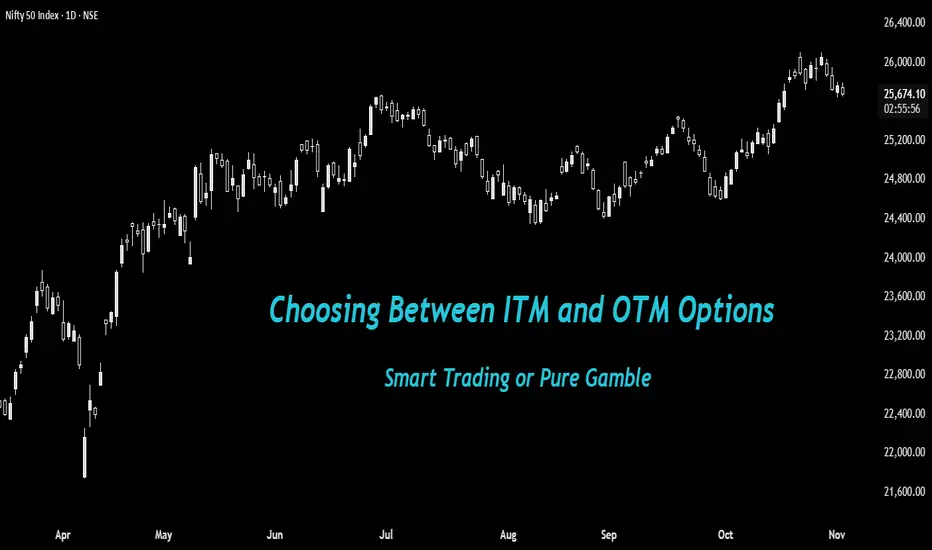
According to a SEBI report, trading activity in equity derivatives (especially index options) has exploded in recent years. The average daily premium has been growing at an astonishing 72% CAGR over the last six years. Despite this surge, SEBI’s data also reveals a harsh reality- nearly 91% of retail traders ended up losing money in FY25.
With options becoming every trader’s favorite playground, a basic understanding how they truly work (particularly the popular Out-of-the-Money (OTM) options) has never been much needed than present times.
What are OTM and ITM Options?
In-the-Money (ITM) options and Out-of-the-Money (OTM) options describe how the option’s strike price relates to the current market price of the underlying asset.
➡ITM
ITM Options already have intrinsic value.
These options move almost in line with the underlying and are costlier because they have real value even if expired immediately.
➡OTM
OTM Options have no intrinsic value, only time value.
They are cheaper but riskier, as they expire worthless unless the market moves strongly in their favor before expiry.
✅ Advantages of ITM Options over OTM Options (Weekly Expiry)
➡Higher Probability of Profit
ITM options have intrinsic value from the start, so even minor favorable price movements can keep them profitable until expiry. In contrast, OTM options must travel a significant distance just to break even.
➡Lower Time Decay Risk
Because much of an ITM option’s price is intrinsic value, it doesn’t melt as quickly due to theta. OTM options, being pure time value, lose value sharply as expiry nears- especially in the last two days.
➡More Stable Pricing
ITM premiums don’t fluctuate wildly with small market changes or volatility swings, making them more predictable and easier to manage intraday.
➡Better Delta Exposure
ITM options have high delta (0.6–0.9), meaning they move almost in sync with the underlying. This gives the trader cleaner directional exposure without paying the full cost of the underlying.
➡Suitable for Professional Risk Management
ITM options are often used by institutional and professional traders for hedging or directional exposure, since they behave more linearly and carry less “decay risk.”
❌ Disadvantages of ITM Options over OTM Options (Weekly Expiry)
➡High Capital Requirement
ITM options are expensive because they include intrinsic value. This limits position size, especially for retail traders with smaller accounts.
➡Lower Percentage Return
Even though profits are steadier, the percentage return on investment is smaller compared to cheap OTM options that can multiply several times in value during strong moves.
➡Reduced Leverage
The high premium reduces the leverage advantage that options provide. OTM options offer greater leverage for a given amount of capital.
➡Limited Benefit from Volatility Spikes
ITM options are less responsive to changes in implied volatility, so traders don’t gain much even if volatility surges before expiry.
➡Less Attractive for Event-Based Speculation
During events like RBI policy or earnings releases, traders prefer cheap OTM options to play for explosive moves. ITM options are costlier and therefore less appealing for such high-risk bets.
➡Potential Liquidity Drop in Deep ITMs
Deep ITM options can sometimes be illiquid, leading to wide bid–ask spreads and slippage during exit.
Therefore, weekly options are a double-edged sword. ITMs reward patience and discipline, OTMs reward timing and aggression. A good trader knows that it’s not about choosing sides but about using each wisely in the right market condition.
What is your favorite day trading instrument?
Do you think Index Futures are better than Index Options?
Comment your views.
With options becoming every trader’s favorite playground, a basic understanding how they truly work (particularly the popular Out-of-the-Money (OTM) options) has never been much needed than present times.
What are OTM and ITM Options?
In-the-Money (ITM) options and Out-of-the-Money (OTM) options describe how the option’s strike price relates to the current market price of the underlying asset.
➡ITM
ITM Options already have intrinsic value.
A Call option is ITM when the market price is above its strike price.
A Put option is ITM when the market price is below its strike price.
These options move almost in line with the underlying and are costlier because they have real value even if expired immediately.
➡OTM
OTM Options have no intrinsic value, only time value.
A Call option is OTM when the market price is below its strike price.
A Put option is OTM when the market price is above its strike price.
They are cheaper but riskier, as they expire worthless unless the market moves strongly in their favor before expiry.
✅ Advantages of ITM Options over OTM Options (Weekly Expiry)
➡Higher Probability of Profit
ITM options have intrinsic value from the start, so even minor favorable price movements can keep them profitable until expiry. In contrast, OTM options must travel a significant distance just to break even.
➡Lower Time Decay Risk
Because much of an ITM option’s price is intrinsic value, it doesn’t melt as quickly due to theta. OTM options, being pure time value, lose value sharply as expiry nears- especially in the last two days.
➡More Stable Pricing
ITM premiums don’t fluctuate wildly with small market changes or volatility swings, making them more predictable and easier to manage intraday.
➡Better Delta Exposure
ITM options have high delta (0.6–0.9), meaning they move almost in sync with the underlying. This gives the trader cleaner directional exposure without paying the full cost of the underlying.
➡Suitable for Professional Risk Management
ITM options are often used by institutional and professional traders for hedging or directional exposure, since they behave more linearly and carry less “decay risk.”
❌ Disadvantages of ITM Options over OTM Options (Weekly Expiry)
➡High Capital Requirement
ITM options are expensive because they include intrinsic value. This limits position size, especially for retail traders with smaller accounts.
➡Lower Percentage Return
Even though profits are steadier, the percentage return on investment is smaller compared to cheap OTM options that can multiply several times in value during strong moves.
➡Reduced Leverage
The high premium reduces the leverage advantage that options provide. OTM options offer greater leverage for a given amount of capital.
➡Limited Benefit from Volatility Spikes
ITM options are less responsive to changes in implied volatility, so traders don’t gain much even if volatility surges before expiry.
➡Less Attractive for Event-Based Speculation
During events like RBI policy or earnings releases, traders prefer cheap OTM options to play for explosive moves. ITM options are costlier and therefore less appealing for such high-risk bets.
➡Potential Liquidity Drop in Deep ITMs
Deep ITM options can sometimes be illiquid, leading to wide bid–ask spreads and slippage during exit.
Therefore, weekly options are a double-edged sword. ITMs reward patience and discipline, OTMs reward timing and aggression. A good trader knows that it’s not about choosing sides but about using each wisely in the right market condition.
What is your favorite day trading instrument?
Do you think Index Futures are better than Index Options?
Comment your views.

JJ Singh
Trader/Investor
Moderator, TradingView
🚀Join t.me/jjsingh_2020 ,
A Free Education channel
🚀Tweet at twitter.com/JaySingh_2020
Trader/Investor
Moderator, TradingView
🚀Join t.me/jjsingh_2020 ,
A Free Education channel
🚀Tweet at twitter.com/JaySingh_2020
منشورات ذات صلة
إخلاء المسؤولية
لا يُقصد بالمعلومات والمنشورات أن تكون، أو تشكل، أي نصيحة مالية أو استثمارية أو تجارية أو أنواع أخرى من النصائح أو التوصيات المقدمة أو المعتمدة من TradingView. اقرأ المزيد في شروط الاستخدام.
JJ Singh
Trader/Investor
Moderator, TradingView
🚀Join t.me/jjsingh_2020 ,
A Free Education channel
🚀Tweet at twitter.com/JaySingh_2020
Trader/Investor
Moderator, TradingView
🚀Join t.me/jjsingh_2020 ,
A Free Education channel
🚀Tweet at twitter.com/JaySingh_2020
منشورات ذات صلة
إخلاء المسؤولية
لا يُقصد بالمعلومات والمنشورات أن تكون، أو تشكل، أي نصيحة مالية أو استثمارية أو تجارية أو أنواع أخرى من النصائح أو التوصيات المقدمة أو المعتمدة من TradingView. اقرأ المزيد في شروط الاستخدام.