
More exclusive indicators from SurjeetKakkar
Subscribe to Demand Supply Ultimate Suite for $27.00/month to get exclusive indicators by this author. You pay right on TradingView and can use them on your charts straight away.
Explore Demand Supply Ultimate SuiteFEAR OF LOSING MONEY – THE EMOTION THAT CAN RUIN YOUR TRADING DECISIONS!
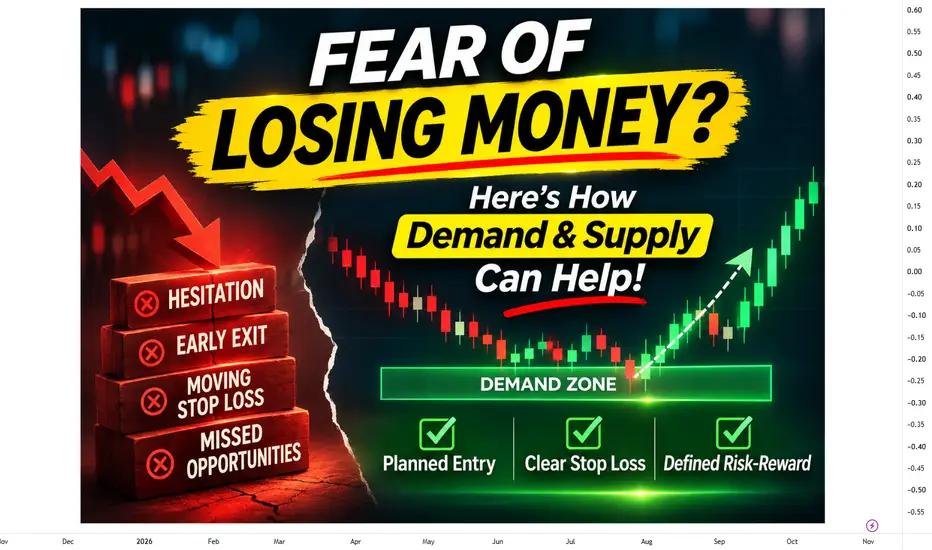
Have you ever identified a perfect trading setup, but hesitated to enter because you were afraid of losing money?
Or entered a trade, watched it move slightly against you, and exited immediately just to avoid a potential loss?
You're not alone.
Fear of losing money is one of the biggest psychological challenges traders face. And ironically, the more you try to avoid losses, the more likely you are to make decisions that hurt your trading performance.
Let's understand why this happens and how a structured Demand & Supply approach can help.
1. WHY ARE TRADERS AFRAID OF LOSING MONEY?
Fear often comes from three things:
As a result, traders often:
The real problem isn't the possibility of losing. It's not knowing how to deal with a loss before entering the trade.
2. HOW DEMAND & SUPPLY TRADING CAN HELP
Demand & Supply trading provides a structured framework to make decisions before entering a trade.
Instead of reacting to every price movement, you identify important price zones where buying or selling pressure previously created a significant imbalance.
Here's how this helps:
A. PREDEFINED ENTRY AREAS
Rather than chasing price or entering randomly, identify potential Demand and Supply Zones in advance.
This helps you avoid impulsive entries driven by market movements.
B. CLEAR INVALIDATION LEVELS
Before entering a trade, determine the price level at which your trading idea becomes invalid.
For example:
Your stop-loss should be planned around this invalidation, with appropriate allowance for volatility and execution.
You now know where your trade idea is wrong before putting your money at risk.
C. PREDEFINED RISK-REWARD
Before entering, calculate:
If the trade doesn't offer an acceptable risk-reward opportunity, simply skip it.
You don't need to take every trade.
D. FOCUS ON THE PROCESS, NOT THE OUTCOME
A good trade can result in a loss. A poorly executed trade can sometimes generate a profit.
Your job is not to make every trade profitable.
Your job is to consistently execute a well-defined trading process.
3. CHANGE THE WAY YOU THINK ABOUT LOSSES
Here's an important mindset shift:
If you identified a valid zone, waited for your setup, followed your entry rules, and respected your stop loss, you executed your plan correctly.
The market simply didn't move in your expected direction.
Don't judge your trading ability based on the outcome of one trade.
Evaluate yourself based on the quality and consistency of your decisions over a meaningful sample of trades.
4. THE BOTTOM LINE
You cannot eliminate the risk of losing money from trading.
You cannot control what the market does next.
But you can control:
Demand & Supply trading doesn't eliminate fear or guarantee profitable trades. But a structured approach can reduce uncertainty and help you make more objective trading decisions.
What about you?
What's your biggest challenge when it comes to fear of losing money?
Share your experience in the comments. Let's learn from each other!
If you found this post useful, FOLLOW and BOOST to help more traders understand the psychological side of trading.
DISCLAIMER: This post is for educational purposes only and should not be considered financial or investment advice. Demand and Supply Zones indicate areas of previous price imbalance and do not guarantee future price movements.
Have you ever identified a perfect trading setup, but hesitated to enter because you were afraid of losing money?
Or entered a trade, watched it move slightly against you, and exited immediately just to avoid a potential loss?
You're not alone.
Fear of losing money is one of the biggest psychological challenges traders face. And ironically, the more you try to avoid losses, the more likely you are to make decisions that hurt your trading performance.
Let's understand why this happens and how a structured Demand & Supply approach can help.
1. WHY ARE TRADERS AFRAID OF LOSING MONEY?
Fear often comes from three things:
- Uncertainty: You don't know what price will do next.
- Lack of confidence: You aren't completely sure about your entry or exit.
- Emotional attachment: You start treating every trade as a test of your trading ability.
As a result, traders often:
- Skip valid trading opportunities.
- Exit winning trades too early.
- Move stop losses to avoid getting stopped out.
- Hesitate even when their trading setup meets all their criteria.
The real problem isn't the possibility of losing. It's not knowing how to deal with a loss before entering the trade.
2. HOW DEMAND & SUPPLY TRADING CAN HELP
Demand & Supply trading provides a structured framework to make decisions before entering a trade.
Instead of reacting to every price movement, you identify important price zones where buying or selling pressure previously created a significant imbalance.
Here's how this helps:
A. PREDEFINED ENTRY AREAS
Rather than chasing price or entering randomly, identify potential Demand and Supply Zones in advance.
- Look for buying opportunities near relevant Demand Zones.
- Look for selling opportunities near relevant Supply Zones.
This helps you avoid impulsive entries driven by market movements.
B. CLEAR INVALIDATION LEVELS
Before entering a trade, determine the price level at which your trading idea becomes invalid.
For example:
- A Demand Zone becomes invalid when price breaks through its distal boundary, according to your predefined zone rules.
- A Supply Zone becomes invalid when price breaks through its distal boundary.
Your stop-loss should be planned around this invalidation, with appropriate allowance for volatility and execution.
You now know where your trade idea is wrong before putting your money at risk.
C. PREDEFINED RISK-REWARD
Before entering, calculate:
- Your potential loss.
- Your potential profit.
- Your risk-reward ratio.
If the trade doesn't offer an acceptable risk-reward opportunity, simply skip it.
You don't need to take every trade.
D. FOCUS ON THE PROCESS, NOT THE OUTCOME
A good trade can result in a loss. A poorly executed trade can sometimes generate a profit.
Your job is not to make every trade profitable.
Your job is to consistently execute a well-defined trading process.
3. CHANGE THE WAY YOU THINK ABOUT LOSSES
Here's an important mindset shift:
A LOSS IS NOT NECESSARILY A BAD TRADE.
If you identified a valid zone, waited for your setup, followed your entry rules, and respected your stop loss, you executed your plan correctly.
The market simply didn't move in your expected direction.
Don't judge your trading ability based on the outcome of one trade.
Evaluate yourself based on the quality and consistency of your decisions over a meaningful sample of trades.
4. THE BOTTOM LINE
You cannot eliminate the risk of losing money from trading.
You cannot control what the market does next.
But you can control:
- Where you enter.
- How much you risk.
- Where your trade idea becomes invalid.
- Whether you follow your trading plan.
Demand & Supply trading doesn't eliminate fear or guarantee profitable trades. But a structured approach can reduce uncertainty and help you make more objective trading decisions.
The goal isn't to become a trader who never loses. It's to become a trader who knows exactly what to do when a trade doesn't work.
What about you?
What's your biggest challenge when it comes to fear of losing money?
- Hesitating to enter a valid setup.
- Exiting winning trades too early.
- Moving stop losses to avoid a loss.
- Taking revenge trades after a losing trade.
Share your experience in the comments. Let's learn from each other!
If you found this post useful, FOLLOW and BOOST to help more traders understand the psychological side of trading.
DISCLAIMER: This post is for educational purposes only and should not be considered financial or investment advice. Demand and Supply Zones indicate areas of previous price imbalance and do not guarantee future price movements.

📚 Learn Demand & Supply Trading — 100% Free
🌐 surjeetkakkar.com
🎁 Demand & Supply Zone Indicator — Free Trial
surjeetkakkar.com/demand-supply-zone-indicator-trial/?tv
Educational content only. Not investment advice.
🌐 surjeetkakkar.com
🎁 Demand & Supply Zone Indicator — Free Trial
surjeetkakkar.com/demand-supply-zone-indicator-trial/?tv
Educational content only. Not investment advice.
إخلاء المسؤولية
لا يُقصد بالمعلومات والمنشورات أن تكون، أو تشكل، أي نصيحة مالية أو استثمارية أو تجارية أو أنواع أخرى من النصائح أو التوصيات المقدمة أو المعتمدة من TradingView. اقرأ المزيد في شروط الاستخدام.