
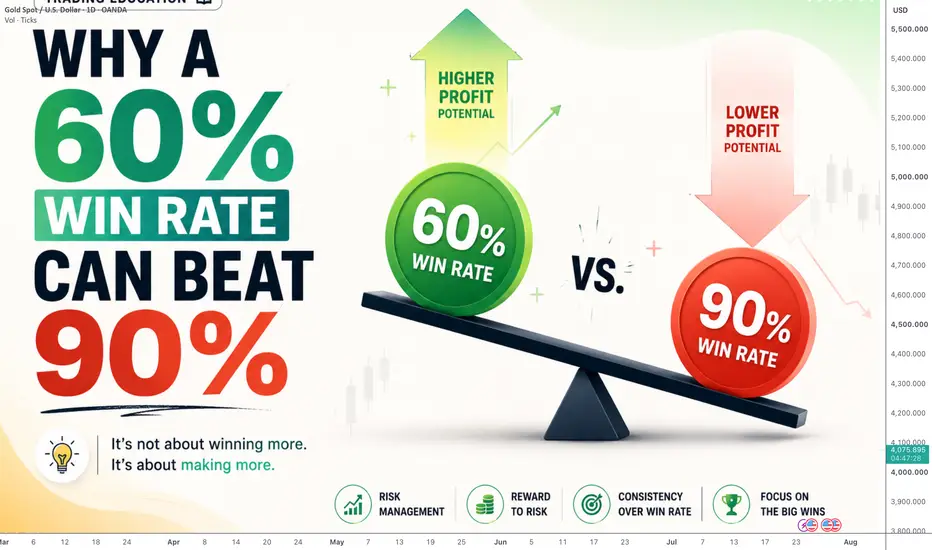
When I first started trading, I was obsessed with one number: "win rate".
Like many beginners, I believed that the trader with the highest percentage of winning trades had the best strategy. It sounded logical—90% must be better than 60%, right?
Years later, after reviewing thousands of trades, I realized that this belief is one of the biggest misconceptions in trading.
A high win rate looks impressive, but it tells only a small part of the story. What truly determines long-term success isn't "how often you win"—it's "how much you make when you're right and how little you lose when you're wrong".
I've seen traders with a 90% win rate lose months of profits in a single bad trade because they refused to accept a small loss. On the other hand, I've watched traders with a 55–60% win rate steadily grow their accounts by letting winners run, cutting losses quickly, and respecting their risk management. Their edge wasn't accuracy—it was consistency.
The market doesn't reward perfection. It rewards positive expectancy.
Every trade is simply one outcome in a long series of probabilities. Some of the best traders in the world accept that losses are part of the business. They don't chase a perfect win rate—they focus on executing their plan with discipline and allowing the mathematics of their strategy to work over hundreds of trades.
A strategy that wins 60% of the time while earning "twice as much on winning trades as it risks on losing trades" can outperform a strategy with a 90% win rate but poor risk management. That's why professional traders pay far more attention to "risk-to-reward ratio, expectancy, and consistency" than they do to win percentage alone.
In this article, we'll break down why win rate can be misleading, explore the relationship between probability and profitability, and discover why chasing a higher win rate often leads traders away from what actually matters.
Because in trading, "it's not the number of winning trades that builds wealth—it's the quality of your decisions and the consistency of your execution."
Like many beginners, I believed that the trader with the highest percentage of winning trades had the best strategy. It sounded logical—90% must be better than 60%, right?
Years later, after reviewing thousands of trades, I realized that this belief is one of the biggest misconceptions in trading.
A high win rate looks impressive, but it tells only a small part of the story. What truly determines long-term success isn't "how often you win"—it's "how much you make when you're right and how little you lose when you're wrong".
I've seen traders with a 90% win rate lose months of profits in a single bad trade because they refused to accept a small loss. On the other hand, I've watched traders with a 55–60% win rate steadily grow their accounts by letting winners run, cutting losses quickly, and respecting their risk management. Their edge wasn't accuracy—it was consistency.
The market doesn't reward perfection. It rewards positive expectancy.
Every trade is simply one outcome in a long series of probabilities. Some of the best traders in the world accept that losses are part of the business. They don't chase a perfect win rate—they focus on executing their plan with discipline and allowing the mathematics of their strategy to work over hundreds of trades.
A strategy that wins 60% of the time while earning "twice as much on winning trades as it risks on losing trades" can outperform a strategy with a 90% win rate but poor risk management. That's why professional traders pay far more attention to "risk-to-reward ratio, expectancy, and consistency" than they do to win percentage alone.
In this article, we'll break down why win rate can be misleading, explore the relationship between probability and profitability, and discover why chasing a higher win rate often leads traders away from what actually matters.
Because in trading, "it's not the number of winning trades that builds wealth—it's the quality of your decisions and the consistency of your execution."

منشورات ذات صلة
إخلاء المسؤولية
لا يُقصد بالمعلومات والمنشورات أن تكون، أو تشكل، أي نصيحة مالية أو استثمارية أو تجارية أو أنواع أخرى من النصائح أو التوصيات المقدمة أو المعتمدة من TradingView. اقرأ المزيد في شروط الاستخدام.
منشورات ذات صلة
إخلاء المسؤولية
لا يُقصد بالمعلومات والمنشورات أن تكون، أو تشكل، أي نصيحة مالية أو استثمارية أو تجارية أو أنواع أخرى من النصائح أو التوصيات المقدمة أو المعتمدة من TradingView. اقرأ المزيد في شروط الاستخدام.