
Ask a group of traders what separates successful traders from unsuccessful ones, and many will mention strategy.
Some believe the answer is finding the perfect indicator.
Others search endlessly for the best chart pattern or the highest win-rate trading system.
While these things have value, they are not what determines long-term success.
The truth is much simpler.
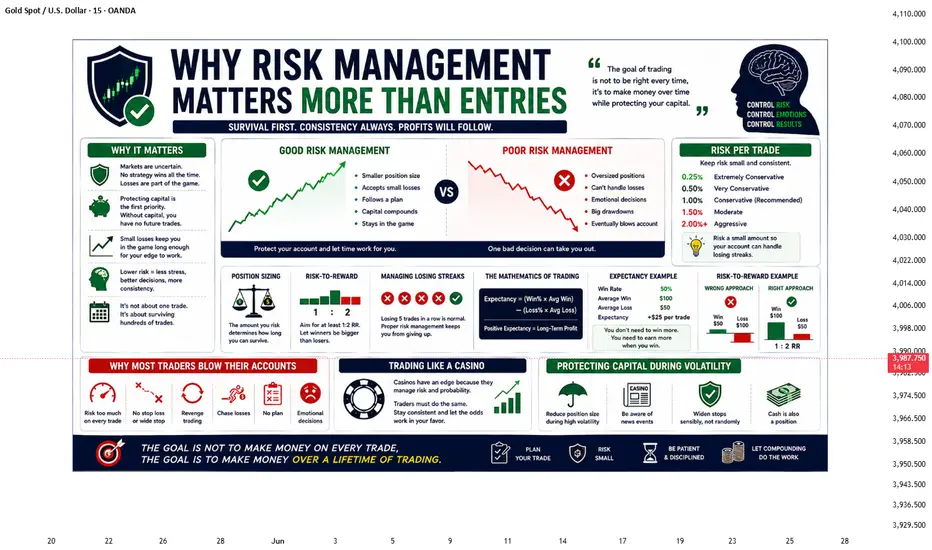
A great entry cannot save poor risk management, but good risk management can survive imperfect entries.
This is one of the most important lessons every trader eventually learns.
Trading Is a Probability Game
No trader wins every trade.
Even the world's most experienced professionals experience losses.
Financial markets are uncertain by nature, which means every trade is simply a probability—not a guarantee.
The goal is not to avoid losing trades.
The goal is to ensure that no single trade has the power to seriously damage your account.
Professional traders understand this.
Instead of trying to predict every move correctly, they focus on managing uncertainty.
Why Great Entries Still Fail
Imagine identifying what appears to be the perfect setup.
The trend is strong.
Support is holding.
The candlestick confirmation looks ideal.
Everything points toward a winning trade.
Then, unexpected news is released.
The market reverses sharply.
Your analysis wasn't necessarily wrong.
The market simply changed.
This is why successful traders never assume that any setup is certain.
Every trade must include a plan for what happens if the market proves them wrong.
Protecting Capital Comes First
Your trading account is your most valuable asset.
Without capital, you cannot participate in future opportunities.
Many beginners become obsessed with making money quickly.
Professional traders think differently.
Their first priority is protecting what they already have.
Because opportunities appear every day.
Capital lost through poor risk management can take months—or even years—to recover.
Small Losses Are Part of the Business
Many new traders view losses as failure.
Experienced traders view them as business expenses.
Every profession has costs.
A restaurant pays rent.
A manufacturer buys raw materials.
A trader accepts occasional losses.
The difference is that professional traders keep those losses small.
A controlled loss is simply the cost of staying in the game.
The Power of Position Sizing
Risk management is not only about placing stop losses.
It also involves deciding how much capital to risk on each trade.
A trader risking 1% of their account on a losing trade remains financially and emotionally stable.
A trader risking 20% may struggle to recover after only a few losses.
Position sizing ensures that one mistake never becomes a disaster.
Consistency matters far more than aggression.
Risk-to-Reward Is More Important Than Win Rate
Many traders chase strategies with the highest possible win rate.
But a high win rate does not always produce consistent profits.
Imagine two traders.
The first wins 80% of the time but loses far more on losing trades than they gain on winners.
The second wins only 45% of the time but allows winning trades to be much larger than losing ones.
Over time, the second trader may outperform the first.
This is why professional traders pay close attention to risk-to-reward ratios instead of focusing only on how often they win.
Emotional Control Begins With Risk
Many trading mistakes begin before the trade even starts.
When too much money is at risk, emotions become stronger.
Fear causes traders to exit too early.
Greed encourages them to hold too long.
Hope prevents them from accepting small losses.
Proper risk management reduces emotional pressure.
When each trade risks only a small portion of your account, it becomes much easier to follow your trading plan objectively.
Long-Term Thinking Wins
Successful trading is not about one trade.
It is not about one week.
It is not even about one month.
It is about surviving long enough for your edge to play out over hundreds of trades.
The traders who stay in the market for years are rarely the ones taking the biggest risks.
They are the ones managing risk with discipline and consistency.
Final words:
Every trader wants better entries.
But better entries alone are never enough.
Markets are unpredictable, and losses are unavoidable.
Risk management is what allows traders to survive those losses and continue growing over time.
The most successful traders are not those who predict the market perfectly.
They are the ones who protect their capital, control their emotions, and remain consistent through both winning and losing periods.
Because in trading, survival comes first.
Profit is simply the reward for surviving long enough.
Some believe the answer is finding the perfect indicator.
Others search endlessly for the best chart pattern or the highest win-rate trading system.
While these things have value, they are not what determines long-term success.
The truth is much simpler.
A great entry cannot save poor risk management, but good risk management can survive imperfect entries.
This is one of the most important lessons every trader eventually learns.
Trading Is a Probability Game
No trader wins every trade.
Even the world's most experienced professionals experience losses.
Financial markets are uncertain by nature, which means every trade is simply a probability—not a guarantee.
The goal is not to avoid losing trades.
The goal is to ensure that no single trade has the power to seriously damage your account.
Professional traders understand this.
Instead of trying to predict every move correctly, they focus on managing uncertainty.
Why Great Entries Still Fail
Imagine identifying what appears to be the perfect setup.
The trend is strong.
Support is holding.
The candlestick confirmation looks ideal.
Everything points toward a winning trade.
Then, unexpected news is released.
The market reverses sharply.
Your analysis wasn't necessarily wrong.
The market simply changed.
This is why successful traders never assume that any setup is certain.
Every trade must include a plan for what happens if the market proves them wrong.
Protecting Capital Comes First
Your trading account is your most valuable asset.
Without capital, you cannot participate in future opportunities.
Many beginners become obsessed with making money quickly.
Professional traders think differently.
Their first priority is protecting what they already have.
Because opportunities appear every day.
Capital lost through poor risk management can take months—or even years—to recover.
Small Losses Are Part of the Business
Many new traders view losses as failure.
Experienced traders view them as business expenses.
Every profession has costs.
A restaurant pays rent.
A manufacturer buys raw materials.
A trader accepts occasional losses.
The difference is that professional traders keep those losses small.
A controlled loss is simply the cost of staying in the game.
The Power of Position Sizing
Risk management is not only about placing stop losses.
It also involves deciding how much capital to risk on each trade.
A trader risking 1% of their account on a losing trade remains financially and emotionally stable.
A trader risking 20% may struggle to recover after only a few losses.
Position sizing ensures that one mistake never becomes a disaster.
Consistency matters far more than aggression.
Risk-to-Reward Is More Important Than Win Rate
Many traders chase strategies with the highest possible win rate.
But a high win rate does not always produce consistent profits.
Imagine two traders.
The first wins 80% of the time but loses far more on losing trades than they gain on winners.
The second wins only 45% of the time but allows winning trades to be much larger than losing ones.
Over time, the second trader may outperform the first.
This is why professional traders pay close attention to risk-to-reward ratios instead of focusing only on how often they win.
Emotional Control Begins With Risk
Many trading mistakes begin before the trade even starts.
When too much money is at risk, emotions become stronger.
Fear causes traders to exit too early.
Greed encourages them to hold too long.
Hope prevents them from accepting small losses.
Proper risk management reduces emotional pressure.
When each trade risks only a small portion of your account, it becomes much easier to follow your trading plan objectively.
Long-Term Thinking Wins
Successful trading is not about one trade.
It is not about one week.
It is not even about one month.
It is about surviving long enough for your edge to play out over hundreds of trades.
The traders who stay in the market for years are rarely the ones taking the biggest risks.
They are the ones managing risk with discipline and consistency.
Final words:
Every trader wants better entries.
But better entries alone are never enough.
Markets are unpredictable, and losses are unavoidable.
Risk management is what allows traders to survive those losses and continue growing over time.
The most successful traders are not those who predict the market perfectly.
They are the ones who protect their capital, control their emotions, and remain consistent through both winning and losing periods.
Because in trading, survival comes first.
Profit is simply the reward for surviving long enough.

إخلاء المسؤولية
لا يُقصد بالمعلومات والمنشورات أن تكون، أو تشكل، أي نصيحة مالية أو استثمارية أو تجارية أو أنواع أخرى من النصائح أو التوصيات المقدمة أو المعتمدة من TradingView. اقرأ المزيد في شروط الاستخدام.
إخلاء المسؤولية
لا يُقصد بالمعلومات والمنشورات أن تكون، أو تشكل، أي نصيحة مالية أو استثمارية أو تجارية أو أنواع أخرى من النصائح أو التوصيات المقدمة أو المعتمدة من TradingView. اقرأ المزيد في شروط الاستخدام.