
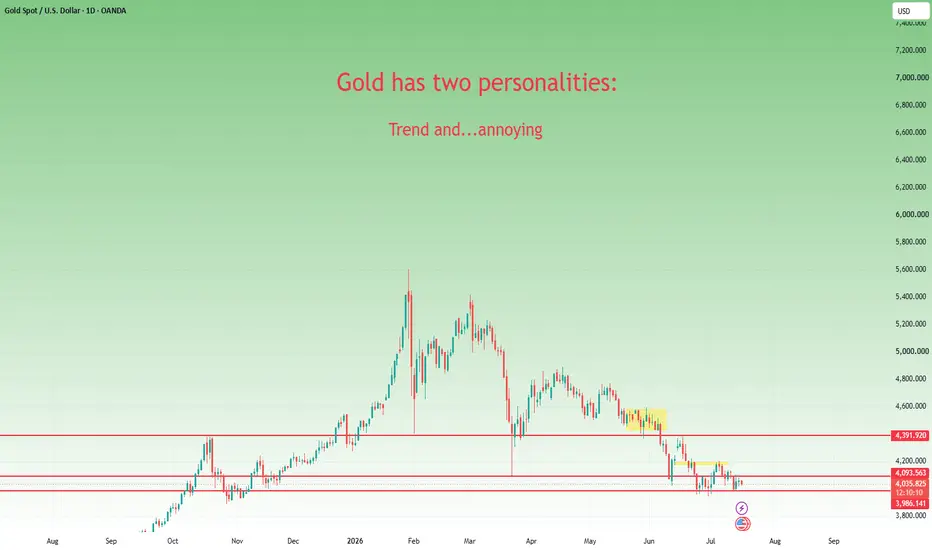
Trend... and Annoying.
One of the very first things every trader learns is that markets operate in two different environments: trends and ranges.
The theory is simple enough. During a trend, you trade in the direction of momentum. During a range, you buy support, sell resistance, and avoid chasing breakouts. Most trading books stop there, and for many markets, that framework works reasonably well.
Then you start trading Gold.
After more than two decades in the markets and well over a decade focused primarily on XAUUSD, I've come to the conclusion that Gold follows the same rules only on paper. In reality, it feels like an entirely different animal.
Gold doesn't have two market conditions.
It has two personalities.
Trending.
And... annoying.
It may sound like an oversimplification, but I genuinely believe it describes the market better than the traditional "trend versus range" definition.
The Market Isn't Always Offering Opportunities
Everybody loves Gold when it trends.
It breaks important levels, respects pullbacks, and can travel two or three thousand pips in a surprisingly short period of time. During those phases, trading almost feels easy. Momentum follows through, technical analysis appears flawless, and holding a position suddenly becomes much easier than finding one.
The problem is that these periods represent only a small portion of Gold's life.
The majority of the time, Gold is not trending. More importantly, it isn't even ranging in the clean textbook sense.
Instead, it becomes frustrating.
It produces aggressive spikes that immediately reverse. It breaks support only to recover an hour later. It trades above resistance just long enough to convince breakout traders before collapsing back into the previous range. It can spend an entire week moving hundreds of pips while making virtually no progress.
From a distance, it looks active.
In reality, it is going nowhere.
This is where many traders make a fundamental mistake. They assume that because price is moving, opportunities must exist.
But movement and opportunity are two completely different things.
Gold Is Testing You More Than Your Strategy
When traders go through these frustrating periods, they usually start questioning everything.
- Maybe support and resistance no longer work.
- Maybe price action has stopped working.
- Maybe the market is manipulated.
- Maybe their strategy has suddenly lost its edge.
- Most of the time, none of those conclusions are true.
The market environment simply changed.
Gold isn't asking you to become a better analyst.
It is asking you to become more patient.
The difficult part is that patience rarely feels productive. Sitting on your hands while the market moves 300 or 400 pips in both directions creates the uncomfortable feeling that you're constantly missing opportunities. That emotional pressure slowly pushes traders into lower-quality trades, forcing entries where no real edge exists.
Ironically, many of those trades end exactly the same way—with another small stop loss.
Not because the strategy was wrong, but because the timing was.
That is why one of the biggest improvements I made over the years came from changing a single question.
Instead of asking, "Where is Gold going next?"
I started asking, "Is Gold even worth trading right now?"
Those are two completely different questions.
The first assumes there must be an opportunity.
The second accepts that sometimes there simply isn't.
When Gold Finally Moves, Stay With It
There is another lesson that took me years to fully appreciate.
When Gold finally stops being annoying and starts trending, that is not the moment to become impatient.
It is the moment to stay.
One of the biggest mistakes traders make is surviving weeks of choppy price action, several small stop losses, endless fake breakouts, and emotional frustration, only to close the winning trade after three or four hundred pips because they are afraid the market will reverse once again.
The irony is almost painful.
They absorbed all the emotional damage created by Gold's frustrating personality, but they never allow themselves to be rewarded when that personality finally changes.
Over time, I realized that a strong Gold trend should never be treated as just another trade.
It is the market paying you back for everything you endured during the previous days.
If Gold finally commits to a direction, I want to stay with that move for 2,000 or even 3,000 pips whenever market structure allows it. Not because I know exactly where the trend will end, but because I understand that this is the way it's moving.
Those trends are the ones that compensate for the small stop losses, the false breakouts, the frustrating sessions, and the emotional energy spent waiting for conditions to improve.
In many ways, they also compensate for something we rarely talk about.
Emotional capital.
Every unnecessary trade, every fake breakout, and every stop loss slowly drains confidence, even when your risk management is flawless. A genuine trend is your opportunity not only to recover financially, but also to recover psychologically.
That is why treating every trade the same on Gold makes very little sense.
Some trades exist simply to tell you that the market is still undecided.
Others carry your entire month's performance.
Knowing the difference is one of the most valuable skills a Gold trader can develop.
The Real Edge Is Knowing When to Do Nothing
Professional traders are often described as people with exceptional discipline.
I think the description is incomplete.
Professional traders are simply better at recognizing when their edge is absent.
During a trending market, the objective is obvious: maximize profits and avoid exiting too early.
During Gold's annoying personality, the objective changes completely.
It is no longer about making money.
It is about protecting both your capital and your confidence until conditions improve.
Those are two entirely different jobs, yet many traders approach them exactly the same way.
The market doesn't reward activity.
It rewards timing.
Sometimes the highest-quality trade is not the long setup or the short setup.
Sometimes it is having the confidence to close the platform and wait.
Final Thoughts
Perhaps markets really do alternate between trends and ranges.
But if you have traded Gold long enough, you know the experience feels very different.
It alternates between periods where everything seems to work and periods where almost nothing does.
The mistake is believing that both deserve the same level of participation.
They don't.
Gold has a unique way of exhausting traders before revealing its real intention. It forces impatience, creates doubt, and makes perfectly capable traders abandon good strategies simply because they expect every week to produce meaningful opportunities.
The traders who survive are rarely the ones who predict every move.
They are the ones who recognize when Gold has entered its "annoying" personality, patiently wait for it to become itself again, and when it finally does...
they don't settle for 300 pips.
They stay with the trend long enough to let the market repay every stop loss, every frustrating day, and every ounce of patience it demanded along the way.
One of the very first things every trader learns is that markets operate in two different environments: trends and ranges.
The theory is simple enough. During a trend, you trade in the direction of momentum. During a range, you buy support, sell resistance, and avoid chasing breakouts. Most trading books stop there, and for many markets, that framework works reasonably well.
Then you start trading Gold.
After more than two decades in the markets and well over a decade focused primarily on XAUUSD, I've come to the conclusion that Gold follows the same rules only on paper. In reality, it feels like an entirely different animal.
Gold doesn't have two market conditions.
It has two personalities.
Trending.
And... annoying.
It may sound like an oversimplification, but I genuinely believe it describes the market better than the traditional "trend versus range" definition.
The Market Isn't Always Offering Opportunities
Everybody loves Gold when it trends.
It breaks important levels, respects pullbacks, and can travel two or three thousand pips in a surprisingly short period of time. During those phases, trading almost feels easy. Momentum follows through, technical analysis appears flawless, and holding a position suddenly becomes much easier than finding one.
The problem is that these periods represent only a small portion of Gold's life.
The majority of the time, Gold is not trending. More importantly, it isn't even ranging in the clean textbook sense.
Instead, it becomes frustrating.
It produces aggressive spikes that immediately reverse. It breaks support only to recover an hour later. It trades above resistance just long enough to convince breakout traders before collapsing back into the previous range. It can spend an entire week moving hundreds of pips while making virtually no progress.
From a distance, it looks active.
In reality, it is going nowhere.
This is where many traders make a fundamental mistake. They assume that because price is moving, opportunities must exist.
But movement and opportunity are two completely different things.
Gold Is Testing You More Than Your Strategy
When traders go through these frustrating periods, they usually start questioning everything.
- Maybe support and resistance no longer work.
- Maybe price action has stopped working.
- Maybe the market is manipulated.
- Maybe their strategy has suddenly lost its edge.
- Most of the time, none of those conclusions are true.
The market environment simply changed.
Gold isn't asking you to become a better analyst.
It is asking you to become more patient.
The difficult part is that patience rarely feels productive. Sitting on your hands while the market moves 300 or 400 pips in both directions creates the uncomfortable feeling that you're constantly missing opportunities. That emotional pressure slowly pushes traders into lower-quality trades, forcing entries where no real edge exists.
Ironically, many of those trades end exactly the same way—with another small stop loss.
Not because the strategy was wrong, but because the timing was.
That is why one of the biggest improvements I made over the years came from changing a single question.
Instead of asking, "Where is Gold going next?"
I started asking, "Is Gold even worth trading right now?"
Those are two completely different questions.
The first assumes there must be an opportunity.
The second accepts that sometimes there simply isn't.
When Gold Finally Moves, Stay With It
There is another lesson that took me years to fully appreciate.
When Gold finally stops being annoying and starts trending, that is not the moment to become impatient.
It is the moment to stay.
One of the biggest mistakes traders make is surviving weeks of choppy price action, several small stop losses, endless fake breakouts, and emotional frustration, only to close the winning trade after three or four hundred pips because they are afraid the market will reverse once again.
The irony is almost painful.
They absorbed all the emotional damage created by Gold's frustrating personality, but they never allow themselves to be rewarded when that personality finally changes.
Over time, I realized that a strong Gold trend should never be treated as just another trade.
It is the market paying you back for everything you endured during the previous days.
If Gold finally commits to a direction, I want to stay with that move for 2,000 or even 3,000 pips whenever market structure allows it. Not because I know exactly where the trend will end, but because I understand that this is the way it's moving.
Those trends are the ones that compensate for the small stop losses, the false breakouts, the frustrating sessions, and the emotional energy spent waiting for conditions to improve.
In many ways, they also compensate for something we rarely talk about.
Emotional capital.
Every unnecessary trade, every fake breakout, and every stop loss slowly drains confidence, even when your risk management is flawless. A genuine trend is your opportunity not only to recover financially, but also to recover psychologically.
That is why treating every trade the same on Gold makes very little sense.
Some trades exist simply to tell you that the market is still undecided.
Others carry your entire month's performance.
Knowing the difference is one of the most valuable skills a Gold trader can develop.
The Real Edge Is Knowing When to Do Nothing
Professional traders are often described as people with exceptional discipline.
I think the description is incomplete.
Professional traders are simply better at recognizing when their edge is absent.
During a trending market, the objective is obvious: maximize profits and avoid exiting too early.
During Gold's annoying personality, the objective changes completely.
It is no longer about making money.
It is about protecting both your capital and your confidence until conditions improve.
Those are two entirely different jobs, yet many traders approach them exactly the same way.
The market doesn't reward activity.
It rewards timing.
Sometimes the highest-quality trade is not the long setup or the short setup.
Sometimes it is having the confidence to close the platform and wait.
Final Thoughts
Perhaps markets really do alternate between trends and ranges.
But if you have traded Gold long enough, you know the experience feels very different.
It alternates between periods where everything seems to work and periods where almost nothing does.
The mistake is believing that both deserve the same level of participation.
They don't.
Gold has a unique way of exhausting traders before revealing its real intention. It forces impatience, creates doubt, and makes perfectly capable traders abandon good strategies simply because they expect every week to produce meaningful opportunities.
The traders who survive are rarely the ones who predict every move.
They are the ones who recognize when Gold has entered its "annoying" personality, patiently wait for it to become itself again, and when it finally does...
they don't settle for 300 pips.
They stay with the trend long enough to let the market repay every stop loss, every frustrating day, and every ounce of patience it demanded along the way.

🎯 Want More Trading Ideas?
📈 Join the FREE Forex & Gold Channel
👉 t.me/intradaytradingsignals
💎 Join the FREE Crypto Channel
👉 t.me/FanCryptocurrency
📈 Join the FREE Forex & Gold Channel
👉 t.me/intradaytradingsignals
💎 Join the FREE Crypto Channel
👉 t.me/FanCryptocurrency
منشورات ذات صلة
إخلاء المسؤولية
لا يُقصد بالمعلومات والمنشورات أن تكون، أو تشكل، أي نصيحة مالية أو استثمارية أو تجارية أو أنواع أخرى من النصائح أو التوصيات المقدمة أو المعتمدة من TradingView. اقرأ المزيد في شروط الاستخدام.
🎯 Want More Trading Ideas?
📈 Join the FREE Forex & Gold Channel
👉 t.me/intradaytradingsignals
💎 Join the FREE Crypto Channel
👉 t.me/FanCryptocurrency
📈 Join the FREE Forex & Gold Channel
👉 t.me/intradaytradingsignals
💎 Join the FREE Crypto Channel
👉 t.me/FanCryptocurrency
منشورات ذات صلة
إخلاء المسؤولية
لا يُقصد بالمعلومات والمنشورات أن تكون، أو تشكل، أي نصيحة مالية أو استثمارية أو تجارية أو أنواع أخرى من النصائح أو التوصيات المقدمة أو المعتمدة من TradingView. اقرأ المزيد في شروط الاستخدام.