[blackcat] L1 Fast Scalp Profiter
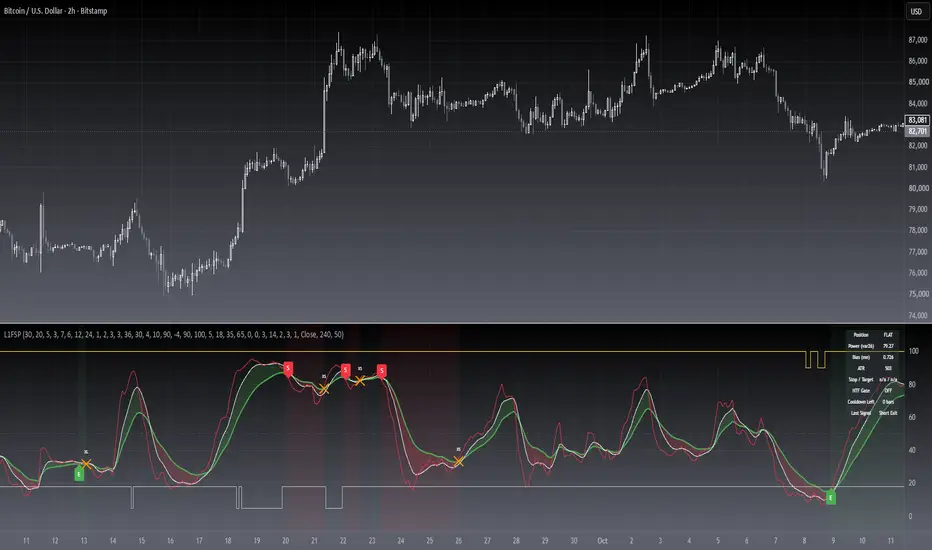
█ OVERVIEW
L1 Fast Scalp Profiter is a fast oscillator for intraday and scalp
trading: it runs a two-speed stochastic engine, a weighted price-bias
line and a power oscillator, then turns them into a two-sided signal
system with exits, cooldown, ATR stop and target levels, a dashboard and
a full alert set.
█ CONCEPTS
• Two-Speed Oscillator: a fast and a slow smoothed stochastic line run
on a 0 to 100 scale. The fill between them turns green while the fast
line leads up and red while it falls back: the core scalp trigger.
• Power Oscillator: a wider lookback version of the same idea, measured
against the lowest low and the highest high. It shows where in the
range price sits, so a cross is read in context.
• Weighted Bias: three price-bias averages combined into one line. Deep
negative readings mark the watch zone of the original script.
• Signal governance: signals are entries, not orders. One position
state (long, short, flat) arbitrates every trigger, so the pane never
shows contradictory or repeated markers.
█ SIGNALS
On the oscillator pane
• Slow Line (green, thick), Mid Line (white), Fast Line (red), with a
green or red fill between slow and mid.
• E long entry, S short entry, RL and RS re-entry, XL and XS drawn as
an orange cross, W bias watch marker.
• Yellow and white step lines mark the bottom-power and top-power
states; dotted lines mark oversold and overbought.
• The pane background tints green while the state machine is long and
red while it is short.
Entry logic
• Long: the fast line crosses above the slow line while the power
oscillator is still in the lower part of its range and the weighted
bias is negative.
• Short: the mirror image, with the power oscillator in the upper part
and a positive bias.
• Optional second path: a power recovery out of the oversold or
overbought zone in the direction of the fast line.
Exit logic
• A reverse cross appears against the open position, or
• the power oscillator falls back out of the extreme zone, or
• optionally the weighted bias crosses its zero line against it.
█ HOW TO USE
1 — Add the indicator to any liquid instrument. It opens in its own
pane; the defaults reproduce the original V1 lengths and levels.
2 — Read the dashboard: position state, power value, bias value, ATR,
stop and target, HTF gate, remaining cooldown and last signal.
3 — Tune the entry filters before the oscillator: raise the Long Entry
Power Ceiling for aggressive scalps, lower it for pullback-only
entries.
4 — Keep the governance defaults (exclusivity plus a three bar cooldown)
unless you measure raw trigger frequency.
5 — Create alerts from the seven alertcondition entries, or use the
dynamic alerts that already carry power, bias, stop and target.
█ FEATURES
• Bidirectional entries with three exit mechanisms, cooldown and
same-bar exclusivity.
• ATR based stop and target levels in the data window and the table.
• Optional re-entry after an exit and an optional higher timeframe gate.
• Seven alertcondition entries plus four close confirmed dynamic alerts.
• Every length, weight and level hard-coded in V1 is now an input; the
unused V1 branches were removed.
█ IMPLEMENTATION NOTES
Pine v6. The oscillator core keeps the original V1 maths: a stochastic
range smoothed twice, three price biases combined by weight, and a
wide-range power measure. ta.crossover and ta.crossunder drive entries
and exits, ta.atr drives the risk levels. Divisions are guarded, so a
flat range yields a neutral 50. The optional higher timeframe gate reads
closed higher timeframe bars only, so it never repaints.
█ LIMITATIONS
• Built for fast timeframes; on very quiet or gappy data the oscillator
flattens and the crosses lose meaning.
• Stop and target levels are informational: this is an indicator, not a
strategy, so no orders are placed and no backtest is produced.
• The bias watch marker is a context hint, not a trade signal.
• Filters lower frequency, they do not remove false signals; test any
setup in a demo first.
█ NOTES
• Built on the open source V1 by blackcat1402; released under the
Mozilla Public License 2.0.
═════════════════════════════════════════════════════════════════════════
For questions or feedback, use the comments section below.
Feel free to use and modify — attribution appreciated.

Don't miss out! The first and most important thing to do is to join my Discord chat now! Click here to start your adventure: discord.com/invite/ZTGpQJq My new github for more pine development soon: github.com/wxt-coder
إخلاء المسؤولية
لا يُقصد بالمعلومات والمنشورات أن تكون، أو تشكل، أي نصيحة مالية أو استثمارية أو تجارية أو أنواع أخرى من النصائح أو التوصيات المقدمة أو المعتمدة من TradingView. اقرأ المزيد في شروط الاستخدام.