Adaptive Supertrend Signals [QuantAlgo]
🟢 Overview
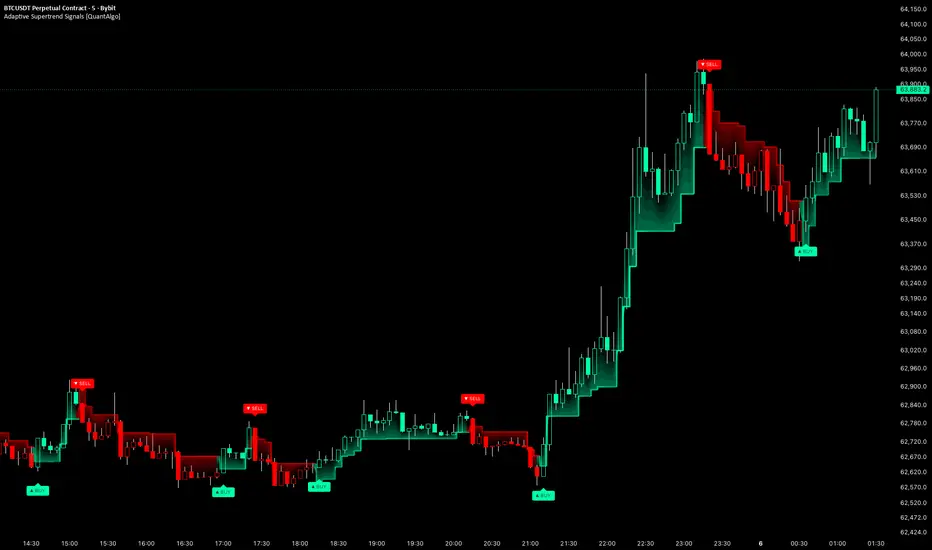
The Adaptive Supertrend Signals is an advanced trend-following tool that adjusts its own sensitivity to the market instead of applying the fixed multiplier used by a standard supertrend. On every bar, it evaluates the current behaviour of price and volume, gauges how strongly market conditions support a sustained directional move, and automatically widens or tightens its trend boundary accordingly. This allows the indicator to adapt naturally across different market environments, instruments, and timeframes without requiring manual recalibration.

🟢 How It Works
Like any supertrend, the indicator plots a single trailing line that follows price and switches sides when price crosses it. The difference lies in how far that line sits from price. Rather than holding that distance fixed, the indicator scores the strength of the current move into a unified conviction reading and uses it to size the line's offset. Strong, sustained moves draw the line closer to price so it tracks the trend more directly, while weak or indecisive conditions push it further out to reduce premature flips.
The line only advances in the direction of the active signal and does not retreat, acting as a rising support level beneath long positions and a falling resistance level above short positions. A flip is registered when price closes through the line, and the distance required to trigger that flip is scaled by the current conviction reading, so a firmer move is needed to reverse the signal when conditions are uncertain. In addition to this standard breach, a separate regime check monitors for sudden shifts in market character and can flip the signal ahead of the line when the change is pronounced enough.

🟢 How to Use It
▶ For Long entries, act on a bullish flip, marked by a green triangle (▲), which registers when price closes above the line and the move clears the adaptive threshold. Once long, the line sits beneath price as a rising support level and functions as a dynamic trailing stop: while price holds above it the bullish read stands, and a close back below it flips the signal and marks the exit.
▶ For Short entries, act on a bearish flip, marked by a red triangle (▼), which registers when price closes below the line and the move clears the adaptive threshold. Once short, the line sits above price as a falling resistance level and serves the same trailing role in reverse: while price stays below it the bearish read holds, and a close back above it flips the signal and marks the exit.

🟢 Features
▶ Built-in Alerts: Three alerts cover monitoring without constant observation. Buy Signal fires on a confirmed bullish flip, Sell Signal fires on a confirmed bearish flip, and Any Signal Change fires on either direction through a single alert.

▶ Visual Customisation: Five preset colour themes plus a fully custom pair apply across the line, gradient fill, signal labels, bar colouring, and background. The gradient fill, bar colouring, and background colouring can each be disabled or adjusted through their own transparency controls, and the signal label size is adjustable, allowing the display to be kept as prominent or as subtle as preferred.

🟢 Pro Tips for Trading and Investing
▶ Market context determines how much weight each flip deserves. As a trend-following system, the indicator performs best in trending regimes where directional moves persist and the line has room to trail a run, whereas range-bound conditions produce more frequent flips that reverse quickly, even though the adaptive width already suppresses some of them. Before acting on a signal, read the broader structure on a higher timeframe: in a confirmed uptrend, favour bullish flips as continuation entries and treat bearish flips as pullbacks or exits rather than fresh shorts, then invert that logic in a confirmed downtrend. When price is clearly ranging, flips in either direction carry less weight than they do in a trend and are better confirmed against higher-timeframe structure before entry.
▶ Layer this indicator with complementary analysis rather than treating it as a standalone decision tool. Flips backed by expanding volume point to broader participation, and those that print near major support or resistance carry more weight than flips in open space. Watch also for flips that stall immediately after triggering or cluster into repeated reversals, an early sign that no genuine trend is present and the tape is chopping. Pairing this script with momentum, volatility, or breadth indicators from the QuantAlgo toolkit can further validate directional bias before entry.
The Adaptive Supertrend Signals is an advanced trend-following tool that adjusts its own sensitivity to the market instead of applying the fixed multiplier used by a standard supertrend. On every bar, it evaluates the current behaviour of price and volume, gauges how strongly market conditions support a sustained directional move, and automatically widens or tightens its trend boundary accordingly. This allows the indicator to adapt naturally across different market environments, instruments, and timeframes without requiring manual recalibration.
🟢 How It Works
Like any supertrend, the indicator plots a single trailing line that follows price and switches sides when price crosses it. The difference lies in how far that line sits from price. Rather than holding that distance fixed, the indicator scores the strength of the current move into a unified conviction reading and uses it to size the line's offset. Strong, sustained moves draw the line closer to price so it tracks the trend more directly, while weak or indecisive conditions push it further out to reduce premature flips.
The line only advances in the direction of the active signal and does not retreat, acting as a rising support level beneath long positions and a falling resistance level above short positions. A flip is registered when price closes through the line, and the distance required to trigger that flip is scaled by the current conviction reading, so a firmer move is needed to reverse the signal when conditions are uncertain. In addition to this standard breach, a separate regime check monitors for sudden shifts in market character and can flip the signal ahead of the line when the change is pronounced enough.
🟢 How to Use It
▶ For Long entries, act on a bullish flip, marked by a green triangle (▲), which registers when price closes above the line and the move clears the adaptive threshold. Once long, the line sits beneath price as a rising support level and functions as a dynamic trailing stop: while price holds above it the bullish read stands, and a close back below it flips the signal and marks the exit.
▶ For Short entries, act on a bearish flip, marked by a red triangle (▼), which registers when price closes below the line and the move clears the adaptive threshold. Once short, the line sits above price as a falling resistance level and serves the same trailing role in reverse: while price stays below it the bearish read holds, and a close back above it flips the signal and marks the exit.
🟢 Features
▶ Built-in Alerts: Three alerts cover monitoring without constant observation. Buy Signal fires on a confirmed bullish flip, Sell Signal fires on a confirmed bearish flip, and Any Signal Change fires on either direction through a single alert.
▶ Visual Customisation: Five preset colour themes plus a fully custom pair apply across the line, gradient fill, signal labels, bar colouring, and background. The gradient fill, bar colouring, and background colouring can each be disabled or adjusted through their own transparency controls, and the signal label size is adjustable, allowing the display to be kept as prominent or as subtle as preferred.
🟢 Pro Tips for Trading and Investing
▶ Market context determines how much weight each flip deserves. As a trend-following system, the indicator performs best in trending regimes where directional moves persist and the line has room to trail a run, whereas range-bound conditions produce more frequent flips that reverse quickly, even though the adaptive width already suppresses some of them. Before acting on a signal, read the broader structure on a higher timeframe: in a confirmed uptrend, favour bullish flips as continuation entries and treat bearish flips as pullbacks or exits rather than fresh shorts, then invert that logic in a confirmed downtrend. When price is clearly ranging, flips in either direction carry less weight than they do in a trend and are better confirmed against higher-timeframe structure before entry.
▶ Layer this indicator with complementary analysis rather than treating it as a standalone decision tool. Flips backed by expanding volume point to broader participation, and those that print near major support or resistance carry more weight than flips in open space. Watch also for flips that stall immediately after triggering or cluster into repeated reversals, an early sign that no genuine trend is present and the tape is chopping. Pairing this script with momentum, volatility, or breadth indicators from the QuantAlgo toolkit can further validate directional bias before entry.
متوفر في الفضاء المدفوع
هذا المؤشر متاح فقط لمشتركي QuantAlgo Essential. انضم للوصول إلى هذا وغيره من النصوص البرمجية من QuantAlgo.

🟢 Access our best trading & investing tools: joinquantalgo.com/plans
🟢 Free Special Edition indicators: joinquantalgo.com/special-editions
🟢 Discord: discord.gg/hJaFyGEAyX
🟢 Free Special Edition indicators: joinquantalgo.com/special-editions
🟢 Discord: discord.gg/hJaFyGEAyX
إخلاء المسؤولية
لا يُقصد بالمعلومات والمنشورات أن تكون، أو تشكل، أي نصيحة مالية أو استثمارية أو تجارية أو أنواع أخرى من النصائح أو التوصيات المقدمة أو المعتمدة من TradingView. اقرأ المزيد في شروط الاستخدام.
متوفر في الفضاء المدفوع
هذا المؤشر متاح فقط لمشتركي QuantAlgo Essential. انضم للوصول إلى هذا وغيره من النصوص البرمجية من QuantAlgo.
🟢 Access our best trading & investing tools: joinquantalgo.com/plans
🟢 Free Special Edition indicators: joinquantalgo.com/special-editions
🟢 Discord: discord.gg/hJaFyGEAyX
🟢 Free Special Edition indicators: joinquantalgo.com/special-editions
🟢 Discord: discord.gg/hJaFyGEAyX
إخلاء المسؤولية
لا يُقصد بالمعلومات والمنشورات أن تكون، أو تشكل، أي نصيحة مالية أو استثمارية أو تجارية أو أنواع أخرى من النصائح أو التوصيات المقدمة أو المعتمدة من TradingView. اقرأ المزيد في شروط الاستخدام.