
Why Long Volatility Matters in Euro FX Right Now
Euro FX futures offer a clean and highly liquid way to observe how macro forces, relative growth expectations, and monetary policy differentials express themselves through price. While directional narratives often dominate discussion, options markets frequently reveal a different story — one centered on volatility pricing rather than directional certainty.
This Options Blueprint focuses on Euro FX futures (6E) and Micro EUR/USD futures (M6E) during a period when implied volatility is historically compressed, while price structure suggests an elevated probability of expansion. The purpose of this case study is not to anticipate direction, but to explore how options structures can be engineered to respond to range resolution risk when price compression and technical conflict coexist.
This article is strictly educational and illustrative, designed to demonstrate principles of volatility analysis, options structure design, and risk management.
Volatility Context: Reading Implied Volatility with CVOL
Implied volatility reflects the market’s collective expectation of future price variability. When implied volatility is elevated, options tend to price in larger potential moves. When it is compressed, options reflect an assumption of relative calm.
In this case, the CVOL index for Euro FX futures is observed at relatively low levels compared to its behavior earlier in the year. While CVOL is not predictive, it provides valuable context: the market is currently assigning a lower probability to large price swings than it has at other times.
Periods of compressed implied volatility are noteworthy because price expansion often follows periods of contraction, particularly when price structure begins to show signs of instability. This does not guarantee movement, but it shifts the analytical focus toward strategies that can benefit from expansion rather than stagnation.
Technical Landscape: A Market at an Inflection Point
From a structural perspective, Euro FX futures present a rare but important configuration: conflicting continuation and reversal patterns.
When viewed in isolation, each pattern offers a directional narrative. When viewed together, they create directional ambiguity but expansion risk clarity. In other words, the market may not be signaling where it intends to go — but it is signaling that remaining stagnant may be increasingly difficult.
This type of structural conflict is often where volatility-focused strategies become more relevant than directional trades.
Mapping Price Targets to Market Structure
Technical patterns are most useful when they provide reference points, not predictions. In this case, both patterns generate projected levels that act as structural guideposts.
These levels form a structural range boundary. Price acceptance beyond either boundary would represent meaningful resolution of the current compression phase. For options traders, these projected zones are valuable because they provide logical strike selection reference points when designing volatility structures.
Strategy Foundation: The Role of a Long Straddle
A traditional long straddle involves purchasing both a call and a put at the same strike, typically near the current price. This structure is directionally neutral and benefits from large price movements in either direction.
The strength of a long straddle lies in its convexity. Its primary weakness lies in time decay, particularly when implied volatility is low and price remains range-bound.
In compressed volatility environments, a pure long straddle can be inefficient if price takes time to resolve. This is where structure refinement becomes essential.
Strategy Evolution: Structuring an Asymmetric Long Volatility Approach
Instead of relying on a textbook long straddle, this Options Blueprint explores an asymmetric volatility structure designed to reflect the underlying technical landscape.
The structure begins with a long at-the-money straddle, capturing core volatility exposure:
To refine the payoff and reduce exposure to time decay, options are sold at technically
meaningful projected targets:
This transforms the strategy into a defined-risk, asymmetric volatility structure.
Key educational concepts illustrated by this construction:
The goal is not optimization, but intentional payoff shaping based on structure.
Risk Profile Analysis: Understanding the Payoff Diagram
The resulting risk profile highlights several important principles.
This structure favors movement over stagnation, reflecting the belief that expansion risk outweighs the likelihood of prolonged consolidation — without requiring directional conviction.
Contract Specifications
Euro FX futures are available in both standard and micro formats.
o 6E (Euro FX Futures)
o M6E (Micro EUR/USD Futures)
Both contracts reference the same underlying market structure, allowing the same analytical framework to be applied across different risk profiles.
Margin requirements vary and are subject to change, making position sizing and risk definition essential considerations when selecting between standard and micro contracts.
Euro FX futures (6E) have a tick size of 0.000050 per Euro increment = $6.25 tick value and currently require roughly ~$2,700 in margin per contract, while Micro EUR/USD Futures (M6E) use a 0.0001 tick size per euro = $1.25 tick value and margin closer to ~$270.
Risk Management Considerations
Options strategies are not defined solely by payoff diagrams — they are defined by how risk is managed over time.
Key considerations include:
Risk management is not about avoiding losses; it is about controlling exposure to uncertainty.
Key Takeaways from This Options Blueprint
This case study demonstrates how volatility, structure, and risk management intersect — without requiring directional forecasts.
Data Consideration
When charting futures, the data provided could be delayed. Traders working with the ticker symbols discussed in this idea may prefer to use CME Group real-time data plan on TradingView: tradingview.com/cme/ - This consideration is particularly important for shorter-term traders, whereas it may be less critical for those focused on longer-term trading strategies.
General Disclaimer
The trade ideas presented herein are solely for illustrative purposes forming a part of a case study intended to demonstrate key principles in risk management within the context of the specific market scenarios discussed. These ideas are not to be interpreted as investment recommendations or financial advice. They do not endorse or promote any specific trading strategies, financial products, or services. The information provided is based on data believed to be reliable; however, its accuracy or completeness cannot be guaranteed. Trading in financial markets involves risks, including the potential loss of principal. Each individual should conduct their own research and consult with professional financial advisors before making any investment decisions. The author or publisher of this content bears no responsibility for any actions taken based on the information provided or for any resultant financial or other losses.
Euro FX futures offer a clean and highly liquid way to observe how macro forces, relative growth expectations, and monetary policy differentials express themselves through price. While directional narratives often dominate discussion, options markets frequently reveal a different story — one centered on volatility pricing rather than directional certainty.
This Options Blueprint focuses on Euro FX futures (6E) and Micro EUR/USD futures (M6E) during a period when implied volatility is historically compressed, while price structure suggests an elevated probability of expansion. The purpose of this case study is not to anticipate direction, but to explore how options structures can be engineered to respond to range resolution risk when price compression and technical conflict coexist.
This article is strictly educational and illustrative, designed to demonstrate principles of volatility analysis, options structure design, and risk management.
Volatility Context: Reading Implied Volatility with CVOL
Implied volatility reflects the market’s collective expectation of future price variability. When implied volatility is elevated, options tend to price in larger potential moves. When it is compressed, options reflect an assumption of relative calm.
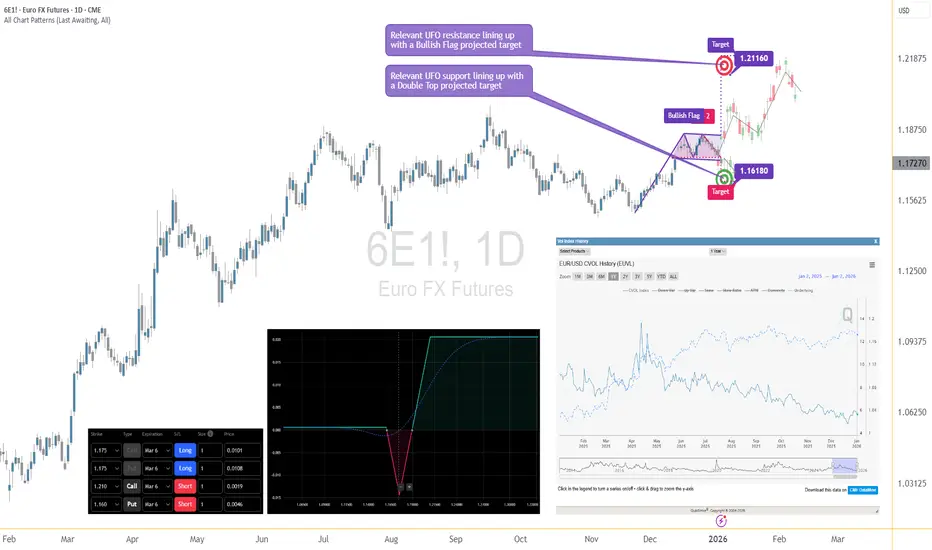
In this case, the CVOL index for Euro FX futures is observed at relatively low levels compared to its behavior earlier in the year. While CVOL is not predictive, it provides valuable context: the market is currently assigning a lower probability to large price swings than it has at other times.
Periods of compressed implied volatility are noteworthy because price expansion often follows periods of contraction, particularly when price structure begins to show signs of instability. This does not guarantee movement, but it shifts the analytical focus toward strategies that can benefit from expansion rather than stagnation.
Technical Landscape: A Market at an Inflection Point
From a structural perspective, Euro FX futures present a rare but important configuration: conflicting continuation and reversal patterns.
- A bullish flag has developed following an impulsive advance, suggesting the potential for trend continuation.
- Simultaneously, a double top formation has emerged, introducing the possibility of a downside resolution.
When viewed in isolation, each pattern offers a directional narrative. When viewed together, they create directional ambiguity but expansion risk clarity. In other words, the market may not be signaling where it intends to go — but it is signaling that remaining stagnant may be increasingly difficult.
This type of structural conflict is often where volatility-focused strategies become more relevant than directional trades.
Mapping Price Targets to Market Structure
Technical patterns are most useful when they provide reference points, not predictions. In this case, both patterns generate projected levels that act as structural guideposts.
- The bullish flag projects an upside objective near 1.2116, which also aligns with a clearly defined UFO resistance zone.
- The double top projects a downside objective near 1.1618, aligning with a well-defined UFO support zone.
These levels form a structural range boundary. Price acceptance beyond either boundary would represent meaningful resolution of the current compression phase. For options traders, these projected zones are valuable because they provide logical strike selection reference points when designing volatility structures.
Strategy Foundation: The Role of a Long Straddle
A traditional long straddle involves purchasing both a call and a put at the same strike, typically near the current price. This structure is directionally neutral and benefits from large price movements in either direction.
The strength of a long straddle lies in its convexity. Its primary weakness lies in time decay, particularly when implied volatility is low and price remains range-bound.
In compressed volatility environments, a pure long straddle can be inefficient if price takes time to resolve. This is where structure refinement becomes essential.
Strategy Evolution: Structuring an Asymmetric Long Volatility Approach
Instead of relying on a textbook long straddle, this Options Blueprint explores an asymmetric volatility structure designed to reflect the underlying technical landscape.
The structure begins with a long at-the-money straddle, capturing core volatility exposure:
- Long 1.175 Call
- Long 1.175 Put
To refine the payoff and reduce exposure to time decay, options are sold at technically
meaningful projected targets:
- Short 1.21 Call
- Short 1.16 Put
This transforms the strategy into a defined-risk, asymmetric volatility structure.
Key educational concepts illustrated by this construction:
- The long options capture expansion risk near the current price.
- The short options align with projected structural boundaries.
- The payoff becomes skewed, favoring upside expansion while still allowing for limited downside participation.
- Theta exposure is reduced compared to a pure long straddle.
The goal is not optimization, but intentional payoff shaping based on structure.
Risk Profile Analysis: Understanding the Payoff Diagram
The resulting risk profile highlights several important principles.
- Maximum risk occurs if price remains trapped between the short strikes into expiration.
- Upside expansion toward the upper projected level produces the most favorable outcome.
- Downside expansion produces a smaller, but still positive, outcome.
- Both risk and reward are defined, removing uncertainty around extreme scenarios.
This structure favors movement over stagnation, reflecting the belief that expansion risk outweighs the likelihood of prolonged consolidation — without requiring directional conviction.
Contract Specifications
Euro FX futures are available in both standard and micro formats.
o 6E (Euro FX Futures)
- Larger notional exposure
- Suitable for accounts with higher margin tolerance
o M6E (Micro EUR/USD Futures)
- One-tenth the size of the standard contract
- Greater flexibility for position sizing
- Often useful for testing or scaling strategies
Both contracts reference the same underlying market structure, allowing the same analytical framework to be applied across different risk profiles.
Margin requirements vary and are subject to change, making position sizing and risk definition essential considerations when selecting between standard and micro contracts.
Euro FX futures (6E) have a tick size of 0.000050 per Euro increment = $6.25 tick value and currently require roughly ~$2,700 in margin per contract, while Micro EUR/USD Futures (M6E) use a 0.0001 tick size per euro = $1.25 tick value and margin closer to ~$270.
Risk Management Considerations
Options strategies are not defined solely by payoff diagrams — they are defined by how risk is managed over time.
Key considerations include:
- Sizing positions so that the maximum loss is acceptable within the broader portfolio context.
- Understanding how time decay accelerates as expiration approaches.
- Recognizing that volatility expansion does not occur on a fixed schedule.
- Accepting predefined loss zones as part of the structure rather than reacting emotionally.
Risk management is not about avoiding losses; it is about controlling exposure to uncertainty.
Key Takeaways from This Options Blueprint
- Implied volatility provides context, not direction.
- Conflicting chart patterns often increase expansion risk.
- Options structures can be shaped to reflect technical asymmetry.
- Modifying classic strategies can improve alignment with market conditions.
- Defined risk and intentional design matter more than prediction.
This case study demonstrates how volatility, structure, and risk management intersect — without requiring directional forecasts.
Data Consideration
When charting futures, the data provided could be delayed. Traders working with the ticker symbols discussed in this idea may prefer to use CME Group real-time data plan on TradingView: tradingview.com/cme/ - This consideration is particularly important for shorter-term traders, whereas it may be less critical for those focused on longer-term trading strategies.
General Disclaimer
The trade ideas presented herein are solely for illustrative purposes forming a part of a case study intended to demonstrate key principles in risk management within the context of the specific market scenarios discussed. These ideas are not to be interpreted as investment recommendations or financial advice. They do not endorse or promote any specific trading strategies, financial products, or services. The information provided is based on data believed to be reliable; however, its accuracy or completeness cannot be guaranteed. Trading in financial markets involves risks, including the potential loss of principal. Each individual should conduct their own research and consult with professional financial advisors before making any investment decisions. The author or publisher of this content bears no responsibility for any actions taken based on the information provided or for any resultant financial or other losses.

Trade Smarter — See What Most Traders Don’t. Explore AutoClimate™ and AutoUFOs® (patented) in the UFO Trading Suite: tradingview.com/spaces/traddictiv/
Publicações relacionadas
Aviso legal
As informações e publicações não se destinam a ser, e não constituem, conselhos ou recomendações financeiras, de investimento, comerciais ou de outro tipo fornecidos ou endossados pela TradingView. Leia mais nos Termos de Uso.
Trade Smarter — See What Most Traders Don’t. Explore AutoClimate™ and AutoUFOs® (patented) in the UFO Trading Suite: tradingview.com/spaces/traddictiv/
Publicações relacionadas
Aviso legal
As informações e publicações não se destinam a ser, e não constituem, conselhos ou recomendações financeiras, de investimento, comerciais ou de outro tipo fornecidos ou endossados pela TradingView. Leia mais nos Termos de Uso.