
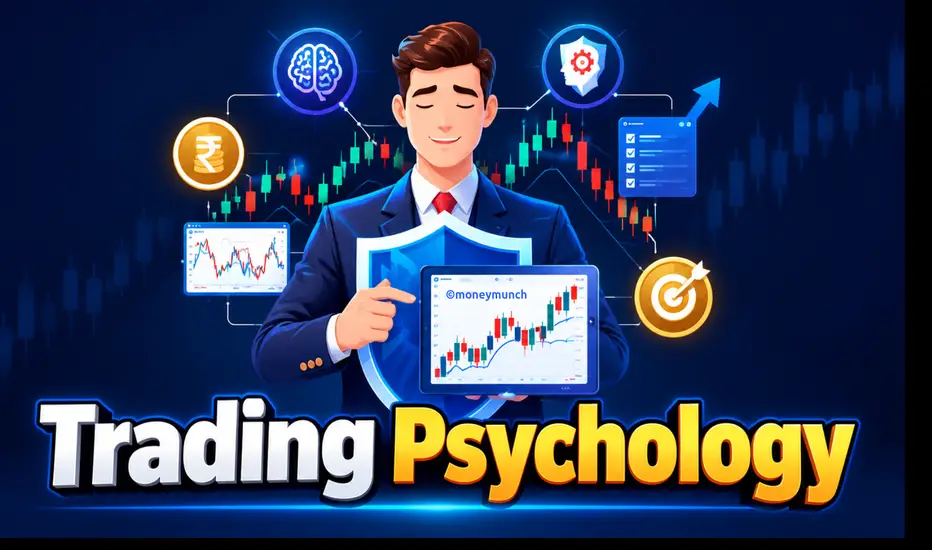
👩🏫️ Trading Psychology: The Missing Dimension of Trading Success
Every trader begins their journey believing that success comes from understanding the market. With time, however, we discover that analysing price movements is only one part of the equation.
Trading success involves three interconnected dimensions: market analysis, risk management, and psychology.
1️⃣️ The First Stage: Learning to Analyse the Market
When we begin trading, we often believe that finding the right stock, identifying a perfect chart pattern, or predicting the next price movement is enough to become profitable. We study technical analysis, fundamental analysis, indicators, chart patterns, and market trends. We search for strategies that can help us identify profitable opportunities. Yet, even after learning these concepts, many traders continue to struggle. Why? Because a good analysis does not automatically produce a good trading result. Markets are uncertain, and even a well-researched trade can move against us.
The first important lesson is that being right about the market and making money in the market are not the same thing.
2️⃣️ The Second Stage: Understanding Risk Management
The next stage begins when we realise that trading is not simply about predicting price movements. It is also about managing uncertainty. Every trade involves risk. We cannot eliminate uncertainty, but we can decide how much capital we are willing to expose to it. This is where position sizing, stop-loss discipline, capital preservation, and risk-to-reward assessment become essential. A trader who repeatedly takes excessive risks can lose money even when several predictions are correct.
Conversely, a trader with a reasonable strategy and disciplined risk management may be better equipped to survive losing streaks. The objective is not to win every trade. It is to manage losses, protect capital, and allow a sound strategy to work over a series of trades. But even this is not the complete picture.
3️⃣️ The Third Stage: Mastering Trading Psychology
The final dimension is often the most difficult to recognise because it requires us to examine our own behaviour.
These behaviours are not necessarily caused by a lack of market knowledge. They often arise from fear, greed, overconfidence, regret, and the desire to avoid being wrong. Markets are uncertain, and human beings are not always rational decision-makers. Our emotions can influence how we interpret information and respond to price movements.
The challenge is not merely to understand the market. It is to recognise how our own minds influence our decisions.
🪤️ The Hidden Trap: “It's Only the Market's Money”
Consider a simple example. Two traders, Elliott and Alexander, each purchase a share for $100. The price rises to $200, giving each trader an unrealised profit of $100 per share. Elliott decides to sell at $200 and secures his $100 profit. Alexander decides to continue holding. The price subsequently falls to $180, and he sells. His final profit is $80 per share. Now imagine asking Elliott whether he lost $20 when the price fell from $200 to $180. He might respond, “No, I am still in profit. I haven't lost my own money.”
But consider what happened: at $200, his position was worth $200 per share. At $180, it was worth $180. The value of his position declined by $20 per share. The fact that he remains profitable relative to his purchase price does not change that decline.
We may become less cautious after a winning trade, hold a deteriorating position because we are still in profit, or take risks that we would never accept with our original capital. The same psychological bias can appear after a casino win, a successful investment, or a profitable trading streak. Money does not become less valuable simply because it came from a gain rather than our original capital.
Of course, a decline in unrealised profit is not automatically a reason to sell. Markets fluctuate, and a profitable position may still fit a valid trading plan. The important question is whether we are following our strategy or making excuses to protect our emotions.
🤯️ Paper Profits, Realised Profits, and Rational Decisions
Unrealised profits are part of a position's current economic value, but they are not guaranteed. Until a position is closed, its profit or loss can change with the market. Successful traders understand this distinction without becoming emotionally attached to either outcome. They establish their exit criteria in advance, manage risk according to their strategy, and avoid changing their decisions merely because a trade has become profitable or unprofitable. The goal is not to protect every dollar of unrealised profit at all costs. It is to make consistent, rational decisions based on a predefined process.
🪖️ The Real Battle Is With Ourselves
Trading is a continuous series of decisions: whether to enter, exit, hold, reduce risk, or do nothing.
Each decision creates an opportunity to follow our plan or allow our emotions to take control. Market analysis helps us identify opportunities. Risk management helps us control our exposure. Trading psychology helps us apply our knowledge consistently when uncertainty and emotions make that difficult.
Ultimately, we cannot control every market movement. We can, however, work towards controlling our reactions, improving our discipline, and learning from our decisions.
💬 What do you think is the biggest challenge in trading — market analysis, risk management, or controlling your emotions? Share your thoughts in the comments below!
Educational content only. This post is intended to discuss trading behaviour and decision-making, not to provide a buy or sell recommendation.
Every trader begins their journey believing that success comes from understanding the market. With time, however, we discover that analysing price movements is only one part of the equation.
Trading success involves three interconnected dimensions: market analysis, risk management, and psychology.
1️⃣️ The First Stage: Learning to Analyse the Market
When we begin trading, we often believe that finding the right stock, identifying a perfect chart pattern, or predicting the next price movement is enough to become profitable. We study technical analysis, fundamental analysis, indicators, chart patterns, and market trends. We search for strategies that can help us identify profitable opportunities. Yet, even after learning these concepts, many traders continue to struggle. Why? Because a good analysis does not automatically produce a good trading result. Markets are uncertain, and even a well-researched trade can move against us.
The first important lesson is that being right about the market and making money in the market are not the same thing.
2️⃣️ The Second Stage: Understanding Risk Management
The next stage begins when we realise that trading is not simply about predicting price movements. It is also about managing uncertainty. Every trade involves risk. We cannot eliminate uncertainty, but we can decide how much capital we are willing to expose to it. This is where position sizing, stop-loss discipline, capital preservation, and risk-to-reward assessment become essential. A trader who repeatedly takes excessive risks can lose money even when several predictions are correct.
Conversely, a trader with a reasonable strategy and disciplined risk management may be better equipped to survive losing streaks. The objective is not to win every trade. It is to manage losses, protect capital, and allow a sound strategy to work over a series of trades. But even this is not the complete picture.
3️⃣️ The Third Stage: Mastering Trading Psychology
The final dimension is often the most difficult to recognise because it requires us to examine our own behaviour.
- Why do we exit profitable trades too early?
- Why do we hold losing positions longer than planned?
- Why do we increase position sizes after a winning streak or try to recover losses immediately after a bad trade?
These behaviours are not necessarily caused by a lack of market knowledge. They often arise from fear, greed, overconfidence, regret, and the desire to avoid being wrong. Markets are uncertain, and human beings are not always rational decision-makers. Our emotions can influence how we interpret information and respond to price movements.
The challenge is not merely to understand the market. It is to recognise how our own minds influence our decisions.
🪤️ The Hidden Trap: “It's Only the Market's Money”
Consider a simple example. Two traders, Elliott and Alexander, each purchase a share for $100. The price rises to $200, giving each trader an unrealised profit of $100 per share. Elliott decides to sell at $200 and secures his $100 profit. Alexander decides to continue holding. The price subsequently falls to $180, and he sells. His final profit is $80 per share. Now imagine asking Elliott whether he lost $20 when the price fell from $200 to $180. He might respond, “No, I am still in profit. I haven't lost my own money.”
But consider what happened: at $200, his position was worth $200 per share. At $180, it was worth $180. The value of his position declined by $20 per share. The fact that he remains profitable relative to his purchase price does not change that decline.
This illustrates a psychological trap: we sometimes treat unrealised profits as though they belong to a separate pool of money that we can risk more freely.
We may become less cautious after a winning trade, hold a deteriorating position because we are still in profit, or take risks that we would never accept with our original capital. The same psychological bias can appear after a casino win, a successful investment, or a profitable trading streak. Money does not become less valuable simply because it came from a gain rather than our original capital.
Of course, a decline in unrealised profit is not automatically a reason to sell. Markets fluctuate, and a profitable position may still fit a valid trading plan. The important question is whether we are following our strategy or making excuses to protect our emotions.
🤯️ Paper Profits, Realised Profits, and Rational Decisions
Unrealised profits are part of a position's current economic value, but they are not guaranteed. Until a position is closed, its profit or loss can change with the market. Successful traders understand this distinction without becoming emotionally attached to either outcome. They establish their exit criteria in advance, manage risk according to their strategy, and avoid changing their decisions merely because a trade has become profitable or unprofitable. The goal is not to protect every dollar of unrealised profit at all costs. It is to make consistent, rational decisions based on a predefined process.
🪖️ The Real Battle Is With Ourselves
Trading is a continuous series of decisions: whether to enter, exit, hold, reduce risk, or do nothing.
Each decision creates an opportunity to follow our plan or allow our emotions to take control. Market analysis helps us identify opportunities. Risk management helps us control our exposure. Trading psychology helps us apply our knowledge consistently when uncertainty and emotions make that difficult.
Ultimately, we cannot control every market movement. We can, however, work towards controlling our reactions, improving our discipline, and learning from our decisions.
The market does not reward us simply for being intelligent. Long-term success requires a process that combines knowledge, risk management, and emotional discipline.
💬 What do you think is the biggest challenge in trading — market analysis, risk management, or controlling your emotions? Share your thoughts in the comments below!
Educational content only. This post is intended to discuss trading behaviour and decision-making, not to provide a buy or sell recommendation.

Publicações relacionadas
Aviso legal
As informações e publicações não se destinam a ser, e não constituem, conselhos ou recomendações financeiras, de investimento, comerciais ou de outro tipo fornecidos ou endossados pela TradingView. Leia mais nos Termos de Uso.
Publicações relacionadas
Aviso legal
As informações e publicações não se destinam a ser, e não constituem, conselhos ou recomendações financeiras, de investimento, comerciais ou de outro tipo fornecidos ou endossados pela TradingView. Leia mais nos Termos de Uso.