
Hey what's up guys, today a little bit about psychology.
Traders blow up because they treat every session like the championship final then wonder why discipline disappears the moment one loss hits.
After years of mistakes, journaling, and rebuilding, the pattern is always the same: the traders who last aren't the smartest ones. They're the most boring ones focused on Process first. Capital first. Emotion last.
Here are nine rules worth building your entire operation around.
1. 🔭 Zoom Out Before You Judge Anything
Daily P&L is noise. Weekly P&L is still noise for most systems. Your edge shows up over a series not on trade seven of a bad Tuesday.
When you judge yourself trade by trade, you invite emotion into decisions that should be mechanical. One loss becomes identity. A string of losses becomes a reason to force setups that were never there.
Process over outcome. Judge execution quality before you judge the dollar.
2. 🎯 Kill Expectations Before They Kill Your Account
Daily profit targets sound disciplined. They're often the fastest route to overtrading.
"I need $500 today" becomes three mediocre entries by lunch. "I need to be in the market to be a real trader" becomes activity mistaken for edge. Some days the correct decision is zero trades. That's not failure it's that's filtering.
Data over emotion. No trade owes you a result.
3. 📓 The Game Is Execution, Money Is Just the Scoreboard
Chasing the number on the screen is how smart traders get dumb fast. The shift happens when you stop asking "how much did I make?" and start asking "what did this trade teach me?"
Every loss is a lesson if you journal it honestly. Every win is a lesson too, especially wins that came from breaking rules, because those are the ones that train bad habits.
Education over signals. Journal the why, not just the what.
4. ⚡ Trade Your A-Game or Don't Trade
Your body runs the terminal before your strategy does. Bad sleep, high anxiety, distraction, life stress, these aren't excuses. They're risk factors.
Run a pre-session scan: sleep, focus, emotional load, calendar pressure. If you're not fit to decide, you're fit to watch. Sitting out isn't weakness. It's capital preservation.
Consistency over excitement. No hero trades on a bad state day.
5. 🎣 Pickiness Is a Feature, Not a Flaw
More trades rarely means more edge. It usually means more ways to donate.
Narrow your universe. Learn a few instruments deeply, how they move, when they respect structure, when they don't. Wait for setups that meet your criteria without negotiation.
Missing a hundred average opportunities to catch one clean A+ setup. Is what I call professional filtering. If you need two confirmations, one confirmation isn't "close enough."
Independence over dependency. Your edge lives in selectivity, not in being everywhere at once.
6. 🛡️ Your First Job Is Not Losing
You're not paid to be right. You're paid to manage risk.
The traders who survive long enough to compound aren't always the ones with the biggest winners. They're the ones with the smallest, most controlled losers. Capital preservation keeps you in the game long enough for your edge to matter.
Small losses, big wins. Show me your losses and I'll tell you if you're going to make it as a profitable trader.
7. 📊 Adapt Don't Fight the Tape
Markets change. Strategies that worked in one regime bleed in another. Stubbornness is expensive.
Trade with the environment in front of you, not the one you wish existed. Fighting trend without a defined reversal framework and clear risk is speculation dressed as analysis.
Adaptation isn't abandoning your system. It's applying it when conditions match — and standing down when they don't.
8. 🚌 Missed Trades Don't Matter. Forced Trades Do
You will miss setups. The market runs without you. Another bus is always coming.
FOMO is an account killer because it turns a missed winner into a forced loser. The mature response: log it, step away, come back tomorrow with the same rules intact.
If you miss a trade, it's completely fine. Forced trades are not.
9. ✅ Accountability Beats Motivation
Motivation fades. Accountability stays.
When you lose, don't outsource blame to the market, the feed, or Trump. Look at your journal. Did you follow the plan? Did you size correctly? Did you move a stop?
Write it down with pen and paper if you have to. What you will do. What you will not do. Review it before the session opens.
Hold yourself to the process before you sell anyone a story about your results.
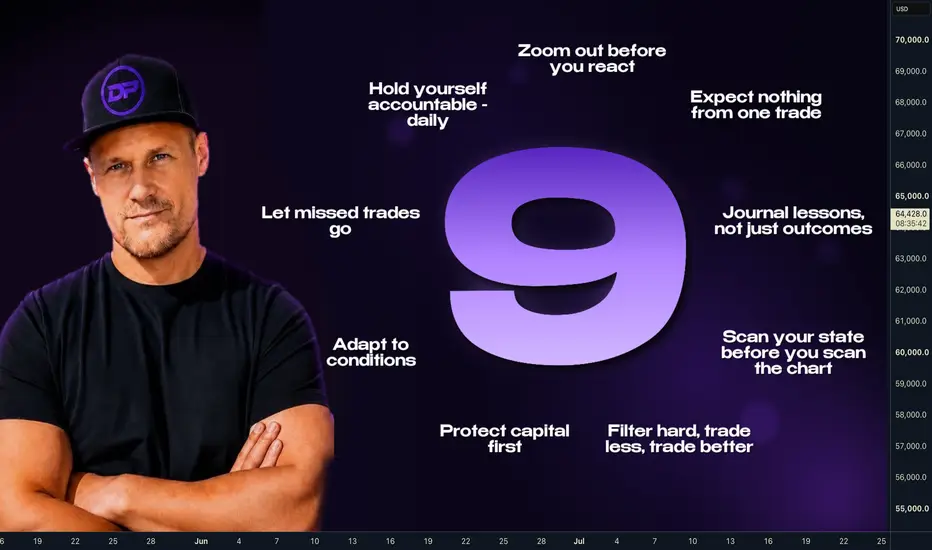
🧪 Power of Nine 9
Don't treat this as inspiration content. It's part of the operating system same tier as risk rules and execution checklists.
- Zoom out before you react
- Expect nothing from one trade
- Journal lessons, not just outcomes
- Scan your state before you scan the chart
- Filter hard, trade less, trade better
- Protect capital first
- Adapt to conditions
- Let missed trades go
- Hold yourself accountable - daily
‼️ None of this guarantees profits. Nothing in trading does. But these rules give you a fighting chance to stay independent, stay structured, and stay in the game long enough for your actual edge to show up.
Trading is hard. That's not the problem. The problem is trying to survive it without a psychological operating system.
Build one. Run it daily. Let the scoreboard take care of itself.
🚀Boost | 🔁 Share | 💬 Comment | ✅Follow for more CLS setups
Adapt useful, Reject useless and add what is specifically yours.
David Perk
Traders blow up because they treat every session like the championship final then wonder why discipline disappears the moment one loss hits.
After years of mistakes, journaling, and rebuilding, the pattern is always the same: the traders who last aren't the smartest ones. They're the most boring ones focused on Process first. Capital first. Emotion last.
Here are nine rules worth building your entire operation around.
1. 🔭 Zoom Out Before You Judge Anything
Daily P&L is noise. Weekly P&L is still noise for most systems. Your edge shows up over a series not on trade seven of a bad Tuesday.
When you judge yourself trade by trade, you invite emotion into decisions that should be mechanical. One loss becomes identity. A string of losses becomes a reason to force setups that were never there.
Process over outcome. Judge execution quality before you judge the dollar.
2. 🎯 Kill Expectations Before They Kill Your Account
Daily profit targets sound disciplined. They're often the fastest route to overtrading.
"I need $500 today" becomes three mediocre entries by lunch. "I need to be in the market to be a real trader" becomes activity mistaken for edge. Some days the correct decision is zero trades. That's not failure it's that's filtering.
Data over emotion. No trade owes you a result.
3. 📓 The Game Is Execution, Money Is Just the Scoreboard
Chasing the number on the screen is how smart traders get dumb fast. The shift happens when you stop asking "how much did I make?" and start asking "what did this trade teach me?"
Every loss is a lesson if you journal it honestly. Every win is a lesson too, especially wins that came from breaking rules, because those are the ones that train bad habits.
Education over signals. Journal the why, not just the what.
4. ⚡ Trade Your A-Game or Don't Trade
Your body runs the terminal before your strategy does. Bad sleep, high anxiety, distraction, life stress, these aren't excuses. They're risk factors.
Run a pre-session scan: sleep, focus, emotional load, calendar pressure. If you're not fit to decide, you're fit to watch. Sitting out isn't weakness. It's capital preservation.
Consistency over excitement. No hero trades on a bad state day.
5. 🎣 Pickiness Is a Feature, Not a Flaw
More trades rarely means more edge. It usually means more ways to donate.
Narrow your universe. Learn a few instruments deeply, how they move, when they respect structure, when they don't. Wait for setups that meet your criteria without negotiation.
Missing a hundred average opportunities to catch one clean A+ setup. Is what I call professional filtering. If you need two confirmations, one confirmation isn't "close enough."
Independence over dependency. Your edge lives in selectivity, not in being everywhere at once.
6. 🛡️ Your First Job Is Not Losing
You're not paid to be right. You're paid to manage risk.
The traders who survive long enough to compound aren't always the ones with the biggest winners. They're the ones with the smallest, most controlled losers. Capital preservation keeps you in the game long enough for your edge to matter.
Small losses, big wins. Show me your losses and I'll tell you if you're going to make it as a profitable trader.
7. 📊 Adapt Don't Fight the Tape
Markets change. Strategies that worked in one regime bleed in another. Stubbornness is expensive.
Trade with the environment in front of you, not the one you wish existed. Fighting trend without a defined reversal framework and clear risk is speculation dressed as analysis.
Adaptation isn't abandoning your system. It's applying it when conditions match — and standing down when they don't.
8. 🚌 Missed Trades Don't Matter. Forced Trades Do
You will miss setups. The market runs without you. Another bus is always coming.
FOMO is an account killer because it turns a missed winner into a forced loser. The mature response: log it, step away, come back tomorrow with the same rules intact.
If you miss a trade, it's completely fine. Forced trades are not.
9. ✅ Accountability Beats Motivation
Motivation fades. Accountability stays.
When you lose, don't outsource blame to the market, the feed, or Trump. Look at your journal. Did you follow the plan? Did you size correctly? Did you move a stop?
Write it down with pen and paper if you have to. What you will do. What you will not do. Review it before the session opens.
Hold yourself to the process before you sell anyone a story about your results.
🧪 Power of Nine 9
Don't treat this as inspiration content. It's part of the operating system same tier as risk rules and execution checklists.
- Zoom out before you react
- Expect nothing from one trade
- Journal lessons, not just outcomes
- Scan your state before you scan the chart
- Filter hard, trade less, trade better
- Protect capital first
- Adapt to conditions
- Let missed trades go
- Hold yourself accountable - daily
‼️ None of this guarantees profits. Nothing in trading does. But these rules give you a fighting chance to stay independent, stay structured, and stay in the game long enough for your actual edge to show up.
Trading is hard. That's not the problem. The problem is trying to survive it without a psychological operating system.
Build one. Run it daily. Let the scoreboard take care of itself.
🚀Boost | 🔁 Share | 💬 Comment | ✅Follow for more CLS setups
Adapt useful, Reject useless and add what is specifically yours.
David Perk

🌎 Website & Verified Results
davidperkfx.com/
🔮 Community
davidperkfx.com/discord
🧪 Telegram
shorturl.at/fPjTX
50% Trading Bonus
shorturl.at/lmFa8
‼️ Tradingview Prop USA
shorturl.at/dNxSj
davidperkfx.com/
🔮 Community
davidperkfx.com/discord
🧪 Telegram
shorturl.at/fPjTX
50% Trading Bonus
shorturl.at/lmFa8
‼️ Tradingview Prop USA
shorturl.at/dNxSj
Publicações relacionadas
Aviso legal
As informações e publicações não se destinam a ser, e não constituem, conselhos ou recomendações financeiras, de investimento, comerciais ou de outro tipo fornecidos ou endossados pela TradingView. Leia mais nos Termos de Uso.
🌎 Website & Verified Results
davidperkfx.com/
🔮 Community
davidperkfx.com/discord
🧪 Telegram
shorturl.at/fPjTX
50% Trading Bonus
shorturl.at/lmFa8
‼️ Tradingview Prop USA
shorturl.at/dNxSj
davidperkfx.com/
🔮 Community
davidperkfx.com/discord
🧪 Telegram
shorturl.at/fPjTX
50% Trading Bonus
shorturl.at/lmFa8
‼️ Tradingview Prop USA
shorturl.at/dNxSj
Publicações relacionadas
Aviso legal
As informações e publicações não se destinam a ser, e não constituem, conselhos ou recomendações financeiras, de investimento, comerciais ou de outro tipo fornecidos ou endossados pela TradingView. Leia mais nos Termos de Uso.