
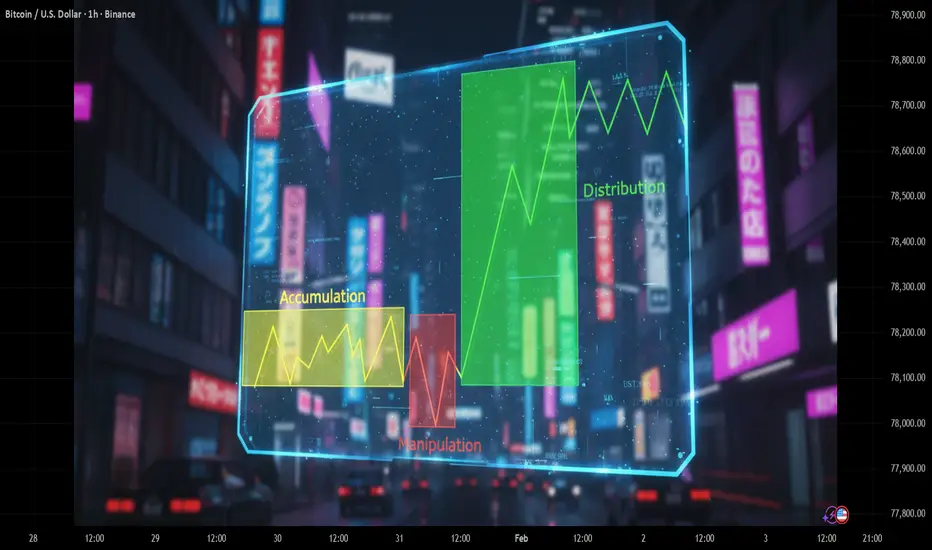
Mastering AMD: The Smart Money Cycle
If you have ever felt like the market is personally hunting your Stop Loss, you are probably right. But it isn't personal—it's AMD.
Accumulation, Manipulation, Distribution (AMD) is the blueprint used by Institutional Traders ("Smart Money") to move the market. Instead of random chaos, the market actually moves in a structured, repeatable three-stage cycle.
This concept is the backbone of Smart Money Concepts (SMC) and ICT methodologies. Whether you trade Forex, Crypto, or Stocks, understanding AMD is the difference between being the "Liquidity" (the victim) and being the "Market Maker" (the predator).
In this masterclass, we will break down exactly how to spot the cycle, how to trade it, and how to avoid the traps that wreck 90% of retail traders.

1. What is AMD?
AMD is a framework that explains Volume and Time. Institutions like banks and hedge funds cannot simply click "Buy" at the current price. Their order sizes are too big; if they bought all at once, they would slip the price up 10% instantly and get a terrible entry.
Instead, they execute a three-step plan:
Accumulate orders quietly to hide their intentions.
Manipulate price to trick retail traders into selling to them.
Distribute the price in the real direction to book profits.
2. The Three Phases Explained
Phase 1: Accumulation (The Spring)
This is the "Boring" phase.
The Look: Price moves sideways in a tight, narrow range. Volume is extremely low.
The Psychology: Most retail traders lose interest here because "nothing is happening."
The Reality: Smart Money is quietly building massive positions. Think of this phase like compressing a spring. The longer the accumulation, the more explosive the eventual move will be.
Phase 2: Manipulation (The Trap)
This is the "Violent" phase. Also known as the "Judas Swing" or "Liquidity Sweep."
The Look: A sudden, aggressive breakout below support (or above resistance) that looks like a new trend starting.
The Trap: Retail traders see the breakout and rush to enter. Simultaneously, traders who were long the range get their Stop Losses hit.
The Reality: Institutions use this liquidity to fill the rest of their massive orders at a better price. They are buying your panic selling.
Phase 3: Distribution (The Trend)
This is the "Payday" phase.
The Look: Price reverses sharply from the manipulation zone and expands rapidly in the opposite direction.
The Psychology: Retail traders who were trapped in the wrong direction are now underwater, fueling the move as they panic-close. FOMO traders jump in late.
The Reality: Institutions are now in profit and are "distributing" (selling) their position to the latecomers to lock in gains.
3. How to Identify AMD on Your Charts
To trade this, you need to be a detective. Here are your clues:
A. Chart Patterns
Accumulation: Look for a clear "Box" or channel. (e.g., The Asian Session range in Forex/Crypto).
Manipulation: Look for a "Turtle Soup" pattern—a wick that breaks the box high/low but closes back inside.
Distribution: Look for "Expansion Candles"—large, full-bodied candles with little to no wicks moving away from the range.
B. Volume Clues
Accumulation: Volume is dying/flat.
Manipulation: Sudden Spike in volume (Stopping Volume). This indicates a battle where stops are being absorbed.
Distribution: Sustained high volume that supports the trend.
C. Multi-Timeframe Confirmation AMD is fractal.
You might see an Accumulation range on the 4-Hour chart.
Drop to the 15-Minute chart to spot the Manipulation wick.
Aligning these timeframes prevents you from getting faked out by market noise.
4. Basic AMD Trading Strategies
Stop guessing and start trading the phases.
Strategy 1: The "Manipulation" Reversal (Aggressive)
The Setup: Wait for price to break the Accumulation Range support.
The Trigger: Do not short the breakdown. Wait for a "Change of Character" (CHoCH) on a lower timeframe, or for price to close back inside the range.
The Entry: Enter Long as soon as the trap is confirmed.
Stop Loss: Just below the Manipulation wick.
Strategy 2: The "Distribution" Retest (Conservative)
The Setup: Wait for the Manipulation to finish and the real trend (Distribution) to start.
The Trigger: Wait for price to break market structure and then pull back.
The Entry: Enter on the retest of the Accumulation Range (now acting as support) or an Order Block.
Target: The next major liquidity pool.
5. Common AMD Mistakes (How to Not Get Wrecked)
Even pros make mistakes. Avoid these three deadly sins:
Chasing the Manipulation:
Mistake: Seeing the sudden drop in Phase 2 and thinking "The crash is here!"
Fix: Ask yourself: "Are we near a higher timeframe support?" If yes, it's likely a trap, not a crash.
Ignoring the Accumulation Zone:
Mistake: Thinking the market is "boring" and walking away.
Fix: Mark the High and Low of the range. Set alerts. The breakout of this range is the start of the day's real trade.
Overtrading the Distribution:
Mistake: Entering too late when the move is already extended.
Fix: If you missed the Manipulation entry, wait for a pullback. Never FOMO into a vertical green candle.
Conclusion
Accumulation builds the energy. Manipulation traps the victims. Distribution pays the winners.
Once you start seeing the market through the lens of AMD, you stop reacting to every red candle and start understanding the narrative. The market isn't random; it's a cycle.
Identify the phase. Spot the trap. Ride the flow
If you have ever felt like the market is personally hunting your Stop Loss, you are probably right. But it isn't personal—it's AMD.
Accumulation, Manipulation, Distribution (AMD) is the blueprint used by Institutional Traders ("Smart Money") to move the market. Instead of random chaos, the market actually moves in a structured, repeatable three-stage cycle.
This concept is the backbone of Smart Money Concepts (SMC) and ICT methodologies. Whether you trade Forex, Crypto, or Stocks, understanding AMD is the difference between being the "Liquidity" (the victim) and being the "Market Maker" (the predator).
In this masterclass, we will break down exactly how to spot the cycle, how to trade it, and how to avoid the traps that wreck 90% of retail traders.
1. What is AMD?
AMD is a framework that explains Volume and Time. Institutions like banks and hedge funds cannot simply click "Buy" at the current price. Their order sizes are too big; if they bought all at once, they would slip the price up 10% instantly and get a terrible entry.
Instead, they execute a three-step plan:
Accumulate orders quietly to hide their intentions.
Manipulate price to trick retail traders into selling to them.
Distribute the price in the real direction to book profits.
2. The Three Phases Explained
Phase 1: Accumulation (The Spring)
This is the "Boring" phase.
The Look: Price moves sideways in a tight, narrow range. Volume is extremely low.
The Psychology: Most retail traders lose interest here because "nothing is happening."
The Reality: Smart Money is quietly building massive positions. Think of this phase like compressing a spring. The longer the accumulation, the more explosive the eventual move will be.
Phase 2: Manipulation (The Trap)
This is the "Violent" phase. Also known as the "Judas Swing" or "Liquidity Sweep."
The Look: A sudden, aggressive breakout below support (or above resistance) that looks like a new trend starting.
The Trap: Retail traders see the breakout and rush to enter. Simultaneously, traders who were long the range get their Stop Losses hit.
The Reality: Institutions use this liquidity to fill the rest of their massive orders at a better price. They are buying your panic selling.
Phase 3: Distribution (The Trend)
This is the "Payday" phase.
The Look: Price reverses sharply from the manipulation zone and expands rapidly in the opposite direction.
The Psychology: Retail traders who were trapped in the wrong direction are now underwater, fueling the move as they panic-close. FOMO traders jump in late.
The Reality: Institutions are now in profit and are "distributing" (selling) their position to the latecomers to lock in gains.
3. How to Identify AMD on Your Charts
To trade this, you need to be a detective. Here are your clues:
A. Chart Patterns
Accumulation: Look for a clear "Box" or channel. (e.g., The Asian Session range in Forex/Crypto).
Manipulation: Look for a "Turtle Soup" pattern—a wick that breaks the box high/low but closes back inside.
Distribution: Look for "Expansion Candles"—large, full-bodied candles with little to no wicks moving away from the range.
B. Volume Clues
Accumulation: Volume is dying/flat.
Manipulation: Sudden Spike in volume (Stopping Volume). This indicates a battle where stops are being absorbed.
Distribution: Sustained high volume that supports the trend.
C. Multi-Timeframe Confirmation AMD is fractal.
You might see an Accumulation range on the 4-Hour chart.
Drop to the 15-Minute chart to spot the Manipulation wick.
Aligning these timeframes prevents you from getting faked out by market noise.
4. Basic AMD Trading Strategies
Stop guessing and start trading the phases.
Strategy 1: The "Manipulation" Reversal (Aggressive)
The Setup: Wait for price to break the Accumulation Range support.
The Trigger: Do not short the breakdown. Wait for a "Change of Character" (CHoCH) on a lower timeframe, or for price to close back inside the range.
The Entry: Enter Long as soon as the trap is confirmed.
Stop Loss: Just below the Manipulation wick.
Strategy 2: The "Distribution" Retest (Conservative)
The Setup: Wait for the Manipulation to finish and the real trend (Distribution) to start.
The Trigger: Wait for price to break market structure and then pull back.
The Entry: Enter on the retest of the Accumulation Range (now acting as support) or an Order Block.
Target: The next major liquidity pool.
5. Common AMD Mistakes (How to Not Get Wrecked)
Even pros make mistakes. Avoid these three deadly sins:
Chasing the Manipulation:
Mistake: Seeing the sudden drop in Phase 2 and thinking "The crash is here!"
Fix: Ask yourself: "Are we near a higher timeframe support?" If yes, it's likely a trap, not a crash.
Ignoring the Accumulation Zone:
Mistake: Thinking the market is "boring" and walking away.
Fix: Mark the High and Low of the range. Set alerts. The breakout of this range is the start of the day's real trade.
Overtrading the Distribution:
Mistake: Entering too late when the move is already extended.
Fix: If you missed the Manipulation entry, wait for a pullback. Never FOMO into a vertical green candle.
Conclusion
Accumulation builds the energy. Manipulation traps the victims. Distribution pays the winners.
Once you start seeing the market through the lens of AMD, you stop reacting to every red candle and start understanding the narrative. The market isn't random; it's a cycle.
Identify the phase. Spot the trap. Ride the flow

Mubite | Crypto Prop Firm
GET 30% OFF mubite.com/?discount=TW30
Discord: discord.gg/mubite
Twitter: x.com/mubite_com
Instagram: instagram.com/mubite_official
Youtube: youtube.com/@mubite_official
GET 30% OFF mubite.com/?discount=TW30
Discord: discord.gg/mubite
Twitter: x.com/mubite_com
Instagram: instagram.com/mubite_official
Youtube: youtube.com/@mubite_official
Aviso legal
As informações e publicações não se destinam a ser, e não constituem, conselhos ou recomendações financeiras, de investimento, comerciais ou de outro tipo fornecidos ou endossados pela TradingView. Leia mais nos Termos de Uso.
Mubite | Crypto Prop Firm
GET 30% OFF mubite.com/?discount=TW30
Discord: discord.gg/mubite
Twitter: x.com/mubite_com
Instagram: instagram.com/mubite_official
Youtube: youtube.com/@mubite_official
GET 30% OFF mubite.com/?discount=TW30
Discord: discord.gg/mubite
Twitter: x.com/mubite_com
Instagram: instagram.com/mubite_official
Youtube: youtube.com/@mubite_official
Aviso legal
As informações e publicações não se destinam a ser, e não constituem, conselhos ou recomendações financeiras, de investimento, comerciais ou de outro tipo fornecidos ou endossados pela TradingView. Leia mais nos Termos de Uso.