
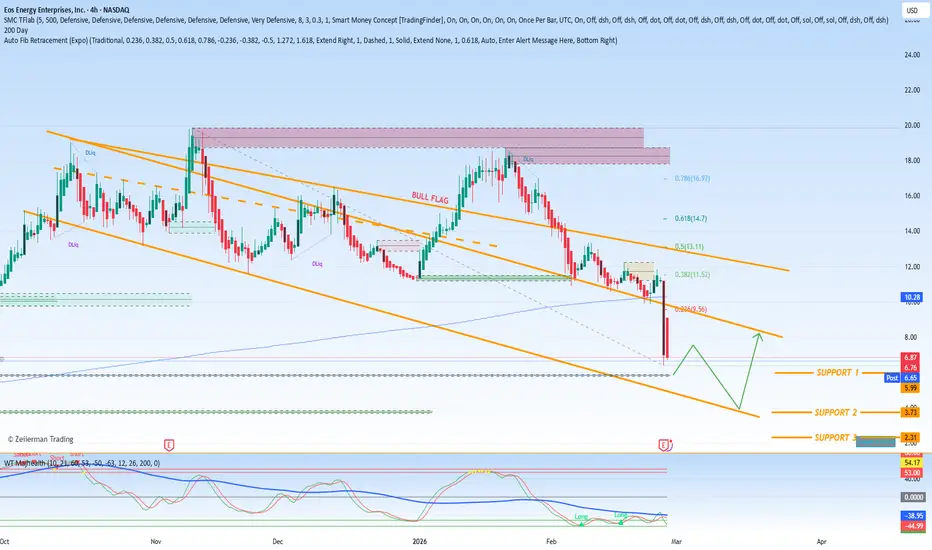
Eos Energy Enterprises (EOSE) Q4 & Full-Year 2025 Earnings Report: Key Takeaways
Eos Energy Enterprises held its fourth-quarter and full-year 2025 earnings call, revealing a period of stark contrasts. The company is navigating a surge in market demand, particularly from the AI and data center sector, while simultaneously grappling with significant operational hurdles that led to missed financial targets. Here’s a comprehensive breakdown of the call's critical themes.
1. Market Dynamics: A Fundamental Shift Toward Reliability
CEO Joe Mastrangelo opened the call by framing a pivotal change in the energy storage market. He stated that the primary driver is shifting "away from managing volatility to providing reliability." This transition is fueled by a convergence of powerful trends:
Explosive Growth in Data Centers: The insatiable power demands of hyperscalers and AI operations are creating a need for constant, dependable power.
Widespread Electrification: The move toward electric vehicles, electric heating, and increased domestic industrial production is placing unprecedented strain and new requirements on the grid.
Mastrangelo positioned Eos’ technology, with its flexible discharge durations (from 2 to 12+ hours) and rapid response capabilities, as ideally suited to meet this new reliability imperative. However, he offered a stark dose of realism, emphasizing that having the right technology is only half the battle, stating, "execution is what counts." He took full responsibility for the company missing its 2025 guidance, underscoring a commitment to accountability.
2. Operational Setbacks: The "Why" Behind Missed Guidance
COO John Mahaz, in his first full quarter, provided a transparent and detailed account of the operational challenges that derailed the company's 2025 production targets. While celebrating the achievement of a fully automated battery line and a record fourth quarter for revenue, he pinpointed three specific, non-demand-related issues:
Supplier Quality Issue: An isolated instance of supplier non-conformance brought production to a halt for one week. Mahaz assured that corrective actions and enhanced supplier controls have been implemented to prevent a recurrence.
Automation Ramp-Up Challenges: The new automated bipolar production line took significantly longer than anticipated to achieve the required quality standards. This delay resulted in extensive rework and lost potential revenue. The company has since responded by refining tooling, tightening material specifications, reducing process variation, and integrating advanced laser detection for quality assurance.
Excessive Equipment Downtime: This was the most significant operational drag. As production utilization intensified, equipment downtime spiked to the "mid-30% range," far exceeding the best-in-class target of roughly 10%. Mahaz detailed a comprehensive remediation plan that addressed robotics, hardware, control systems, preventive maintenance schedules, and spare parts inventory. He noted that downtime has already "improved significantly" in the early part of Q1 2026.
Mahaz identified the lack of redundancy on the primary production line as the key structural risk, as any failure forces a complete stop. This vulnerability is being directly addressed with the introduction of Line 2. Equipment for this new line is progressing through factory acceptance testing and is expected to arrive at the Turtle Creek facility in Q2 2026, with fully automated production targeted for Q4 2026. Line 2 will incorporate redundancy at critical stations, providing a crucial backup and increasing overall production resilience.
3. Technological Evolution: DawnOS and the Indensity Platform
CTO Francis Richey outlined the company's strategic product evolution, moving from simply selling DC battery blocks to delivering fully integrated energy storage solutions. This comprehensive offering now includes the batteries, the DawnOS software platform, controls, AC integration, and complete site design.
Key technological advancements highlighted include:
DawnOS Platform: Field operations in harsh environments and rigorous testing at the Edison, NJ facility have led to the development and launch of DawnOS. This software enables granular, individual battery monitoring and control, enhancing system performance, resilience, and data analytics.
Indensity Product Launch: Richey unveiled details on the new Indensity product configuration. While based on the same core zinc hybrid chemistry and DawnOS platform, Indensity is a completely repackaged system designed around three core principles:
Serviceability: Modules are designed for quick, crane-less disconnection and service using a standard forklift, drastically reducing maintenance complexity and cost.
Cost Reduction: The new architecture targets lower system costs.
Higher Energy Density: The modular design allows for vertical stacking—"as many as 12 units high"—which significantly improves site energy density, a critical factor for space-constrained projects like urban data centers or substations. First shipments of Indensity are planned for the second half of 2026.
4. Commercial Momentum: Backlog and Pipeline Surge
Chief Commercial Officer Nathan Kroeker presented a picture of robust and accelerating commercial traction, driven by the demand for longer-duration storage.
Backlog: The company closed the quarter with a backlog of just over $701 million, a 9% sequential increase. This was fueled by nearly 1.1 GWh in new orders across eight customers and nine projects. Notable wins included a 50 MWh master supply agreement with a developer participating in ComEd's distributed generation program and initial hotel projects in Florida.
Commercial Pipeline: The total addressable opportunity ballooned to a staggering $23.6 billion, representing approximately 99 GWh. This marks a 64% increase year-over-year.
Hyperscaler & AI Impact: Demand from data centers is a primary growth engine. Data-center-specific leads jumped 50% quarter-over-quarter, and the active data center pipeline grew by more than 40%.
The Shift to Long-Duration: A critical trend highlighted by Kroeker is that 63% of the pipeline now consists of systems with 8-hour or longer discharge durations. This confirms the market's move toward co-locating storage with generation assets to provide reliable, long-duration power, particularly for large-scale loads.
Key Projects: Kroeker mentioned submissions for major NYSERDA projects in New York and noted that developer Bimergen has technically selected the Z3 system for the 400 MWh Redbird project in ERCOT, with a further 2 GW development pipeline in the works.
5. Financial Results: Strong Revenue Growth Amidst Significant Losses
Kroeker, serving as Interim CFO, detailed the financial results, which showed remarkable top-line growth overshadowed by substantial net losses, largely due to non-cash accounting adjustments.
Revenue: The company posted strong revenue growth, with $58 million in Q4 (nearly double the previous quarter) and $114.2 million for the full year 2025—representing a more than 7x increase year-over-year.
Profitability: On a GAAP basis, the company reported a gross loss of $143.8 million for the year. Eos introduced a new non-GAAP metric, "adjusted gross profit," which excludes stock-based compensation and depreciation, showing an adjusted gross loss of $128.5 million. Operating expenses rose to $115.4 million. CEO Mastrangelo clarified that while the company previously aimed for gross margin positivity in Q1 2026, lower-than-planned 2025 volumes have pushed material costs into the first half of the year. The new target is to achieve gross margin positivity in the second half of 2026.
Net Loss: The company reported a massive net loss of $969.6 million for the year. Crucially, Kroeker explained that this includes $746.8 million in non-cash impacts. These are primarily driven by fair value accounting adjustments, including mark-to-market revaluations of liabilities tied to the company's stock price, which increased 135% during the year. This is an accounting reflection of the stock's performance, not a cash expense.
Liquidity & Balance Sheet: A major highlight was the successful November refinancing, which the company called a "transformative" event. It retired 80% of its existing convertible notes, reduced the interest rate by 500 basis points, and crucially, added approximately $474 million in cash to the balance sheet. Combined with proceeds from warrant exercises, Eos ended 2025 with nearly $625 million in cash. This strengthened position allowed the company to remove the "going concern" language from its financial filings, marking a significant step toward financial stability.
6. 2026 Outlook: Guidance and Strategic Priorities
Mastrangelo concluded by providing clear guidance and outlining the company's strategic focus for 2026.
Revenue Guidance: Eos initiated 2026 revenue guidance of $300 million to $400 million. The lower end of the range is expected to be fulfilled from the existing backlog, while the upper end is contingent on converting larger pipeline projects and the successful launch and shipment of the Indensity product in H2 2026.
Manufacturing Capacity: The company is targeting an annualized nameplate manufacturing capacity of 4 GWh by the end of 2026. This expansion is being driven by the addition of Line 2 and close collaboration with automation partners, construction firms, and suppliers to align all elements of the supply chain.
Competitive Positioning: In response to questions, management addressed the competitive landscape, noting that the increasing number of long-duration storage announcements validates the market's direction. Eos believes its solution is optimally positioned for the critical 4- to 16-hour duration range. On pricing, the company emphasizes selling on a levelized cost of storage (LCOS) basis, where a potentially higher upfront capital expenditure is offset by lower operating costs over the system's life.
The Core Message for 2026: Mastrangelo's final message was one of discipline. He framed 2026 as the year for "disciplined execution," focused on improving operational predictability and building "discipline, consistency, and operational trust." He reinforced the idea that Eos is building an infrastructure business, which requires a steady, reliable, and dependable foundation.
Eos Energy Enterprises held its fourth-quarter and full-year 2025 earnings call, revealing a period of stark contrasts. The company is navigating a surge in market demand, particularly from the AI and data center sector, while simultaneously grappling with significant operational hurdles that led to missed financial targets. Here’s a comprehensive breakdown of the call's critical themes.
1. Market Dynamics: A Fundamental Shift Toward Reliability
CEO Joe Mastrangelo opened the call by framing a pivotal change in the energy storage market. He stated that the primary driver is shifting "away from managing volatility to providing reliability." This transition is fueled by a convergence of powerful trends:
Explosive Growth in Data Centers: The insatiable power demands of hyperscalers and AI operations are creating a need for constant, dependable power.
Widespread Electrification: The move toward electric vehicles, electric heating, and increased domestic industrial production is placing unprecedented strain and new requirements on the grid.
Mastrangelo positioned Eos’ technology, with its flexible discharge durations (from 2 to 12+ hours) and rapid response capabilities, as ideally suited to meet this new reliability imperative. However, he offered a stark dose of realism, emphasizing that having the right technology is only half the battle, stating, "execution is what counts." He took full responsibility for the company missing its 2025 guidance, underscoring a commitment to accountability.
2. Operational Setbacks: The "Why" Behind Missed Guidance
COO John Mahaz, in his first full quarter, provided a transparent and detailed account of the operational challenges that derailed the company's 2025 production targets. While celebrating the achievement of a fully automated battery line and a record fourth quarter for revenue, he pinpointed three specific, non-demand-related issues:
Supplier Quality Issue: An isolated instance of supplier non-conformance brought production to a halt for one week. Mahaz assured that corrective actions and enhanced supplier controls have been implemented to prevent a recurrence.
Automation Ramp-Up Challenges: The new automated bipolar production line took significantly longer than anticipated to achieve the required quality standards. This delay resulted in extensive rework and lost potential revenue. The company has since responded by refining tooling, tightening material specifications, reducing process variation, and integrating advanced laser detection for quality assurance.
Excessive Equipment Downtime: This was the most significant operational drag. As production utilization intensified, equipment downtime spiked to the "mid-30% range," far exceeding the best-in-class target of roughly 10%. Mahaz detailed a comprehensive remediation plan that addressed robotics, hardware, control systems, preventive maintenance schedules, and spare parts inventory. He noted that downtime has already "improved significantly" in the early part of Q1 2026.
Mahaz identified the lack of redundancy on the primary production line as the key structural risk, as any failure forces a complete stop. This vulnerability is being directly addressed with the introduction of Line 2. Equipment for this new line is progressing through factory acceptance testing and is expected to arrive at the Turtle Creek facility in Q2 2026, with fully automated production targeted for Q4 2026. Line 2 will incorporate redundancy at critical stations, providing a crucial backup and increasing overall production resilience.
3. Technological Evolution: DawnOS and the Indensity Platform
CTO Francis Richey outlined the company's strategic product evolution, moving from simply selling DC battery blocks to delivering fully integrated energy storage solutions. This comprehensive offering now includes the batteries, the DawnOS software platform, controls, AC integration, and complete site design.
Key technological advancements highlighted include:
DawnOS Platform: Field operations in harsh environments and rigorous testing at the Edison, NJ facility have led to the development and launch of DawnOS. This software enables granular, individual battery monitoring and control, enhancing system performance, resilience, and data analytics.
Indensity Product Launch: Richey unveiled details on the new Indensity product configuration. While based on the same core zinc hybrid chemistry and DawnOS platform, Indensity is a completely repackaged system designed around three core principles:
Serviceability: Modules are designed for quick, crane-less disconnection and service using a standard forklift, drastically reducing maintenance complexity and cost.
Cost Reduction: The new architecture targets lower system costs.
Higher Energy Density: The modular design allows for vertical stacking—"as many as 12 units high"—which significantly improves site energy density, a critical factor for space-constrained projects like urban data centers or substations. First shipments of Indensity are planned for the second half of 2026.
4. Commercial Momentum: Backlog and Pipeline Surge
Chief Commercial Officer Nathan Kroeker presented a picture of robust and accelerating commercial traction, driven by the demand for longer-duration storage.
Backlog: The company closed the quarter with a backlog of just over $701 million, a 9% sequential increase. This was fueled by nearly 1.1 GWh in new orders across eight customers and nine projects. Notable wins included a 50 MWh master supply agreement with a developer participating in ComEd's distributed generation program and initial hotel projects in Florida.
Commercial Pipeline: The total addressable opportunity ballooned to a staggering $23.6 billion, representing approximately 99 GWh. This marks a 64% increase year-over-year.
Hyperscaler & AI Impact: Demand from data centers is a primary growth engine. Data-center-specific leads jumped 50% quarter-over-quarter, and the active data center pipeline grew by more than 40%.
The Shift to Long-Duration: A critical trend highlighted by Kroeker is that 63% of the pipeline now consists of systems with 8-hour or longer discharge durations. This confirms the market's move toward co-locating storage with generation assets to provide reliable, long-duration power, particularly for large-scale loads.
Key Projects: Kroeker mentioned submissions for major NYSERDA projects in New York and noted that developer Bimergen has technically selected the Z3 system for the 400 MWh Redbird project in ERCOT, with a further 2 GW development pipeline in the works.
5. Financial Results: Strong Revenue Growth Amidst Significant Losses
Kroeker, serving as Interim CFO, detailed the financial results, which showed remarkable top-line growth overshadowed by substantial net losses, largely due to non-cash accounting adjustments.
Revenue: The company posted strong revenue growth, with $58 million in Q4 (nearly double the previous quarter) and $114.2 million for the full year 2025—representing a more than 7x increase year-over-year.
Profitability: On a GAAP basis, the company reported a gross loss of $143.8 million for the year. Eos introduced a new non-GAAP metric, "adjusted gross profit," which excludes stock-based compensation and depreciation, showing an adjusted gross loss of $128.5 million. Operating expenses rose to $115.4 million. CEO Mastrangelo clarified that while the company previously aimed for gross margin positivity in Q1 2026, lower-than-planned 2025 volumes have pushed material costs into the first half of the year. The new target is to achieve gross margin positivity in the second half of 2026.
Net Loss: The company reported a massive net loss of $969.6 million for the year. Crucially, Kroeker explained that this includes $746.8 million in non-cash impacts. These are primarily driven by fair value accounting adjustments, including mark-to-market revaluations of liabilities tied to the company's stock price, which increased 135% during the year. This is an accounting reflection of the stock's performance, not a cash expense.
Liquidity & Balance Sheet: A major highlight was the successful November refinancing, which the company called a "transformative" event. It retired 80% of its existing convertible notes, reduced the interest rate by 500 basis points, and crucially, added approximately $474 million in cash to the balance sheet. Combined with proceeds from warrant exercises, Eos ended 2025 with nearly $625 million in cash. This strengthened position allowed the company to remove the "going concern" language from its financial filings, marking a significant step toward financial stability.
6. 2026 Outlook: Guidance and Strategic Priorities
Mastrangelo concluded by providing clear guidance and outlining the company's strategic focus for 2026.
Revenue Guidance: Eos initiated 2026 revenue guidance of $300 million to $400 million. The lower end of the range is expected to be fulfilled from the existing backlog, while the upper end is contingent on converting larger pipeline projects and the successful launch and shipment of the Indensity product in H2 2026.
Manufacturing Capacity: The company is targeting an annualized nameplate manufacturing capacity of 4 GWh by the end of 2026. This expansion is being driven by the addition of Line 2 and close collaboration with automation partners, construction firms, and suppliers to align all elements of the supply chain.
Competitive Positioning: In response to questions, management addressed the competitive landscape, noting that the increasing number of long-duration storage announcements validates the market's direction. Eos believes its solution is optimally positioned for the critical 4- to 16-hour duration range. On pricing, the company emphasizes selling on a levelized cost of storage (LCOS) basis, where a potentially higher upfront capital expenditure is offset by lower operating costs over the system's life.
The Core Message for 2026: Mastrangelo's final message was one of discipline. He framed 2026 as the year for "disciplined execution," focused on improving operational predictability and building "discipline, consistency, and operational trust." He reinforced the idea that Eos is building an infrastructure business, which requires a steady, reliable, and dependable foundation.

Publicações relacionadas
Aviso legal
As informações e publicações não se destinam a ser, e não constituem, conselhos ou recomendações financeiras, de investimento, comerciais ou de outro tipo fornecidos ou endossados pela TradingView. Leia mais nos Termos de Uso.
Publicações relacionadas
Aviso legal
As informações e publicações não se destinam a ser, e não constituem, conselhos ou recomendações financeiras, de investimento, comerciais ou de outro tipo fornecidos ou endossados pela TradingView. Leia mais nos Termos de Uso.