

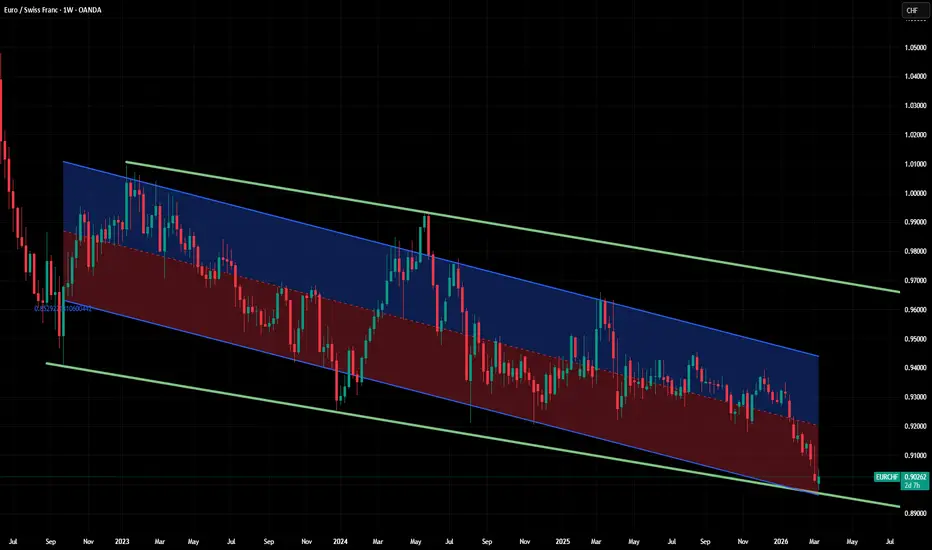
EURCHF fell sharply to the lower line of its weekly trend channel with the start of the Iran war. The decline was driven by pressure from both the euro and the Swiss franc.
The eurozone is vulnerable to disruptions in fossil fuel supply, and this has already weighed on the euro. At the same time, the Swiss franc has appreciated due to safe-haven demand and very low inflation. This combination pushed EURCHF to the lower line of the trend channel, but the same dynamic could also shift momentum in the opposite direction later on.
If the conflict in the Middle East continues for an extended period, the global economy could face stagflation pressure, meaning rising inflation and weaker GDP growth. The eurozone is one of the regions most sensitive to energy price shocks, and the ECB may have to raise rates to keep inflation under control. That decision will depend on whether inflation or growth becomes the bigger concern. But unlike the Fed, the ECB has a mandate more focused on inflation.
On the other hand, Switzerland is still facing very low inflation, and before the Iran war, the possibility of negative rates was already being discussed by analysts. A highly appreciated franc is one of the reasons for such low inflation, and the SNB is not comfortable with that. Both negative rates and franc intervention could be on the table in 2026.
At the moment, fundamentals still support downward momentum in the pair, but future moves by the SNB and ECB could change that dynamic in the coming months.
EURCHF has tested both the lower line of the trend channel from 2022 and the minus two standard deviation level of the regression channel from the same period. This can be seen as a slightly extreme low level, and from a technical perspective, the upside potential now appears stronger. However, if the Iran war turns into a broader and prolonged regional conflict, franc appreciation could continue. The scale of the risks, along with the response of the ECB and SNB, will determine the trend going forward. For now, however, the upside potential toward 0.92 or even 0.96 looks stronger.
The eurozone is vulnerable to disruptions in fossil fuel supply, and this has already weighed on the euro. At the same time, the Swiss franc has appreciated due to safe-haven demand and very low inflation. This combination pushed EURCHF to the lower line of the trend channel, but the same dynamic could also shift momentum in the opposite direction later on.
If the conflict in the Middle East continues for an extended period, the global economy could face stagflation pressure, meaning rising inflation and weaker GDP growth. The eurozone is one of the regions most sensitive to energy price shocks, and the ECB may have to raise rates to keep inflation under control. That decision will depend on whether inflation or growth becomes the bigger concern. But unlike the Fed, the ECB has a mandate more focused on inflation.
On the other hand, Switzerland is still facing very low inflation, and before the Iran war, the possibility of negative rates was already being discussed by analysts. A highly appreciated franc is one of the reasons for such low inflation, and the SNB is not comfortable with that. Both negative rates and franc intervention could be on the table in 2026.
At the moment, fundamentals still support downward momentum in the pair, but future moves by the SNB and ECB could change that dynamic in the coming months.
EURCHF has tested both the lower line of the trend channel from 2022 and the minus two standard deviation level of the regression channel from the same period. This can be seen as a slightly extreme low level, and from a technical perspective, the upside potential now appears stronger. However, if the Iran war turns into a broader and prolonged regional conflict, franc appreciation could continue. The scale of the risks, along with the response of the ECB and SNB, will determine the trend going forward. For now, however, the upside potential toward 0.92 or even 0.96 looks stronger.

Aviso legal
As informações e publicações não se destinam a ser, e não constituem, conselhos ou recomendações financeiras, de investimento, comerciais ou de outro tipo fornecidos ou endossados pela TradingView. Leia mais nos Termos de Uso.
Aviso legal
As informações e publicações não se destinam a ser, e não constituem, conselhos ou recomendações financeiras, de investimento, comerciais ou de outro tipo fornecidos ou endossados pela TradingView. Leia mais nos Termos de Uso.