
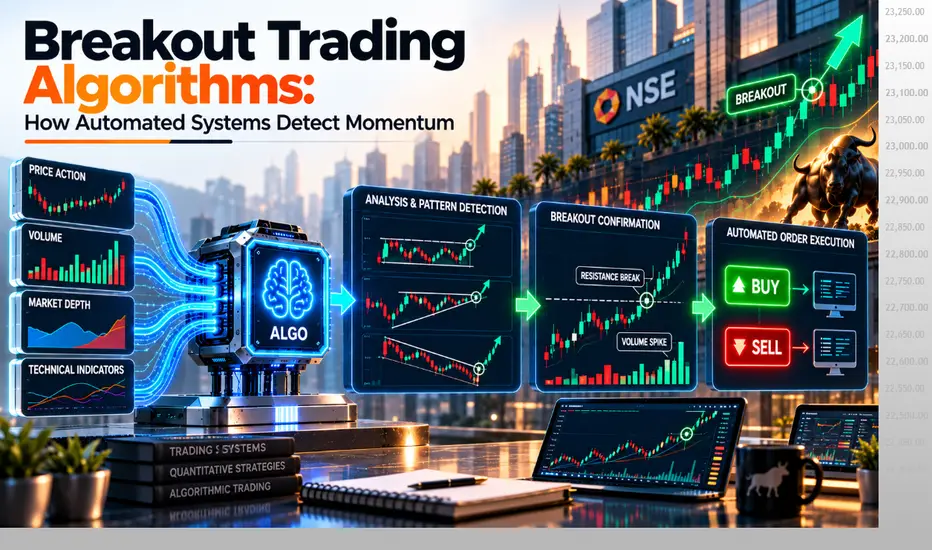
📊 Breakout Trading Algorithms: How Automated Systems Detect Momentum
A breakout algorithm does not simply buy because price moves above resistance.
A better system asks:
**Is this a genuine momentum breakout — or only a temporary spike?**
That is where automation becomes more useful.
---------------------------------
🤖 Step 1: Define the Breakout Level
The algorithm first needs an exact level.
It may use:
• Previous swing high
• Opening range high
• Previous day high
• Consolidation boundary
• Higher-timeframe resistance
For example:
Resistance = Highest High of Previous 20 Candles
Now the computer knows exactly what it is monitoring.
---------------------------------
📈 Step 2: Look for Price Acceptance
Price touching above resistance is not enough.
A stronger breakout may require:
✅ Candle close above resistance
✅ Strong candle body
✅ Close near the candle high
✅ Limited upper wick
✅ Follow-through after breakout
This helps separate:
**Breakout Acceptance**
from:
**Temporary Price Penetration**
---------------------------------
📊 Step 3: Confirm Participation
Momentum becomes more meaningful when volume expands.
A system may require:
**Current Volume > Recent Average Volume**
Why?
Because a breakout with weak participation can fail quickly.
Volume helps the algo determine whether real market interest is supporting the move.
---------------------------------
⚡ Step 4: Detect Momentum Expansion
A strong breakout system may also check:
• Candle range expanding
• ATR increasing
• Price above VWAP
• Higher lows forming
• Relative strength improving
This helps identify the shift from:
**Compression → Expansion**
rather than trading every random breakout candle.
---------------------------------
🎯 Step 5: Check Entry Location
A breakout can be correct...
but the entry can still be poor.
If resistance breaks at 500 and price is already at 515, the move may be too extended.
A good algo can reject trades when:
• Price is too far from breakout
• Stop becomes too wide
• R:R becomes unattractive
Correct direction does not automatically mean good execution.
---------------------------------
🔄 Breakout + Retest Algorithms
Some systems wait for:
**Breakout → Pullback → Retest Hold → Entry**
This can improve:
• Entry location
• False-breakout filtering
• Stop placement
• Risk-to-reward
The algorithm enters only after old resistance begins acting as support.
---------------------------------
⚠️ False Breakout Filters
A breakout may be rejected when:
❌ Large upper wick appears
❌ Price closes back inside the range
❌ Volume remains weak
❌ VWAP fails immediately
❌ Follow-through disappears
The goal is not to trade every breakout.
It is to trade the breakouts showing genuine acceptance.
---------------------------------
📊 For Option Traders
For NIFTY or stock options, the underlying should usually create the directional signal first.
Example:
Underlying:
✅ Resistance breaks
✅ Price above VWAP
✅ Momentum confirms
Then the option engine checks:
• CE / PE selection
• Strike liquidity
• Premium VWAP
• Premium swing breakout
• Spread and volume
**Underlying generates direction.**
**Option premium confirms execution.**
---------------------------------
🛡️ Risk Still Comes Before the Order
Even after a valid signal, the algorithm should check:
• Structural stop
• Position size
• Daily loss limit
• Maximum exposure
• R:R
A breakout signal without risk management is not a complete trading system.
---------------------------------
📊 Simple Formula
Breakout Level + Price Acceptance + Volume Expansion + Momentum + Trend Alignment + Defined Risk
= Higher-Quality Breakout Setup
But:
Level Break + Weak Volume + Rejection + Poor Entry Location
= Possible False Breakout
---------------------------------
📊 Finally, the important point to note is:
A breakout algorithm should not ask only:
“Did price cross resistance?”
It should ask:
**“Did the breakout show enough momentum, participation and structure to deserve capital?”**
That is the real difference between a simple breakout alert and a professional automated momentum system.
---------------------------------
Educational Purpose Only.

⭐For Live Trading Courses And Trading Community 📈
Contact ⬇️
📱wa.me/919322295961
📱t.me/+UgF9lES_XxA0MTk9
⭐Advanced courses
⭐Fully Automated Algo Trading
⭐Daily F&O Trade tips
📱 t.me/+UgF9lES_XxA0MTk9
Contact ⬇️
📱wa.me/919322295961
📱t.me/+UgF9lES_XxA0MTk9
⭐Advanced courses
⭐Fully Automated Algo Trading
⭐Daily F&O Trade tips
📱 t.me/+UgF9lES_XxA0MTk9
Publicações relacionadas
Aviso legal
As informações e publicações não se destinam a ser, e não constituem, conselhos ou recomendações financeiras, de investimento, comerciais ou de outro tipo fornecidos ou endossados pela TradingView. Leia mais nos Termos de Uso.