
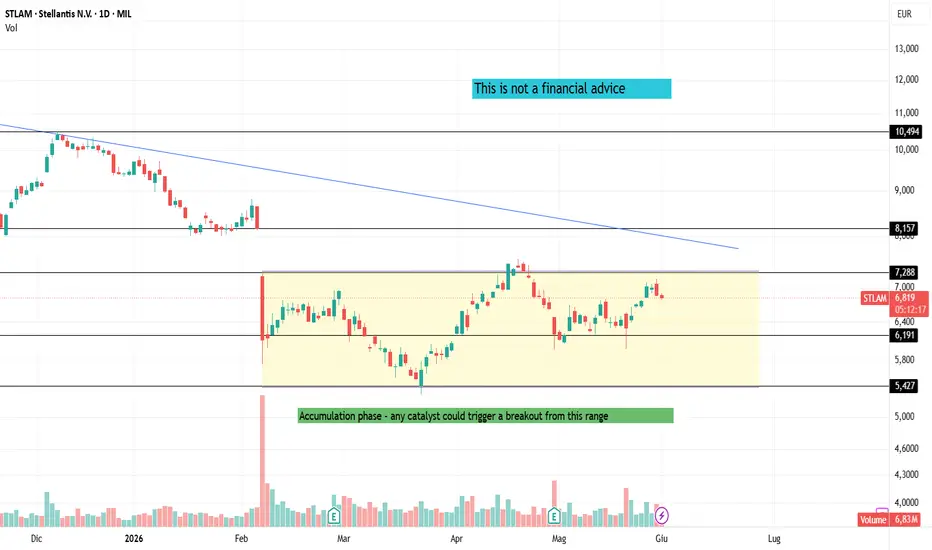
Over the last 24 months, Stellantis has transitioned from a post-pandemic high-margin cycle into a marked deterioration phase in both sales and profitability, as the normalization of industry conditions exposed weaker volumes, margin compression, and increasing pressure across key regions. This combination of declining revenues, lower margins, and negative earnings momentum contributed to a sharp sell-off in early 2026, when the market repriced expectations toward a more conservative cyclical outlook.
Rather than a structural accumulation in the classical sense, the stock has moved into a cyclical consolidation phase, reflecting the transition from peak-cycle profitability to a more normalized and competitive automotive environment, where valuation has been reset in line with weaker short-term fundamentals.
🔎 Macro & Fundamental Context (2024–2025)
2024–2025 was marked by declining revenues and margin compression, particularly in North America and Enlarged Europe due to weaker volumes, pricing pressure and inventory adjustments. The group experienced significant earnings volatility and negative industrial free cash flow in parts of 2025, reflecting restructuring, tariffs and product transition costs.
Despite this, Stellantis maintained a strong liquidity position and continued product pipeline investment, preserving long-term industrial optionality.
📈 Early Signs of Stabilization (2026)
The first quarters of 2026 are starting to show a gradual inflection in fundamentals:
This supports the thesis that Stellantis may be entering a bottoming / early recovery phase within the cycle, although visibility remains limited.
📦 Technical Structure: Consolidation Channel
From a technical perspective, recent price action can be interpreted as a defined consolidation and accumulation range that began around February. During this period, the stock has repeatedly interacted with well-defined support and resistance zones, while gradually exhibiting a compression in volatility following the prior directional expansion phase.
This structure is consistent with a market in equilibrium, where supply from the previous cycle highs is being progressively absorbed rather than aggressively distributed. Momentum has weakened, and price behavior has shifted into a range-bound dynamic characterized by multiple failed breakout attempts and a lack of sustained directional conviction, suggesting a phase of institutional repositioning rather than trend continuation.
⚠️ Catalyst Dependency (Key Structural Element)
Despite early signs of stabilization in fundamentals, a sustained breakout from the current range remains strongly catalyst-dependent.
Potential drivers for a directional expansion include continued improvement in margins across both Europe and North America, stronger-than-expected contribution from new product cycles and platform launches, clearer evidence of demand normalization across key markets, and broader macro tailwinds for the European automotive sector, particularly in relation to interest rates, demand elasticity, and the evolving EV transition.
In the absence of these catalysts, price action is likely to remain confined within the current consolidation structure, characterized by episodic volatility but without a sustained directional breakout.
🧭 Final View
Stellantis is currently positioned within a cyclical consolidation phase that has developed since February, reflecting improving but still incomplete fundamental confirmation.
The market is effectively in a waiting state, where price stability reflects equilibrium rather than conviction, and where the next meaningful directional move will likely require clear external catalysts rather than valuation support alone.
This is not a financial advice, please do your own reserach before make any investment decisions.
Rather than a structural accumulation in the classical sense, the stock has moved into a cyclical consolidation phase, reflecting the transition from peak-cycle profitability to a more normalized and competitive automotive environment, where valuation has been reset in line with weaker short-term fundamentals.
🔎 Macro & Fundamental Context (2024–2025)
2024–2025 was marked by declining revenues and margin compression, particularly in North America and Enlarged Europe due to weaker volumes, pricing pressure and inventory adjustments. The group experienced significant earnings volatility and negative industrial free cash flow in parts of 2025, reflecting restructuring, tariffs and product transition costs.
Despite this, Stellantis maintained a strong liquidity position and continued product pipeline investment, preserving long-term industrial optionality.
📈 Early Signs of Stabilization (2026)
The first quarters of 2026 are starting to show a gradual inflection in fundamentals:
- Revenues returned to growth (+6% YoY in Q1 2026) driven by volume recovery and mix improvement
- Adjusted operating performance improved versus 2025 levels, with positive momentum across multiple regions
- Management confirmed a 2026 improvement trajectory in revenues, margins and industrial cash flow generation
This supports the thesis that Stellantis may be entering a bottoming / early recovery phase within the cycle, although visibility remains limited.
📦 Technical Structure: Consolidation Channel
From a technical perspective, recent price action can be interpreted as a defined consolidation and accumulation range that began around February. During this period, the stock has repeatedly interacted with well-defined support and resistance zones, while gradually exhibiting a compression in volatility following the prior directional expansion phase.
This structure is consistent with a market in equilibrium, where supply from the previous cycle highs is being progressively absorbed rather than aggressively distributed. Momentum has weakened, and price behavior has shifted into a range-bound dynamic characterized by multiple failed breakout attempts and a lack of sustained directional conviction, suggesting a phase of institutional repositioning rather than trend continuation.
⚠️ Catalyst Dependency (Key Structural Element)
Despite early signs of stabilization in fundamentals, a sustained breakout from the current range remains strongly catalyst-dependent.
Potential drivers for a directional expansion include continued improvement in margins across both Europe and North America, stronger-than-expected contribution from new product cycles and platform launches, clearer evidence of demand normalization across key markets, and broader macro tailwinds for the European automotive sector, particularly in relation to interest rates, demand elasticity, and the evolving EV transition.
In the absence of these catalysts, price action is likely to remain confined within the current consolidation structure, characterized by episodic volatility but without a sustained directional breakout.
🧭 Final View
Stellantis is currently positioned within a cyclical consolidation phase that has developed since February, reflecting improving but still incomplete fundamental confirmation.
The market is effectively in a waiting state, where price stability reflects equilibrium rather than conviction, and where the next meaningful directional move will likely require clear external catalysts rather than valuation support alone.
This is not a financial advice, please do your own reserach before make any investment decisions.

Aviso legal
As informações e publicações não se destinam a ser, e não constituem, conselhos ou recomendações financeiras, de investimento, comerciais ou de outro tipo fornecidos ou endossados pela TradingView. Leia mais nos Termos de Uso.
Aviso legal
As informações e publicações não se destinam a ser, e não constituem, conselhos ou recomendações financeiras, de investimento, comerciais ou de outro tipo fornecidos ou endossados pela TradingView. Leia mais nos Termos de Uso.