
Most traders don’t actually have a strategy problem.
They have a separation problem.
They don’t know how to separate what they think from what they do.
And in trading, that difference is everything.
1. Having a Bias Is Normal — Even Necessary
Every time you look at a chart, your brain asks: “What’s more likely to happen next?”
That answer becomes your bias.
Bullish or Bearish.
Without it, you’re not analyzing — you’re just watching candles move.
So let’s be clear:
Having a bias is not a mistake. It’s part of the process.
2. Where It Starts Going Wrong
The problem begins when a simple idea turns into attachment.
You start with:
“I think the market will go down.”
Then it slowly becomes:
“I want the market to go down.”
And without noticing:
“I need the market to go down.”
At that point, you’re no longer reading the market.
You’re defending your opinion.
3. A Bias Costs Nothing. A Trade Costs Money
This is the line most traders blur.
- A bias is just a perspective
- A trade is exposure to risk
- Thinking is free.
- Execution is not.
Opening a trade means:
- You accept uncertainty
- You accept being wrong
- You accept a potential loss
But many traders act as if placing a trade is just “expressing an opinion”.
It isn’t.
It’s a financial decision.
4. Real Example: Silver
Let’s make this practical.
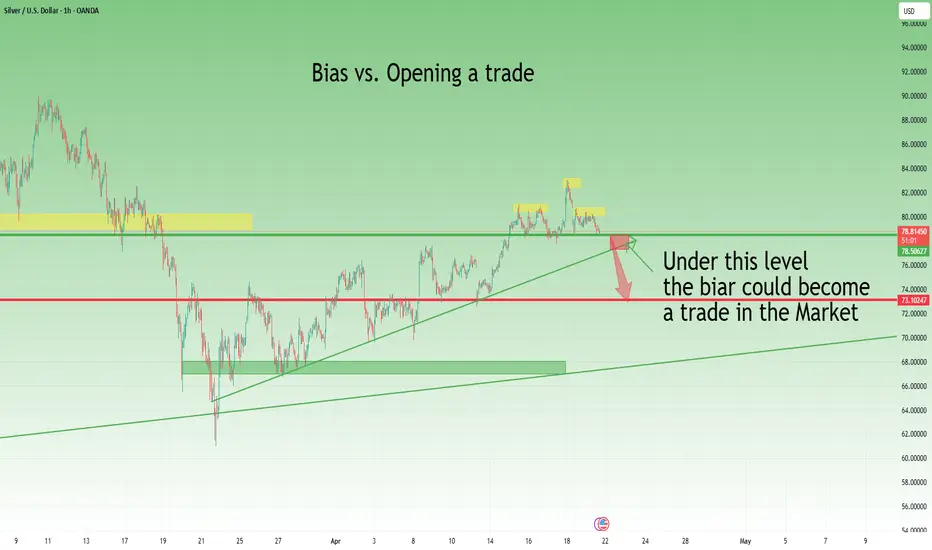
In today's analysis, I stated clearly: My bias on Silver is bearish.
Now the key question: Does that mean I immediately open a sell trade?
No.
A bias is not a trigger.
The Context Matters
Two weeks earlier, I also said: Silver could continue higher, even toward 80, before any real reversal.
What happened next?
Price didn’t stop at 80.
It pushed further — all the way to 83 on Friday.
Now here’s where most traders fail.
They look at this and say: “I was wrong.”
But that’s only true if you acted on it.
5. You’re Only Wrong If You Commit Capital
If you had:
- Sold at 80 with an 82-83 stop
- Ignored structure
- Ignored confirmation
Then yes — you were wrong and you paid for it.
But if your approach was:
- “This is a potential reversal zone”
- “I need confirmation before entering”
- “Until then, I stay out”
Then nothing is wrong.
Because you didn’t trade the idea.
You respected the process.
6. Waiting Is Also a Position
This is uncomfortable for many traders.
They feel like: “If I’m not in a trade, I’m missing something.”
But in reality: Not trading is often the most professional decision you can make.
In the Silver case:
- Bias: bearish
- Market behavior: still above confluence support
- Decision: wait
That’s not hesitation.
That’s discipline.
7. Don’t Trade the Bias. Trade the Confirmation
A bias should guide your attention.
A trade should be triggered by confirmation.
That confirmation can look like:
- Rejection from a key level
- A break of structure
- A clear shift in momentum
Until that happens, your role is simple: Observe, not participate.
8. The Real Reason Traders Lose
Most traders don’t lose because their idea is wrong.
They lose because:
- They are too early
- They force trades
- They can’t stay inactive
In the Silver example, price going to 83 didn’t invalidate the bearish idea.
It only showed one thing: The timing was not there yet, and, especially in these market conditions, the price can spike hard
9. A Simple Question That Changes Everything
Before opening any trade, ask yourself: “Am I trading a setup… or just acting on a bias?”
If you hesitate, you already have your answer.
Wait.
Final Thought:
A bias is a direction.
A trade is a decision.
And the space between them… that’s where discipline lives.
Most traders collapse that space.
Professionals protect it.
They have a separation problem.
They don’t know how to separate what they think from what they do.
And in trading, that difference is everything.
1. Having a Bias Is Normal — Even Necessary
Every time you look at a chart, your brain asks: “What’s more likely to happen next?”
That answer becomes your bias.
Bullish or Bearish.
Without it, you’re not analyzing — you’re just watching candles move.
So let’s be clear:
Having a bias is not a mistake. It’s part of the process.
2. Where It Starts Going Wrong
The problem begins when a simple idea turns into attachment.
You start with:
“I think the market will go down.”
Then it slowly becomes:
“I want the market to go down.”
And without noticing:
“I need the market to go down.”
At that point, you’re no longer reading the market.
You’re defending your opinion.
3. A Bias Costs Nothing. A Trade Costs Money
This is the line most traders blur.
- A bias is just a perspective
- A trade is exposure to risk
- Thinking is free.
- Execution is not.
Opening a trade means:
- You accept uncertainty
- You accept being wrong
- You accept a potential loss
But many traders act as if placing a trade is just “expressing an opinion”.
It isn’t.
It’s a financial decision.
4. Real Example: Silver
Let’s make this practical.
In today's analysis, I stated clearly: My bias on Silver is bearish.
Now the key question: Does that mean I immediately open a sell trade?
No.
A bias is not a trigger.
The Context Matters
Two weeks earlier, I also said: Silver could continue higher, even toward 80, before any real reversal.
What happened next?
Price didn’t stop at 80.
It pushed further — all the way to 83 on Friday.
Now here’s where most traders fail.
They look at this and say: “I was wrong.”
But that’s only true if you acted on it.
5. You’re Only Wrong If You Commit Capital
If you had:
- Sold at 80 with an 82-83 stop
- Ignored structure
- Ignored confirmation
Then yes — you were wrong and you paid for it.
But if your approach was:
- “This is a potential reversal zone”
- “I need confirmation before entering”
- “Until then, I stay out”
Then nothing is wrong.
Because you didn’t trade the idea.
You respected the process.
6. Waiting Is Also a Position
This is uncomfortable for many traders.
They feel like: “If I’m not in a trade, I’m missing something.”
But in reality: Not trading is often the most professional decision you can make.
In the Silver case:
- Bias: bearish
- Market behavior: still above confluence support
- Decision: wait
That’s not hesitation.
That’s discipline.
7. Don’t Trade the Bias. Trade the Confirmation
A bias should guide your attention.
A trade should be triggered by confirmation.
That confirmation can look like:
- Rejection from a key level
- A break of structure
- A clear shift in momentum
Until that happens, your role is simple: Observe, not participate.
8. The Real Reason Traders Lose
Most traders don’t lose because their idea is wrong.
They lose because:
- They are too early
- They force trades
- They can’t stay inactive
In the Silver example, price going to 83 didn’t invalidate the bearish idea.
It only showed one thing: The timing was not there yet, and, especially in these market conditions, the price can spike hard
9. A Simple Question That Changes Everything
Before opening any trade, ask yourself: “Am I trading a setup… or just acting on a bias?”
If you hesitate, you already have your answer.
Wait.
Final Thought:
A bias is a direction.
A trade is a decision.
And the space between them… that’s where discipline lives.
Most traders collapse that space.
Professionals protect it.

🎯 Want More Trading Ideas?
📈 Join the FREE Forex & Gold Channel
👉 t.me/intradaytradingsignals
💎 Join the FREE Crypto Channel
👉 t.me/FanCryptocurrency
📈 Join the FREE Forex & Gold Channel
👉 t.me/intradaytradingsignals
💎 Join the FREE Crypto Channel
👉 t.me/FanCryptocurrency
Publicações relacionadas
Aviso legal
As informações e publicações não se destinam a ser, e não constituem, conselhos ou recomendações financeiras, de investimento, comerciais ou de outro tipo fornecidos ou endossados pela TradingView. Leia mais nos Termos de Uso.
🎯 Want More Trading Ideas?
📈 Join the FREE Forex & Gold Channel
👉 t.me/intradaytradingsignals
💎 Join the FREE Crypto Channel
👉 t.me/FanCryptocurrency
📈 Join the FREE Forex & Gold Channel
👉 t.me/intradaytradingsignals
💎 Join the FREE Crypto Channel
👉 t.me/FanCryptocurrency
Publicações relacionadas
Aviso legal
As informações e publicações não se destinam a ser, e não constituem, conselhos ou recomendações financeiras, de investimento, comerciais ou de outro tipo fornecidos ou endossados pela TradingView. Leia mais nos Termos de Uso.