
Xanadu Quantum Technologies has emerged as a defining player in the commercial quantum computing era, becoming the first pure-play photonic quantum company to go public on both the Nasdaq and Toronto Stock Exchange under the ticker XNDU. Through a business combination with Crane Harbor Acquisition Corp., the firm unlocked critical capital to pursue its ambitious roadmap toward fault-tolerant quantum computing by 2030. Its flagship breakthrough, Aurora, the world's first modular, networked photonic quantum computer, features real-time quantum error correction and has demonstrated twelve logical GKP qubits, validating a scaling architecture that targets one million physical qubits.
Xanadu's photonic architecture offers a distinct macroeconomic advantage in a 2026 environment defined by surging AI energy demand, elevated capital costs, and aging power grids. Operating at room temperature, photonic systems eliminate the costly cryogenic cooling required by superconducting competitors like IBM and Google, positioning Xanadu as a sustainable computing alternative. Strategic partnerships amplify this edge: EV Group provides industrial-scale wafer bonding and hybrid integration for manufacturing scalability, Oak Ridge National Laboratory integrates Xanadu's open-source PennyLane software into the Frontier supercomputer, and Lockheed Martin is jointly developing quantum machine learning models for defense and sensing applications. PennyLane adoption grew 161 percent, creating a powerful developer moat.
The geopolitical backdrop is equally consequential. Global government investment in quantum exceeds $65.9 billion, with the U.S.–China rivalry intensifying as China deploys systems like Jiuzhang 3.0 and Hanyuan-1 alongside a $138 billion National Venture Guidance Fund. Canada's National Quantum Strategy has awarded Xanadu CAD $23 million through the Quantum Champions Program, reducing reliance on volatile foreign capital. Xanadu's intellectual property moat, 50 global patent families spanning squeezed light, Gaussian Boson Sampling, and hybrid resource states, provides durable legal protection against emerging competitors, while supply-chain risks from rare-mineral export controls remain a persistent threat.
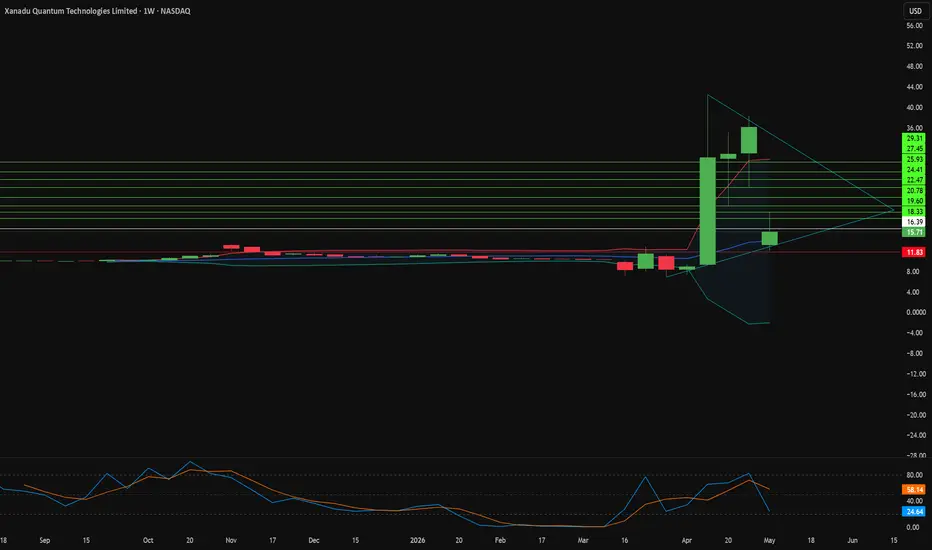
Yet the financial picture is stark. Revenue grew 188 percent to $4.6 million in 2025, but net loss widened to $70.7 million, EPS deteriorated to -$14.29, and cash reserves collapsed from $77.6 million to $16.2 million against an accumulated deficit of $183.3 million. After Nvidia's quantum AI announcement triggered a retail frenzy that drove XNDU up 315 percent to $44.50, a massive S-1 filing to resell roughly 294 million insider shares triggered a 65 percent single-session crash to $13.61, closely aligning with InvestingPro's prior fair-value estimate of $14.93. Analyst sentiment remains split between buy ratings near $45 from Canaccord and Northland, and sell ratings from Weiss. Xanadu offers asymmetric upside through photonic leadership, but execution risk, capital intensity, and a five-to-ten-year horizon to broad commercial advantage keep this firmly in the frontier-tech, high-risk category.
Xanadu's photonic architecture offers a distinct macroeconomic advantage in a 2026 environment defined by surging AI energy demand, elevated capital costs, and aging power grids. Operating at room temperature, photonic systems eliminate the costly cryogenic cooling required by superconducting competitors like IBM and Google, positioning Xanadu as a sustainable computing alternative. Strategic partnerships amplify this edge: EV Group provides industrial-scale wafer bonding and hybrid integration for manufacturing scalability, Oak Ridge National Laboratory integrates Xanadu's open-source PennyLane software into the Frontier supercomputer, and Lockheed Martin is jointly developing quantum machine learning models for defense and sensing applications. PennyLane adoption grew 161 percent, creating a powerful developer moat.
The geopolitical backdrop is equally consequential. Global government investment in quantum exceeds $65.9 billion, with the U.S.–China rivalry intensifying as China deploys systems like Jiuzhang 3.0 and Hanyuan-1 alongside a $138 billion National Venture Guidance Fund. Canada's National Quantum Strategy has awarded Xanadu CAD $23 million through the Quantum Champions Program, reducing reliance on volatile foreign capital. Xanadu's intellectual property moat, 50 global patent families spanning squeezed light, Gaussian Boson Sampling, and hybrid resource states, provides durable legal protection against emerging competitors, while supply-chain risks from rare-mineral export controls remain a persistent threat.
Yet the financial picture is stark. Revenue grew 188 percent to $4.6 million in 2025, but net loss widened to $70.7 million, EPS deteriorated to -$14.29, and cash reserves collapsed from $77.6 million to $16.2 million against an accumulated deficit of $183.3 million. After Nvidia's quantum AI announcement triggered a retail frenzy that drove XNDU up 315 percent to $44.50, a massive S-1 filing to resell roughly 294 million insider shares triggered a 65 percent single-session crash to $13.61, closely aligning with InvestingPro's prior fair-value estimate of $14.93. Analyst sentiment remains split between buy ratings near $45 from Canaccord and Northland, and sell ratings from Weiss. Xanadu offers asymmetric upside through photonic leadership, but execution risk, capital intensity, and a five-to-ten-year horizon to broad commercial advantage keep this firmly in the frontier-tech, high-risk category.

Connecting the dots to Decode the Invisible. This post is a summary. To understand the rigged game, you need the evidence. Access the Full Analysis + Raw Sources (Lab Reports, Patents, Academic Research & Cyber Intel). See the reality here ➜ udisview.com
Aviso legal
As informações e publicações não se destinam a ser, e não constituem, conselhos ou recomendações financeiras, de investimento, comerciais ou de outro tipo fornecidos ou endossados pela TradingView. Leia mais nos Termos de Uso.
Connecting the dots to Decode the Invisible. This post is a summary. To understand the rigged game, you need the evidence. Access the Full Analysis + Raw Sources (Lab Reports, Patents, Academic Research & Cyber Intel). See the reality here ➜ udisview.com
Aviso legal
As informações e publicações não se destinam a ser, e não constituem, conselhos ou recomendações financeiras, de investimento, comerciais ou de outro tipo fornecidos ou endossados pela TradingView. Leia mais nos Termos de Uso.