OPEN-SOURCE SCRIPT
Atualizado [blackcat] L3 Mean Reversion ATR Stop Loss
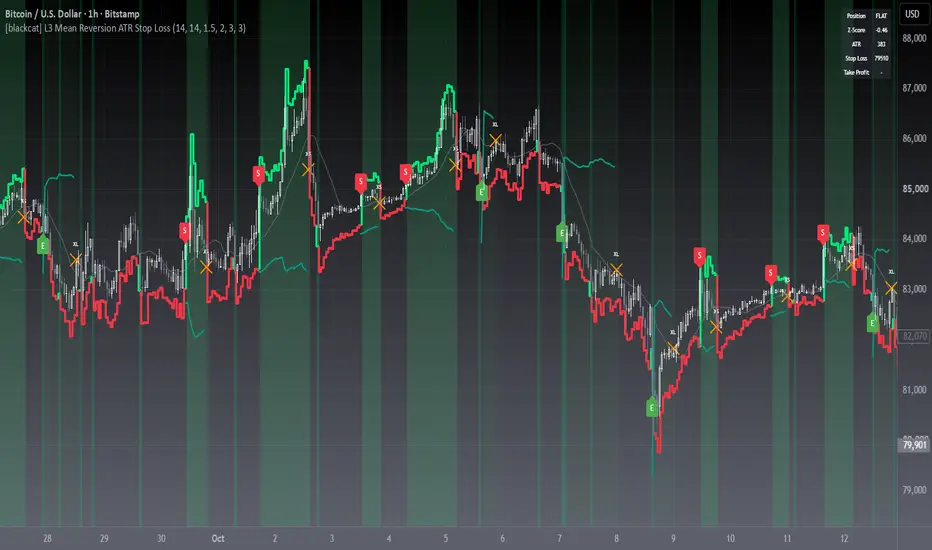
OVERVIEW
The [blackcat] L3 Mean Reversion ATR Stop Loss indicator is meticulously crafted to empower traders by offering statistically-driven stop-loss levels that adapt seamlessly to evolving market dynamics. By harmoniously blending mean reversion concepts with Advanced True Range (ATR) metrics, it delivers a robust framework for managing risks more effectively. 🌐 The primary objective is to furnish traders with intelligent exit points grounded in both short-term volatility assessments and long-term trend evaluations.
Key highlights encompass:
• Dynamic calculation of Z-scores to evaluate deviations from established means
• Adaptive stop-loss pricing leveraging real-time ATR measurements
• Clear visual cues enabling swift decision-making processes
TECHNICAL ANALYSIS COMPONENTS
📉 Z-SCORE CALCULATION
Measures how many standard deviations an asset's current price lies away from its average
Facilitates identification of extreme conditions indicative of impending reversals
Utilizes simple moving averages and standard deviation computations
📊 STANDARD DEVIATION MEASUREMENT
Quantifies dispersion of closing prices around the mean
Provides insights into underlying price distribution characteristics
Crucial for assessing potential volatility levels accurately
🕵️♂️ ADAPTIVE STOP-LOSS DETECTION
Employs ATR as a proxy for prevailing market volatility
Modulates stop-loss placements dynamically responding to shifting trends
Ensures consistent adherence to predetermined risk management protocols
INDICATOR FUNCTIONALITY
🔢 Core Algorithms
Integrate Smooth Moving Averages (SMAs) alongside standardized deviation formulas
Generate precise Z-scores reflecting true price deviations
Leverage ATR-derived multipliers for fine-grained stop-loss adjustments
🖱️ User Interface Elements
Interactive plots displaying real-time stop-loss markers
Context-sensitive color coding enhancing readability
Background shading indicating proximity to stop-level activations
STRATEGY IMPLEMENTATION
✅ Entry Conditions
Confirm bullish/bearish setups validated through multiple confirmatory signals
Ensure alignment between Z-score readings and broader trend directions
Validate entry decisions considering concurrent market sentiment factors
🚫 Exit Mechanisms
Trigger exits upon hitting predefined ATR-based stop-loss thresholds
Monitor continuous breaches signifying potential trend reversals
Execute partial/total closes contingent upon cumulative loss limits
PARAMETER CONFIGURATIONS
🎯 Optimization Guidelines
Period Length: Governs responsiveness versus smoothing trade-offs
ATR Length: Dictates the temporal scope for volatility analysis
Stop Loss ATR Multiplier: Tunes sensitivity towards stop-trigger activations
💬 Customization Recommendations
Commence with baseline defaults; iteratively refine parameters
Evaluate impacts independently prior to combined adjustments
Prioritize minimizing erroneous trigger occurrences first
Sustain balanced risk-reward profiles irrespective of chosen settings
ADVANCED RISK MANAGEMENT
🛡️ Proactive Risk Mitigation Techniques
Enforce strict compliance with pre-defined maximum leverage constraints
Mandatorily apply trailing stop-loss orders conforming to script outputs
Allocate positions proportionately relative to available capital reserves
Conduct periodic reviews gauging strategy effectiveness rigorously
⚠️ Potential Pitfalls & Solutions
Address frequent violations arising during heightened volatility phases
Manage false alerts warranting manual interventions judiciously
Prepare contingency plans mitigating margin call possibilities
Continuously assess automated system reliability amidst fluctuating conditions
PERFORMANCE AUDITS & REFINEMENTS
🔍 Critical Evaluation Metrics
Assess win percentages consistently across diverse trading instruments
Calculate average profit ratios per successful execution
Measure peak drawdown durations alongside associated magnitudes
Analyze signal generation frequencies revealing hidden patterns
📈 Historical Data Analysis Tools
Maintain comprehensive records capturing every triggered event
Compare realized profits/losses against backtested simulations
Identify recurrent systematic errors demanding corrective actions
Implement iterative refinements bolstering overall efficacy steadily
PROBLEM SOLVING ADVICE
🔧 Frequent Encountered Challenges
Unpredictable behaviors emerging within thinly traded markets
Latency issues manifesting during abrupt price fluctuations
Overfitted models yielding suboptimal results post-extensive tuning
Inaccuracies stemming from incomplete or delayed data inputs
💡 Effective Resolution Pathways
Exclude low-liquidity assets prone to erratic movements
Introduce buffer intervals safeguarding major news/event impacts
Limit ongoing optimization attempts preventing model degradation
Verify seamless connectivity ensuring uninterrupted data flows
USER ENGAGEMENT SEGMENT
🤝 Community Contributions Welcome
Highly encourage active participation sharing experiences & recommendations!
THANKS
A heartfelt acknowledgment extends to all developers contributing invaluable insights about adaptive stop-loss strategies using statistical measures! ✨
Notas de Lançamento
█ OVERVIEWBlackcat L3 Mean Reversion ATR Stop Loss is a mean-reversion signal system that times entries from statistical price stretch and manages risk with volatility-scaled stops. It turns the classic Z-score framework into a complete long/short workflow with exits, a take-profit reference, alerts, and an on-chart dashboard.
█ CONCEPTS
The script measures how far price has stretched from its moving average in standard-deviation units (Z-score), then waits for the stretch to normalize:
• Oversold Reversion: long entries when the Z-score falls to or below the entry threshold (default -2.0)
• Overbought Reversion: short entries when the Z-score rises to or above the threshold (default +2.0)
• Mean Touch Exit: a position closes once the Z-score returns to zero, meaning price is back at its average
• ATR Stop Loss: a step line drawn one volatility band (default 1.5 x ATR) from the previous close, mirrored for short setups
• Signal Governance: a position state machine with entry edge detection, same-bar entry/exit arbitration, and a configurable cooldown window to prevent signal spam in choppy conditions
█ HOW TO USE
1 — Add the script to a chart; defaults work out of the box (14-period lookback, 2.0 Z threshold).
2 — Tune the Z-Score Entry Threshold to control sensitivity: lower values trade more often, higher values trade only extreme stretches.
3 — Set the Stop Loss ATR Multiplier and Take Profit (xATR) to match the volatility of your market.
4 — Read signals from the chart labels and the top-right dashboard; create alerts from the alert dialog.
Input Parameters
• Period Length: lookback for the average and deviation, default 14
• ATR Length: lookback for volatility measurements, default 14
• Stop Loss ATR Multiplier: stop distance in ATR units, default 1.5
• Z-Score Entry Threshold: stretch required to enter, default 2.0
• Enable Short Signals: turn off for long-only markets, default on
• Same-bar Entry/Exit Exclusivity: exit-first arbitration, default on
• Cooldown Bars: minimum bars between signals, default 3 (0 disables)
• Take Profit (xATR): target distance in ATR units, default 3.0
• Show Take Profit Level, Show SMA, Show Position Background, Show Dashboard: display toggles
█ FEATURES
• Symmetric long/short mean-reversion engine with position state tracking
• Volatility-scaled stop-loss line and take-profit reference level
• Label-based signal tags, position background shading, and a status dashboard
• Four dedicated alert conditions plus a combined bar-close alert
• All risk and display options are toggleable; the V1 stop line behavior is preserved
█ SIGNALS
Visual Elements
• Green "E" label: long entry (Z-score at or below the negative threshold)
• Red "S" label: short entry (Z-score at or above the positive threshold)
• Orange "XL" / "XS" cross: long / short exit when the Z-score returns to zero
• Lime/red step line: ATR stop-loss price, colored by the original risk rule
• Teal line: take-profit reference anchored to the entry price
• Green/red background: active long / short position state
• Dashboard: position, Z-score, ATR, stop and target values
█ IMPLEMENTATION NOTES
Open-source Pine v6. Built on ta.sma, ta.stdev, and ta.atr; the Z-score is guarded against zero deviation and missing data. Signals evaluate on confirmed bars and alerts use once-per-bar-close frequency, so notifications match the chart. The stop line keeps the original V1 formula (previous close minus multiplier x ATR) and mirrors it for short states.
█ LIMITATIONS
• Mean reversion works best in ranging markets; in strong trends the Z-score can stay stretched and trigger early counter-trend entries
• The stop and target lines are references, not automated orders; sizing and execution remain the trader's responsibility
• Not recommended on very low timeframes where noise dominates the Z-score
█ NOTES
• V2 is a fully backward-compatible upgrade of the V1 stop-loss study: same core calculation and default look, extended into a complete signal system
• Use and modify freely; attribution appreciated
═════════════════════════════════════════════════════════════════════════
For questions or feedback, use the comments section below.
Script de código aberto
Em verdadeiro espírito do TradingView, o criador deste script o tornou de código aberto, para que os traders possam revisar e verificar sua funcionalidade. Parabéns ao autor! Embora você possa usá-lo gratuitamente, lembre-se de que a republicação do código está sujeita às nossas Regras da Casa.

Don't miss out! The first and most important thing to do is to join my Discord chat now! Click here to start your adventure: discord.com/invite/ZTGpQJq My new github for more pine development soon: github.com/wxt-coder
Aviso legal
As informações e publicações não se destinam a ser, e não constituem, conselhos ou recomendações financeiras, de investimento, comerciais ou de outro tipo fornecidos ou endossados pela TradingView. Leia mais nos Termos de Uso.
Script de código aberto
Em verdadeiro espírito do TradingView, o criador deste script o tornou de código aberto, para que os traders possam revisar e verificar sua funcionalidade. Parabéns ao autor! Embora você possa usá-lo gratuitamente, lembre-se de que a republicação do código está sujeita às nossas Regras da Casa.
Don't miss out! The first and most important thing to do is to join my Discord chat now! Click here to start your adventure: discord.com/invite/ZTGpQJq My new github for more pine development soon: github.com/wxt-coder
Aviso legal
As informações e publicações não se destinam a ser, e não constituem, conselhos ou recomendações financeiras, de investimento, comerciais ou de outro tipo fornecidos ou endossados pela TradingView. Leia mais nos Termos de Uso.