Price Volume Divergence Momentum (PVDM)
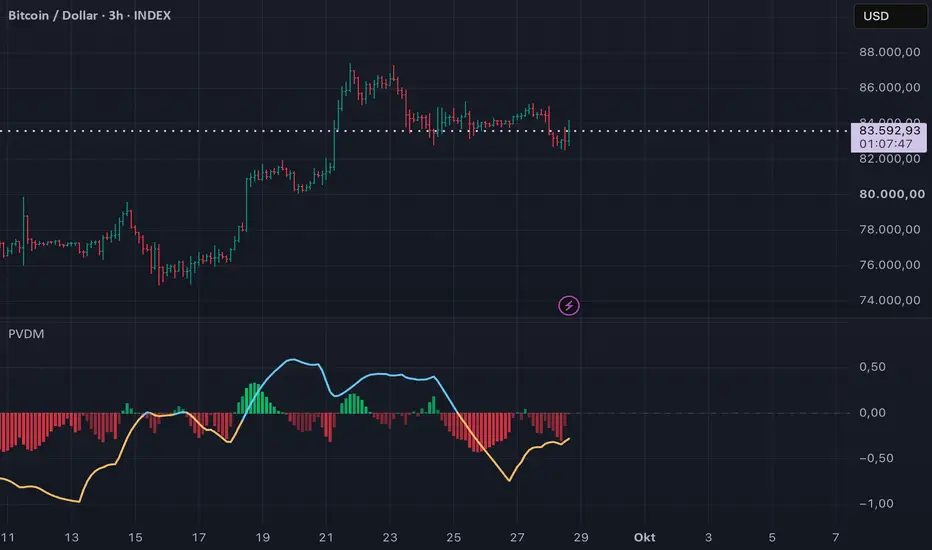
Price Volume Divergence Momentum (PVDM)
Overview
PVDM is an open-source price-volume indicator designed to show two related aspects of the PVD process: current momentum and remaining pressure reserve.
The distinction is important. A market can be moving strongly while its underlying reserve is already weakening, or it can show modest movement while pressure is still being stored.
PVDM is the dynamics layer of the PVD Ecosystem. Its role is to describe how the price-volume process is moving and how much pressure remains behind that movement.
What it shows
PVDM is displayed in a separate pane.
It contains two main elements:
• Momentum histogram — shows the current movement in the PVD process.
• Pressure Reserve line — shows the direction and amount of stored pressure behind that movement.
A simple analogy is a balloon:
• the histogram describes whether air is currently flowing in or out;
• the reserve line describes how much pressure remains stored inside.
How to use it
PVDM can help distinguish between visible movement and underlying reserve.
Useful observations include:
• momentum and reserve strengthening together;
• momentum continuing while reserve fades;
• reserve building before momentum becomes more visible;
• momentum changing while reserve remains on the opposite side.
These relationships can provide context about the quality and durability of a move, but they are not automatic trade instructions.
Optional smoothing can be used to reduce visual noise in the histogram or reserve line.
Role in the PVD Ecosystem
PVDM answers the question:
How is the current price-volume process moving, and how much pressure remains behind it?
Its role is specifically momentum and reserve. It does not try to replace state classification or forward projection.
Originality
PVDM uses an original implementation built around changes in the normalized PVD process, adaptive memory, momentum quality, and a separately maintained pressure-reserve state.
The reserve is not simply another moving average of the histogram. It represents stored pressure derived from the evolving PVD process and is scaled so it can be interpreted alongside momentum.
The script is published open source so users can inspect and understand how the indicator is constructed.
Limitations
PVDM does not forecast certain future prices and does not provide guaranteed entry or exit signals.
Momentum can reverse quickly, and stored pressure does not guarantee that price will move in the same direction or within a specific time.
Results depend on the quality of price and volume data and can vary significantly across symbols, exchanges, and timeframes.
PVDM should be used together with market context, independent judgment, and appropriate risk management.

Aviso legal
As informações e publicações não se destinam a ser, e não constituem, conselhos ou recomendações financeiras, de investimento, comerciais ou de outro tipo fornecidos ou endossados pela TradingView. Leia mais nos Termos de Uso.
Aviso legal
As informações e publicações não se destinam a ser, e não constituem, conselhos ou recomendações financeiras, de investimento, comerciais ou de outro tipo fornecidos ou endossados pela TradingView. Leia mais nos Termos de Uso.