Open Legacy Official
Open Legacy Official
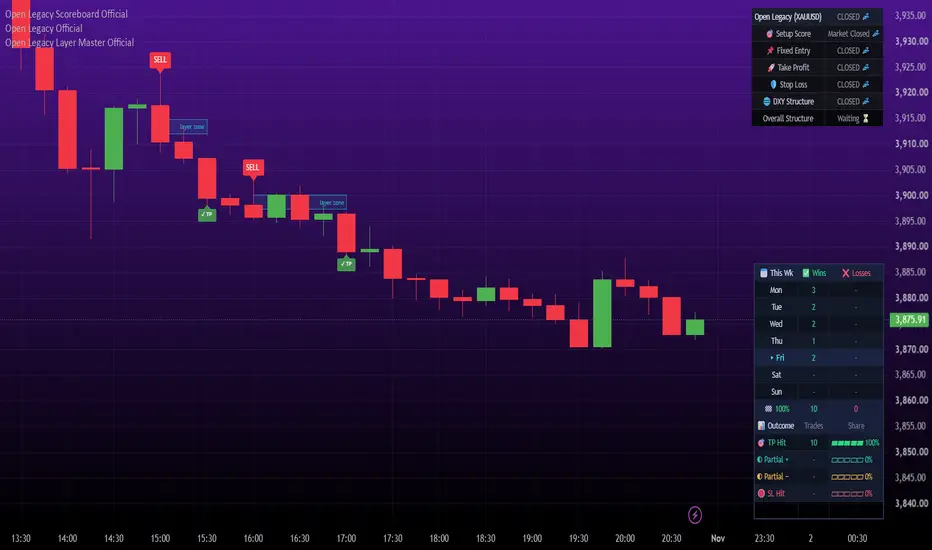
Open Legacy gives you a clear trade plan on your chart. When a setup is confirmed, it draws one fixed Entry, one Take Profit and one Stop Loss, then follows that trade until it finishes. The levels never move, so you always know exactly where you stand.
How it finds a setup
You choose one of two entry styles:
- FVG Pullback: waits for a recent fair value gap, then looks for price to pull back into it.
- EMA Trend: follows the trend using a fast and a slow moving average.
Then choose how strict it should be (Sensitivity):
- Aggressive: more signals.
- Balanced: a good everyday starting point. The close must sit on the right side of the 50 EMA.
- Conservative: fewer, filtered signals. It also needs the bigger trend (a chart 4x your timeframe) and trend strength (ADX of at least 20) to agree.
Getting set up
1. Add it to a chart and pick an Entry Method. Start with Balanced.
2. Enter your Stop Loss and Take Profit in pips. Points Per Pip is 10 for most pairs. Try a wider stop than target, and adjust later.
3. Set your sessions. You get up to 8, each with its own hours and days. Leave them all unticked to run at all times. Check that the Timezone matches the hours you typed.
4. Create an alert with "Any alert() function call" to be told when a trade starts. The message includes the pair, side, entry, TP and SL.
Reading the panel
The panel shows the trade status, Setup Score, Entry, TP and SL, plus context rows for the dollar-index backdrop and overall structure. Setup Score shows how much of the distance between your stop and target is left. It is not a chance of winning.
Good to know
- Signals are confirmed when a candle closes, so the entry is the close price. Real fills can differ by spread and slippage.
- One trade runs at a time. A signal in the same direction is ignored, and an opposite signal ends the trade and starts a new one.
- Higher-timeframe data uses the previous closed candle, so it never looks ahead.
- Please use standard candles. Heikin Ashi, Renko, Kagi, point and figure, line break and range charts are not suitable.
Tip: pair it with Open Legacy Scoreboard Official to see how your settings behave on history before you rely on them, and Open Legacy Layer Master Official if you use layering. Each one also works alone.
This is a charting tool, not investment advice. Trading carries risk of loss, and nothing here predicts future results.

Aviso legal
As informações e publicações não se destinam a ser, e não constituem, conselhos ou recomendações financeiras, de investimento, comerciais ou de outro tipo fornecidos ou endossados pela TradingView. Leia mais nos Termos de Uso.
Aviso legal
As informações e publicações não se destinam a ser, e não constituem, conselhos ou recomendações financeiras, de investimento, comerciais ou de outro tipo fornecidos ou endossados pela TradingView. Leia mais nos Termos de Uso.