OPEN-SOURCE SCRIPT
Atualizado Opening Pullback Planner [AGPro Series]
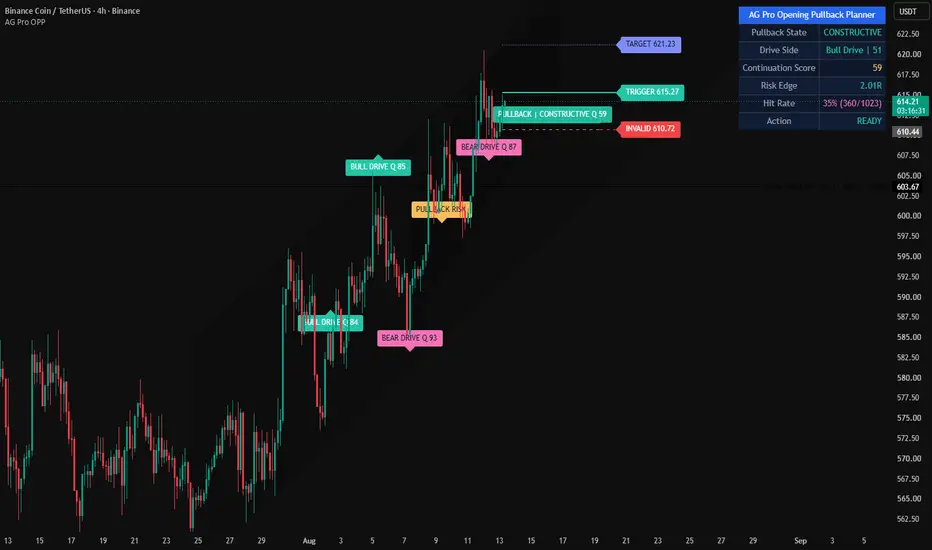
Opening Pullback Planner [AGPro Series]
🧠 Core Idea
Is the first pullback after the open constructive, failing, or too stale to plan around?
📌 Overview / What it does
Opening Pullback Planner is a session pullback decision tool built around the first meaningful retracement after the opening drive. Instead of treating the open as only a breakout moment, it waits for the drive reference to lock, then maps the pullback area where continuation quality can be evaluated.
The script produces an opening pullback box, continuation trigger, failure line, target-room guide, 0-100 continuation score, risk-edge reading, compact event labels, alerts, and a clean AG Pro planning panel.
It does not predict price direction, automate trades, or mark every opening range breakout. Its purpose is to organize the pullback phase after the opening drive so traders can judge whether the first reset is constructive, failing, invalidated, or no longer worth attention.
🎯 Purpose & Design Philosophy
Many session tools focus on the first opening break, the opening range, or the first impulse. The problem is that a strong open often becomes difficult to plan only after price pulls back.
Opening Pullback Planner was built to fill that gap. It helps traders who study intraday continuation, first-pullback behavior, session execution, and risk-defined planning after the initial move.
The design philosophy is simple: lock the opening drive, map the first pullback box, evaluate recovery quality, define the failure line, and keep the next action readable without turning the chart into a crowded signal board.
⚡ Why This Script Is Different
Most tools focus on opening range breakouts, first-drive strength, fixed session boxes, or generic pullback signals.
This script does NOT clone Opening Drive Quality, does NOT act as an ORB breakout tool, and does NOT draw generic support/resistance zones.
Instead, it focuses on the first pullback after the opening drive. It asks whether the pullback is deep enough to matter, shallow enough to preserve structure, recovering with acceptable close quality, holding a measurable failure line, and offering enough target room for continued review.
⚙️ Methodology
1. Context Detection
The script builds an opening reference from either a fixed session window or the first bars of the day. This creates the drive structure that the pullback plan will use.
2. Reference Mapping
After the opening reference locks, the script maps a drive-native pullback box, continuation trigger, failure line, and target-room guide.
3. Reaction Evaluation
The engine evaluates pullback depth, close recovery, relative volume, volatility fit, room-to-risk, and drive quality to create a 0-100 continuation score.
4. Visual Output
The chart shows the pullback box with centered text, continuation and failure references, target-room guide, compact event labels, optional markers, and the AG Pro panel.
🗺️ How to Read the Chart
Opening Pullback Box = the first pullback review area derived from the locked opening drive.
Continuation Trigger = the level price must reclaim or break after the pullback for continuation context to strengthen.
Failure Line = the invalidation reference where the active pullback plan loses structural integrity.
Target Guide = a projected target-room reference based on the opening drive range.
Labels = event markers for drive retain, pullback test, constructive recovery, trigger readiness, pullback risk, failure line, stale plan, and target check.
Colors = teal for bullish continuation context, pink for bearish or invalid context, amber for caution, and indigo for structural emphasis.
Panel = the decision layer showing Pullback State, Drive Side, Continuation Score, Risk Edge, and Action.
🚦 Signals & States
• DRIVE RETAIN → the opening drive quality is strong enough to map a pullback plan.
• PULLBACK TEST → price has entered the opening pullback box.
• CONSTRUCTIVE → pullback depth and recovery quality are acceptable inside the model.
• TRIGGER READY → price has moved through the continuation trigger after a valid pullback.
• PULLBACK RISK → the pullback is becoming too deep, slow, or weak for clean continuation review.
• FAILURE LINE → the active pullback plan has lost structural integrity.
• PULLBACK STALE → the first pullback plan did not resolve inside the review window.
• TARGET CHECK → price reached the projected target-room guide.
🔔 Alerts Logic
The script includes alerts for:
• Opening Pullback Plan Armed → a qualified opening drive mapped the first pullback plan.
• Opening Pullback Test → price is testing the pullback box.
• Constructive Opening Pullback → the pullback is recovering constructively.
• Opening Pullback Continuation Trigger → the continuation trigger is active after the pullback.
• Opening Pullback Failure Line Broken → the plan has broken its failure reference.
• Opening Pullback Plan Expired → the first pullback plan became stale before confirmation.
• Opening Pullback Target Check → price reached the target-room guide.
Alerts are attention markers. They are not trade instructions.
🧩 Confluence Logic
The context becomes stronger when the opening drive has acceptable quality, the first pullback reaches the planned box without violating the failure line, recovery closes improve, volume does not collapse during recovery, and target room remains clean.
The context becomes weaker when the pullback is too deep, recovery is poor, the plan takes too long to resolve, or price violates the failure line.
📊 When to Use
• Intraday session planning after the opening move.
• First-pullback continuation review.
• Daily chart review when the higher-timeframe fallback is enabled.
• Markets where the opening drive often creates a useful early reference.
• Stocks, indices, futures, crypto, or FX charts where the selected opening session is meaningful.
• Review workflows where risk edge and target room need to be visible.
⚠️ When NOT to Use
• Very low-liquidity markets.
• Extremely noisy opens with unstable spreads.
• News-driven bars that distort the opening reference.
• Higher timeframes where session pullback structure is not meaningful.
• Markets where the selected opening window does not represent real participation.
🎛️ Key Inputs
• Opening Reference Mode → chooses between a fixed session window and first bars of day.
• Opening Drive Window → defines the drive reference used before pullback mapping begins.
• Higher Timeframe Fallback → keeps daily, weekly, and monthly charts visually useful by mapping broader opening references.
• Sensitivity → adjusts how strict the planner is with pullback recovery and score requirements.
• Constructive Score Threshold → controls when constructive pullback labels can appear.
• Pullback Box Shallow / Ideal / Deep → define the preferred retracement area.
• Continuation Trigger Buffer ATR → adjusts the trigger line beyond the drive extreme.
• Failure Line Buffer ATR → adjusts the invalidation reference beyond the pullback box.
• Target Guide Range Multiple → controls the projected target-room guide.
• Visual settings → control box, lines, labels, markers, projection, label limits, and font size.
• Panel settings → control panel visibility, location, theme, and font size.
🖥️ Interface & Visual Design
The interface is chart-first and decision-focused. The main visual object is one opening pullback box with centered state text, supported by a continuation trigger, failure line, and target guide.
The panel follows the AGPro public-release standard with one merged blue header row containing only the script name. The five panel rows are Pullback State, Drive Side, Continuation Score, Risk Edge, and Action.
Labels are compact, capped, and offset away from candles so the chart stays active without becoming crowded.
🧪 Practical Usage Workflow
1. Let the opening reference lock.
2. Read the panel to see whether the drive retained enough quality.
3. Watch whether price tests the opening pullback box.
4. Evaluate the continuation score, recovery state, risk edge, and failure line.
5. Treat alerts and labels as review prompts, not instructions.
🔍 Interpretation Guidelines
A strong continuation score means the pullback is controlled, recovering cleanly, preserving the failure line, and keeping useful room to the projected target guide.
A constructive label means the first pullback is behaving better inside the model. It does not mean continuation must occur.
A failure-line label means the plan has lost the structure it needed for this specific pullback framework.
The best use comes from combining the panel state with broader market context, liquidity, volatility, higher-timeframe structure, and personal risk rules.
🚫 What This Script Is NOT
• Not a prediction engine.
• Not financial advice.
• Not auto trading.
• Not guaranteed signals.
• Not a generic support/resistance map.
• Not an order block or FVG scanner.
• Not an Opening Drive Quality clone.
• Not a full opening range breakout system.
⚠️ Limitations & Transparency
Timeframe selection affects the opening reference and the pullback box. A 5-minute chart and a 15-minute chart can produce different plans.
Session definitions matter. The selected opening window should match the asset and market being studied.
Higher-timeframe fallback mode is a broader chart-reference layer. It should be read as a weekly, monthly, or yearly opening-pullback framework rather than a literal intraday open.
Volatility changes can expand or compress risk, target, and pullback behavior.
Low liquidity, abnormal spreads, and high-impact news can reduce the usefulness of any opening pullback model.
🧠 Market Context Notes
The first pullback after the open can be useful because it tests whether the opening move still has sponsorship. A shallow pullback may show strength but offer limited risk clarity. A deep pullback may offer a better reset but also higher failure risk.
This script keeps that decision visible by separating drive retention, pullback quality, continuation trigger, failure line, and target room.
🧾 Use Case Examples
When price locks a bullish opening drive, pulls back into the mapped box, holds above the failure line, and recovers toward the continuation trigger, the panel may shift toward a constructive or ready state.
When price enters the pullback box but keeps closing weakly or pushes beyond the deep boundary, the planner may mark pullback risk.
When price breaks the failure line, the opening pullback plan is no longer structurally intact inside this model.
🧱 System Philosophy
Opening Pullback Planner follows the AGPro Series decision-engine approach: a script should help the trader evaluate validity, strength, risk, target room, and next action instead of only printing another signal.
The tool is built to make one session behavior easier to read: the first pullback after the opening drive.
🔐 Non-Promise Statement
No script can provide certainty.
No opening pullback model can guarantee continuation, reversal, or profitability.
This script provides structured context only.
📉 Risk Disclosure
Trading involves risk.
Users are responsible for their own decisions.
This script does not provide financial advice, investment advice, or guaranteed trading outcomes.
📚 Educational Note
Use this script as an educational planning and visualization tool. The strongest use comes from reading the first opening pullback together with broader market structure, liquidity, volatility, and personal risk rules.
🧠 Core Idea
Is the first pullback after the open constructive, failing, or too stale to plan around?
📌 Overview / What it does
Opening Pullback Planner is a session pullback decision tool built around the first meaningful retracement after the opening drive. Instead of treating the open as only a breakout moment, it waits for the drive reference to lock, then maps the pullback area where continuation quality can be evaluated.
The script produces an opening pullback box, continuation trigger, failure line, target-room guide, 0-100 continuation score, risk-edge reading, compact event labels, alerts, and a clean AG Pro planning panel.
It does not predict price direction, automate trades, or mark every opening range breakout. Its purpose is to organize the pullback phase after the opening drive so traders can judge whether the first reset is constructive, failing, invalidated, or no longer worth attention.
🎯 Purpose & Design Philosophy
Many session tools focus on the first opening break, the opening range, or the first impulse. The problem is that a strong open often becomes difficult to plan only after price pulls back.
Opening Pullback Planner was built to fill that gap. It helps traders who study intraday continuation, first-pullback behavior, session execution, and risk-defined planning after the initial move.
The design philosophy is simple: lock the opening drive, map the first pullback box, evaluate recovery quality, define the failure line, and keep the next action readable without turning the chart into a crowded signal board.
⚡ Why This Script Is Different
Most tools focus on opening range breakouts, first-drive strength, fixed session boxes, or generic pullback signals.
This script does NOT clone Opening Drive Quality, does NOT act as an ORB breakout tool, and does NOT draw generic support/resistance zones.
Instead, it focuses on the first pullback after the opening drive. It asks whether the pullback is deep enough to matter, shallow enough to preserve structure, recovering with acceptable close quality, holding a measurable failure line, and offering enough target room for continued review.
⚙️ Methodology
1. Context Detection
The script builds an opening reference from either a fixed session window or the first bars of the day. This creates the drive structure that the pullback plan will use.
2. Reference Mapping
After the opening reference locks, the script maps a drive-native pullback box, continuation trigger, failure line, and target-room guide.
3. Reaction Evaluation
The engine evaluates pullback depth, close recovery, relative volume, volatility fit, room-to-risk, and drive quality to create a 0-100 continuation score.
4. Visual Output
The chart shows the pullback box with centered text, continuation and failure references, target-room guide, compact event labels, optional markers, and the AG Pro panel.
🗺️ How to Read the Chart
Opening Pullback Box = the first pullback review area derived from the locked opening drive.
Continuation Trigger = the level price must reclaim or break after the pullback for continuation context to strengthen.
Failure Line = the invalidation reference where the active pullback plan loses structural integrity.
Target Guide = a projected target-room reference based on the opening drive range.
Labels = event markers for drive retain, pullback test, constructive recovery, trigger readiness, pullback risk, failure line, stale plan, and target check.
Colors = teal for bullish continuation context, pink for bearish or invalid context, amber for caution, and indigo for structural emphasis.
Panel = the decision layer showing Pullback State, Drive Side, Continuation Score, Risk Edge, and Action.
🚦 Signals & States
• DRIVE RETAIN → the opening drive quality is strong enough to map a pullback plan.
• PULLBACK TEST → price has entered the opening pullback box.
• CONSTRUCTIVE → pullback depth and recovery quality are acceptable inside the model.
• TRIGGER READY → price has moved through the continuation trigger after a valid pullback.
• PULLBACK RISK → the pullback is becoming too deep, slow, or weak for clean continuation review.
• FAILURE LINE → the active pullback plan has lost structural integrity.
• PULLBACK STALE → the first pullback plan did not resolve inside the review window.
• TARGET CHECK → price reached the projected target-room guide.
🔔 Alerts Logic
The script includes alerts for:
• Opening Pullback Plan Armed → a qualified opening drive mapped the first pullback plan.
• Opening Pullback Test → price is testing the pullback box.
• Constructive Opening Pullback → the pullback is recovering constructively.
• Opening Pullback Continuation Trigger → the continuation trigger is active after the pullback.
• Opening Pullback Failure Line Broken → the plan has broken its failure reference.
• Opening Pullback Plan Expired → the first pullback plan became stale before confirmation.
• Opening Pullback Target Check → price reached the target-room guide.
Alerts are attention markers. They are not trade instructions.
🧩 Confluence Logic
The context becomes stronger when the opening drive has acceptable quality, the first pullback reaches the planned box without violating the failure line, recovery closes improve, volume does not collapse during recovery, and target room remains clean.
The context becomes weaker when the pullback is too deep, recovery is poor, the plan takes too long to resolve, or price violates the failure line.
📊 When to Use
• Intraday session planning after the opening move.
• First-pullback continuation review.
• Daily chart review when the higher-timeframe fallback is enabled.
• Markets where the opening drive often creates a useful early reference.
• Stocks, indices, futures, crypto, or FX charts where the selected opening session is meaningful.
• Review workflows where risk edge and target room need to be visible.
⚠️ When NOT to Use
• Very low-liquidity markets.
• Extremely noisy opens with unstable spreads.
• News-driven bars that distort the opening reference.
• Higher timeframes where session pullback structure is not meaningful.
• Markets where the selected opening window does not represent real participation.
🎛️ Key Inputs
• Opening Reference Mode → chooses between a fixed session window and first bars of day.
• Opening Drive Window → defines the drive reference used before pullback mapping begins.
• Higher Timeframe Fallback → keeps daily, weekly, and monthly charts visually useful by mapping broader opening references.
• Sensitivity → adjusts how strict the planner is with pullback recovery and score requirements.
• Constructive Score Threshold → controls when constructive pullback labels can appear.
• Pullback Box Shallow / Ideal / Deep → define the preferred retracement area.
• Continuation Trigger Buffer ATR → adjusts the trigger line beyond the drive extreme.
• Failure Line Buffer ATR → adjusts the invalidation reference beyond the pullback box.
• Target Guide Range Multiple → controls the projected target-room guide.
• Visual settings → control box, lines, labels, markers, projection, label limits, and font size.
• Panel settings → control panel visibility, location, theme, and font size.
🖥️ Interface & Visual Design
The interface is chart-first and decision-focused. The main visual object is one opening pullback box with centered state text, supported by a continuation trigger, failure line, and target guide.
The panel follows the AGPro public-release standard with one merged blue header row containing only the script name. The five panel rows are Pullback State, Drive Side, Continuation Score, Risk Edge, and Action.
Labels are compact, capped, and offset away from candles so the chart stays active without becoming crowded.
🧪 Practical Usage Workflow
1. Let the opening reference lock.
2. Read the panel to see whether the drive retained enough quality.
3. Watch whether price tests the opening pullback box.
4. Evaluate the continuation score, recovery state, risk edge, and failure line.
5. Treat alerts and labels as review prompts, not instructions.
🔍 Interpretation Guidelines
A strong continuation score means the pullback is controlled, recovering cleanly, preserving the failure line, and keeping useful room to the projected target guide.
A constructive label means the first pullback is behaving better inside the model. It does not mean continuation must occur.
A failure-line label means the plan has lost the structure it needed for this specific pullback framework.
The best use comes from combining the panel state with broader market context, liquidity, volatility, higher-timeframe structure, and personal risk rules.
🚫 What This Script Is NOT
• Not a prediction engine.
• Not financial advice.
• Not auto trading.
• Not guaranteed signals.
• Not a generic support/resistance map.
• Not an order block or FVG scanner.
• Not an Opening Drive Quality clone.
• Not a full opening range breakout system.
⚠️ Limitations & Transparency
Timeframe selection affects the opening reference and the pullback box. A 5-minute chart and a 15-minute chart can produce different plans.
Session definitions matter. The selected opening window should match the asset and market being studied.
Higher-timeframe fallback mode is a broader chart-reference layer. It should be read as a weekly, monthly, or yearly opening-pullback framework rather than a literal intraday open.
Volatility changes can expand or compress risk, target, and pullback behavior.
Low liquidity, abnormal spreads, and high-impact news can reduce the usefulness of any opening pullback model.
🧠 Market Context Notes
The first pullback after the open can be useful because it tests whether the opening move still has sponsorship. A shallow pullback may show strength but offer limited risk clarity. A deep pullback may offer a better reset but also higher failure risk.
This script keeps that decision visible by separating drive retention, pullback quality, continuation trigger, failure line, and target room.
🧾 Use Case Examples
When price locks a bullish opening drive, pulls back into the mapped box, holds above the failure line, and recovers toward the continuation trigger, the panel may shift toward a constructive or ready state.
When price enters the pullback box but keeps closing weakly or pushes beyond the deep boundary, the planner may mark pullback risk.
When price breaks the failure line, the opening pullback plan is no longer structurally intact inside this model.
🧱 System Philosophy
Opening Pullback Planner follows the AGPro Series decision-engine approach: a script should help the trader evaluate validity, strength, risk, target room, and next action instead of only printing another signal.
The tool is built to make one session behavior easier to read: the first pullback after the opening drive.
🔐 Non-Promise Statement
No script can provide certainty.
No opening pullback model can guarantee continuation, reversal, or profitability.
This script provides structured context only.
📉 Risk Disclosure
Trading involves risk.
Users are responsible for their own decisions.
This script does not provide financial advice, investment advice, or guaranteed trading outcomes.
📚 Educational Note
Use this script as an educational planning and visualization tool. The strongest use comes from reading the first opening pullback together with broader market structure, liquidity, volatility, and personal risk rules.
Notas de Lançamento
UPDATE NOTES - V1.3This update focuses on premium chart readability, label structure, and publication-grade visual clarity.
The core purpose of the script remains unchanged.
This release improves how the opening-drive pullback logic is presented, organized, and interpreted on the chart.
This script continues to function as an analytical and visualization tool.
It does not attempt to predict price direction or provide guaranteed outcomes.
------------------------
What Changed
------------------------
* Added Smart Badge Lanes.
Pullback-box, drive-retain, pullback-test, trigger, failure, stale, and target-check labels now use ATR-based visual lanes to reduce label superposition.
* Upgraded pullback box labeling.
The opening pullback box now uses a dedicated colored one-line center badge instead of stacked transparent box text.
* Converted chart labels to one-line text.
Drive retain, weak drive, constructive, trigger-ready, risk, stale, and target-check labels now avoid stacked multi-line text.
* Fixed the header version typo.
The script header now uses "Version" consistently.
* Preserved the analytical model.
Opening reference detection, drive quality, pullback depth scoring, continuation trigger, failure line, target guide, panel, and alert logic remain conceptually unchanged.
------------------------
Visual Improvements
------------------------
* Improved chart readability by turning opening pullback context into compact one-line colored badges.
* Reduced visual clutter while keeping the active pullback box visible.
* Refined visual hierarchy so the opening drive, pullback box, continuation trigger, failure line, and target guide remain easier to interpret.
* Adjusted badge positioning to avoid stacking directly on the same price band.
------------------------
Interface & Usability
------------------------
* Added "Use Smart Badge Lanes" to Chart Visuals.
* Added "Badge Lane Spacing ATR" for fine-tuning vertical badge separation.
* Kept label and panel font-size controls intact.
* Kept the AG Pro panel visible by default with the merged blue title row.
------------------------
Behavior Notes
------------------------
This update does not change the core analytical logic of the script.
The goal is to improve clarity and usability, not to introduce new predictive behavior.
Users should interpret outputs the same way as before, but with improved visual structure.
------------------------
Limitations Reminder
------------------------
The script remains a rule-based analytical tool.
Market conditions such as volatility, liquidity, and timeframe differences may affect how signals appear.
Outputs should always be interpreted within broader market context.
------------------------
Risk Reminder
------------------------
This script is for educational and analytical purposes only.
It does not provide financial advice or guaranteed trading outcomes.
Users remain responsible for their own decisions.
Notas de Lançamento
🔧 UPDATE NOTES - v1.4This update focuses on proof, readability, and visual polish.
The core purpose of the script remains unchanged. It still maps the first pullback after an opening drive into a drive-native pullback box, continuation trigger, failure line, target guide, and 0-100 continuation score with clear review states. This release adds a self-measured reliability layer and refines on-chart text contrast.
This script continues to function as a session planning and visualization tool. It does not attempt to predict price direction or provide guaranteed outcomes.
------------------------
What Changed
------------------------
• Added a self-measured Hit Rate.
On the first constructive or continuation readiness, the script arms the drive direction with the failure line as a reference. The setup resolves as a miss if price closes through the failure line first, or as a hit when the move follows through in the drive direction within the proof window. The panel reports the running rate as a transparent percentage with the sample count.
• Added a Hit Rate panel row.
The panel now shows Pullback State, Drive Side, Continuation Score, Risk Edge, Hit Rate, and Action in a single clear column.
• Standardized on-chart text contrast.
Event labels and the centered pullback-box badge now compute a readable text color from their own background using a unified luminance threshold, so amber, pink, and indigo elements stay legible.
------------------------
Visual Improvements
------------------------
• Improved chart readability by aligning every label and badge to a consistent contrast standard.
• Reduced visual strain on bearish, neutral, and accent elements that previously used light text.
• Refined visual hierarchy so the pullback box, continuation trigger, failure line, and target guide read clearly at a glance.
• Kept smart badge lanes so meaningful labels stay separated rather than stacked.
------------------------
Interface & Usability
------------------------
• Optimized panel layout into a clean planning flow ending with Hit Rate and Action.
• Improved label readability across themes and font sizes.
• Adjusted default visual settings for a more balanced appearance.
• Enhanced overall user experience without changing core logic.
------------------------
Behavior Notes
------------------------
This update does not change the core analytical logic of the script.
Opening-drive locking, pullback evaluation, scoring, review states, and the failure line behave the same as before. The new Hit Rate observes those existing outputs; it does not alter them or introduce predictive behavior.
Users should interpret outputs the same way as before, now with an added reliability reference.
------------------------
Limitations Reminder
------------------------
The script remains a rule-based analytical tool.
Market conditions such as volatility, liquidity, session structure, and timeframe differences may affect how plans, review states, and the Hit Rate appear.
Outputs should always be interpreted within broader market context.
------------------------
Risk Reminder
------------------------
This script is for educational and analytical purposes only.
It does not provide financial advice or guaranteed trading outcomes.
Users remain responsible for their own decisions.
Notas de Lançamento
🔧 UPDATE NOTES - V1.5This update focuses on active-plan readability, rail ownership, and collision-safe visual hierarchy.
• Added filled, price-aware TRIGGER, INVALID, and TARGET badges to every visible active rail.
• Added font-aware ATR staggering with owned connectors so nearby rail badges remain readable without losing their exact price references.
• Removed redundant PB TEST and CONSTRUCTIVE event badges when the centered pullback-zone badge already communicates the same live state.
• Added atomic cleanup for active rail badges, connectors, and terminal rail objects when a plan is invalidated or expires.
• Preserved the opening-drive, pullback-scoring, confirmation, hit-rate, and alert engines.
The script remains a rule-based analytical and visualization tool. Market conditions, liquidity, volatility, and timeframe selection can affect its outputs. It does not provide financial advice or guaranteed trading outcomes.
Script de código aberto
Em verdadeiro espírito do TradingView, o criador deste script o tornou de código aberto, para que os traders possam revisar e verificar sua funcionalidade. Parabéns ao autor! Embora você possa usá-lo gratuitamente, lembre-se de que a republicação do código está sujeita às nossas Regras da Casa.

🧠 Trading Suite - Flagship Workflow
tradingview.com/script/XJmX3p98-Trading-Suite-AGPro-Series/
🔷 Crypto Setup Planner - Multi-Symbol Planner
tradingview.com/script/LgVRo7Ql-Crypto-Setup-Planner-AGPro-Series/
tradingview.com/script/XJmX3p98-Trading-Suite-AGPro-Series/
🔷 Crypto Setup Planner - Multi-Symbol Planner
tradingview.com/script/LgVRo7Ql-Crypto-Setup-Planner-AGPro-Series/
Aviso legal
As informações e publicações não se destinam a ser, e não constituem, conselhos ou recomendações financeiras, de investimento, comerciais ou de outro tipo fornecidos ou endossados pela TradingView. Leia mais nos Termos de Uso.
Script de código aberto
Em verdadeiro espírito do TradingView, o criador deste script o tornou de código aberto, para que os traders possam revisar e verificar sua funcionalidade. Parabéns ao autor! Embora você possa usá-lo gratuitamente, lembre-se de que a republicação do código está sujeita às nossas Regras da Casa.
🧠 Trading Suite - Flagship Workflow
tradingview.com/script/XJmX3p98-Trading-Suite-AGPro-Series/
🔷 Crypto Setup Planner - Multi-Symbol Planner
tradingview.com/script/LgVRo7Ql-Crypto-Setup-Planner-AGPro-Series/
tradingview.com/script/XJmX3p98-Trading-Suite-AGPro-Series/
🔷 Crypto Setup Planner - Multi-Symbol Planner
tradingview.com/script/LgVRo7Ql-Crypto-Setup-Planner-AGPro-Series/
Aviso legal
As informações e publicações não se destinam a ser, e não constituem, conselhos ou recomendações financeiras, de investimento, comerciais ou de outro tipo fornecidos ou endossados pela TradingView. Leia mais nos Termos de Uso.