OPEN-SOURCE SCRIPT
KAS VWAP Engine v4.2
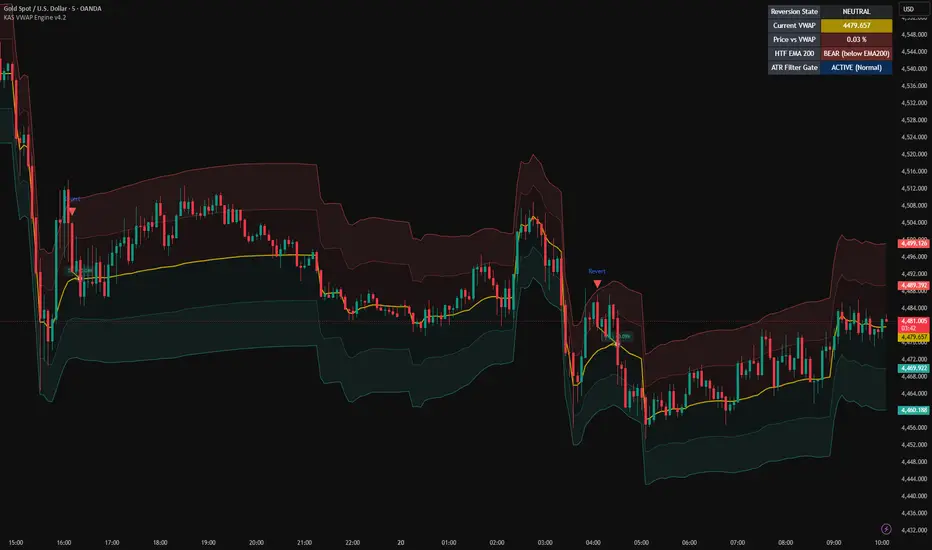
KAS VWAP Engine v4.2 is an open-source auto-anchored VWAP indicator designed for mean-reversion setups around volume-weighted average price. The anchor automatically resets when price establishes a new structural high or low over a configurable lookback period. A 2-stage state machine ensures signals only fire after a confirmed band-touch followed by an opposite-band close-reclaim.
WHAT IT DOES
- Plots an auto-anchored VWAP that resets on structure breaks (configurable lookback)
- Adds inner and outer ATR-based deviation bands around the VWAP baseline
- Detects mean-reversion entries when price touches the outer band and reclaims the inner band
- Visualizes completed trades as directional vectors with inline P&L labels
- Filters signals through an HTF EMA 200 trend gate (optional) and an ATR Z-Score volatility regime gate (optional)
- Displays a real-time dashboard with current reversion state, VWAP value, price deviation, HTF trend, and ATR filter status
HOW IT WORKS
1. Auto-Anchor Detection
The anchor resets when the current bar high exceeds the highest high of the previous N bars (configurable, default 50), or when the current low breaks below the lowest low. Implementation uses ta.highest(high[1], swingLen) and ta.lowest(low[1], swingLen) for the structure-break comparison.
2. Manual VWAP Accumulators
The VWAP uses hlc3 as price source and resets accumulator buffers on each new anchor. This produces a session-style VWAP from each detected structure point. Formula: VWAP = sumSrcVol / sumVol, where sumSrcVol accumulates hlc3 multiplied by volume.
3. ATR Deviation Bands with Bridge
Bands are placed at the VWAP plus/minus inner-multiplier and outer-multiplier times the ATR-14 baseline (SMA-smoothed over 100 bars). On anchor-reset bars, a dedicated bridge variable substitutes hlc3 for the freshly-reset VWAP value, preventing ghost-line artifacts in the visualization.
4. 2-Stage State Machine (Arm to Fire)
Stage 1 (Arm): a touch of the outer band sets the armed state to +1 (long-arm) or -1 (short-arm).
Stage 2 (Fire): a close back inside the inner band fires the entry signal in the same direction.
A signal cooldown (configurable bars) and a VWAP-touch-reset clear the armed state.
5. ATR Z-Score Regime Gate
The ATR-14 z-score is computed against its 100-bar SMA and 100-bar standard deviation. When the z-score falls below -1.0, the regime is classified as Low Vol and signals are blocked (optional filter, on by default).
6. HTF EMA 200 Filter
A request.security call retrieves the EMA-200 from a higher timeframe (default 4h). When enabled, long-reversion signals only fire when close is above the HTF EMA, and short-reversion signals only fire when close is below the HTF EMA.
WHY IT'S UNIQUE
- Unlike standard auto-anchored VWAP scripts that produce ghost-line artifacts when the anchor resets, this indicator substitutes hlc3 on the reset bar via a dedicated bridge variable, providing a continuous, artifact-free anchored VWAP visualization.
- Unlike instant-fire band-touch signals common in VWAP deviation scripts, this indicator uses a 2-stage Arm to Fire state machine: an outer-band touch only arms the setup, and the signal fires only after an inner-band close-reclaim, significantly reducing false signals during volatile band-pierces.
- Unlike static signal markers, this indicator visualizes each completed trade as a directional vector from entry to exit (Take Profit at VWAP, or Stop at opposite outer band) with inline P&L percentage labels, enabling rapid visual back-test review on historical bars.
HOW TO USE
- Add the indicator to a standard candlestick chart on any timeframe (intraday 5m-15m and swing 1h-4h work well)
- Default settings work for most liquid instruments; adjust Structure Lookback (50 bars) based on your timeframe density
- Watch for Revert Long (triangle below bar) or Revert Short (triangle above bar) signals after a touch of the outer band
- The dashboard shows current reversion state, VWAP deviation, HTF trend direction, and whether the ATR regime gate is blocking signals
- Trade trajectory beams visualize each completed setup with TP (return to VWAP) or STOP (extension to opposite band) outcomes
- Combine with your own risk management; the indicator is analytical, not a recommendation
LIMITATIONS
- Mean-reversion logic is designed for ranging or oscillating markets; performance is reduced in strong directional trends
- ATR Z-Score regime detection requires at least 100 bars of history to stabilize
- The HTF EMA 200 filter requires sufficient history on the higher timeframe; on newly-listed instruments or very short timeframes the HTF signal may be unstable
- Signals fire on bar close (barstate.isconfirmed); intra-bar movements are not signaled
- This indicator is for analytical purposes only and does not constitute financial advice or a recommendation to trade
ABOUT
Knecht Alpha Signals delivers Pine Script v6 indicators focused on precision over noise. This open-source release is part of our public toolkit for the TradingView community.
WHAT IT DOES
- Plots an auto-anchored VWAP that resets on structure breaks (configurable lookback)
- Adds inner and outer ATR-based deviation bands around the VWAP baseline
- Detects mean-reversion entries when price touches the outer band and reclaims the inner band
- Visualizes completed trades as directional vectors with inline P&L labels
- Filters signals through an HTF EMA 200 trend gate (optional) and an ATR Z-Score volatility regime gate (optional)
- Displays a real-time dashboard with current reversion state, VWAP value, price deviation, HTF trend, and ATR filter status
HOW IT WORKS
1. Auto-Anchor Detection
The anchor resets when the current bar high exceeds the highest high of the previous N bars (configurable, default 50), or when the current low breaks below the lowest low. Implementation uses ta.highest(high[1], swingLen) and ta.lowest(low[1], swingLen) for the structure-break comparison.
2. Manual VWAP Accumulators
The VWAP uses hlc3 as price source and resets accumulator buffers on each new anchor. This produces a session-style VWAP from each detected structure point. Formula: VWAP = sumSrcVol / sumVol, where sumSrcVol accumulates hlc3 multiplied by volume.
3. ATR Deviation Bands with Bridge
Bands are placed at the VWAP plus/minus inner-multiplier and outer-multiplier times the ATR-14 baseline (SMA-smoothed over 100 bars). On anchor-reset bars, a dedicated bridge variable substitutes hlc3 for the freshly-reset VWAP value, preventing ghost-line artifacts in the visualization.
4. 2-Stage State Machine (Arm to Fire)
Stage 1 (Arm): a touch of the outer band sets the armed state to +1 (long-arm) or -1 (short-arm).
Stage 2 (Fire): a close back inside the inner band fires the entry signal in the same direction.
A signal cooldown (configurable bars) and a VWAP-touch-reset clear the armed state.
5. ATR Z-Score Regime Gate
The ATR-14 z-score is computed against its 100-bar SMA and 100-bar standard deviation. When the z-score falls below -1.0, the regime is classified as Low Vol and signals are blocked (optional filter, on by default).
6. HTF EMA 200 Filter
A request.security call retrieves the EMA-200 from a higher timeframe (default 4h). When enabled, long-reversion signals only fire when close is above the HTF EMA, and short-reversion signals only fire when close is below the HTF EMA.
WHY IT'S UNIQUE
- Unlike standard auto-anchored VWAP scripts that produce ghost-line artifacts when the anchor resets, this indicator substitutes hlc3 on the reset bar via a dedicated bridge variable, providing a continuous, artifact-free anchored VWAP visualization.
- Unlike instant-fire band-touch signals common in VWAP deviation scripts, this indicator uses a 2-stage Arm to Fire state machine: an outer-band touch only arms the setup, and the signal fires only after an inner-band close-reclaim, significantly reducing false signals during volatile band-pierces.
- Unlike static signal markers, this indicator visualizes each completed trade as a directional vector from entry to exit (Take Profit at VWAP, or Stop at opposite outer band) with inline P&L percentage labels, enabling rapid visual back-test review on historical bars.
HOW TO USE
- Add the indicator to a standard candlestick chart on any timeframe (intraday 5m-15m and swing 1h-4h work well)
- Default settings work for most liquid instruments; adjust Structure Lookback (50 bars) based on your timeframe density
- Watch for Revert Long (triangle below bar) or Revert Short (triangle above bar) signals after a touch of the outer band
- The dashboard shows current reversion state, VWAP deviation, HTF trend direction, and whether the ATR regime gate is blocking signals
- Trade trajectory beams visualize each completed setup with TP (return to VWAP) or STOP (extension to opposite band) outcomes
- Combine with your own risk management; the indicator is analytical, not a recommendation
LIMITATIONS
- Mean-reversion logic is designed for ranging or oscillating markets; performance is reduced in strong directional trends
- ATR Z-Score regime detection requires at least 100 bars of history to stabilize
- The HTF EMA 200 filter requires sufficient history on the higher timeframe; on newly-listed instruments or very short timeframes the HTF signal may be unstable
- Signals fire on bar close (barstate.isconfirmed); intra-bar movements are not signaled
- This indicator is for analytical purposes only and does not constitute financial advice or a recommendation to trade
ABOUT
Knecht Alpha Signals delivers Pine Script v6 indicators focused on precision over noise. This open-source release is part of our public toolkit for the TradingView community.
Script de código aberto
Em verdadeiro espírito do TradingView, o criador deste script o tornou de código aberto, para que os traders possam revisar e verificar sua funcionalidade. Parabéns ao autor! Embora você possa usá-lo gratuitamente, lembre-se de que a republicação do código está sujeita às nossas Regras da Casa.

Knecht Alpha Signals (KAS)
Institutional-grade Volume Delta · Momentum · MTF Analysis for TradingView.
Built for traders who demand precision over noise.
Full indicator suite: whop.com/knecht-alpha-signals
Institutional-grade Volume Delta · Momentum · MTF Analysis for TradingView.
Built for traders who demand precision over noise.
Full indicator suite: whop.com/knecht-alpha-signals
Aviso legal
As informações e publicações não se destinam a ser, e não constituem, conselhos ou recomendações financeiras, de investimento, comerciais ou de outro tipo fornecidos ou endossados pela TradingView. Leia mais nos Termos de Uso.
Script de código aberto
Em verdadeiro espírito do TradingView, o criador deste script o tornou de código aberto, para que os traders possam revisar e verificar sua funcionalidade. Parabéns ao autor! Embora você possa usá-lo gratuitamente, lembre-se de que a republicação do código está sujeita às nossas Regras da Casa.
Knecht Alpha Signals (KAS)
Institutional-grade Volume Delta · Momentum · MTF Analysis for TradingView.
Built for traders who demand precision over noise.
Full indicator suite: whop.com/knecht-alpha-signals
Institutional-grade Volume Delta · Momentum · MTF Analysis for TradingView.
Built for traders who demand precision over noise.
Full indicator suite: whop.com/knecht-alpha-signals
Aviso legal
As informações e publicações não se destinam a ser, e não constituem, conselhos ou recomendações financeiras, de investimento, comerciais ou de outro tipo fornecidos ou endossados pela TradingView. Leia mais nos Termos de Uso.