OPEN-SOURCE SCRIPT
AetherEdge - Portfolio Regime Hedge Optimizer
🖊️ Overview
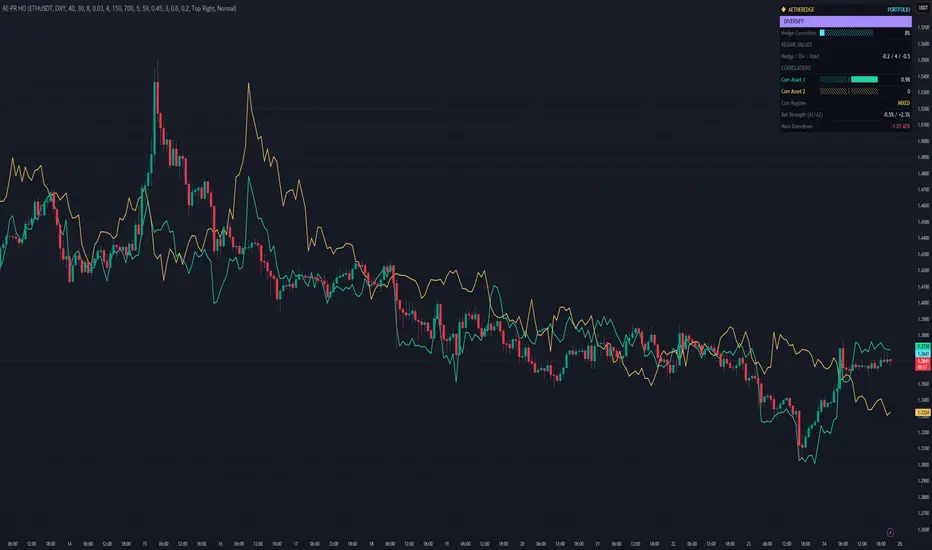
A multi-asset engine for the portfolio era. Rather than reading one symbol in isolation, it pulls in up to two correlated assets (e.g. ETH and DXY alongside BTC, or a stock and an FX pair) and learns their relative regime with a NeuraLib network — relative strength, rolling correlation, and the correlation regime itself (risk-on coupling vs. decoupling). From that, the agent issues hedge signals — when the main asset's downside is best offset by a correlated instrument — and diversification guidance when correlations decouple. A reward based on whether a hedge call actually reduced realized drawdown lets the regime model self-evolve. Visualization: "Hedge Alert" arrows on the main asset plus up to two relative-strength comparison lines.
🔶 Key Features
Multi-asset relative-regime learning — AI learns the main + two correlated assets' relationship (beyond single-symbol analysis)
Correlation-regime classification — labels coupling (COUPLED) / decoupling (DECOUPLED) / inverse (INVERSE) from rolling correlation
Hedge signals — recommends hedging with a correlated asset when correlation rises amid downside pressure
Diversification guidance — flags when low correlation makes spreading exposure favorable
Self-evolving reward — learns from post-hedge drawdown reduction (accounting for hedging cost)
Hedge Alert arrows — warning arrows and labels on the main asset chart
Relative-strength lines — each correlated asset's main-relative performance, rebased onto price, up to two lines
Intelligence panel — hedge conviction, hedge/diversify/hold regime values, each correlation, relative strength, and main drawdown at a glance
🧠 Technical Architecture
The engine pulls in two correlated assets via request.security on the same timeframe as the main chart. The state vector comprises six relative-regime features: (1)(2) main-vs-each-asset rolling correlation, (3)(4) main-vs-each relative strength (relative performance gap), (5) the main asset's drawdown pressure from its recent high, and (6) the main asset's volatility regime — all clamp-normalized.
This feeds a NeuraLib regime network (state(6) → hidden(tanh) → Q[3]) estimating the value of three actions — HEDGE / DIVERSIFY / HOLD. The reward design is the core: HEDGE is rewarded when the main subsequently fell (protection was valuable) and lightly penalized (cost) when it rose; DIVERSIFY is rewarded when correlation is low and the alt outperformed; HOLD is rewarded when the main held up (avoiding needless hedge cost). The model thus learns when to hedge from a drawdown-reduction standpoint. Training is DQN-style (target = r + γ·max Q(s′)) from uniform replay.
Hedge conviction is the normalized dominance of the HEDGE value over the others; after smoothing, when it clears the gate amid main downside pressure, a "Hedge Alert" fires. The relative-strength lines rebase each correlated asset's main-relative performance onto the main close, overlaying them on the price chart for a visual strength comparison.
⚙️ Recommended Settings & Tuning Guide
BTC (main) + ETH + DXY (1H–4H): Correlation 40, Relative 30, High-Corr 0.6, Decoupling 0.2, Hedge Gate 0.45 — a crypto + risk-off-proxy setup
ETH (main) + BTC + Total (1H–4H): BTC as asset 1, the broad crypto market as asset 2
Stock (main) + Index + VIX/DXY: index and a volatility proxy as correlated assets for single-stock hedging
FX (main) + DXY + related pair: for currency relative-regime and hedging
Correlation Window: longer is a steadier correlation regime; shorter is nimbler — ~40 is practical
High-Correlation / Decoupling Level: the coupling/decoupling thresholds — set to the pair's typical correlation
Hedge Gate: higher makes hedge alerts rare and high-confidence; lower more frequent — tune to risk tolerance
Choice of correlated assets: pick economically meaningful pairs (same sector, risk-on/off relationship)
💡 How to Use in Practice
Reacting to Hedge Alert arrows: an arrow marks where the model judges the main's downside can be offset by a correlated asset — a basis to consider hedging (shorting the correlate, options, trimming size)
Reading relative-strength lines: versus the main close (anchor), a correlate line above = that asset outperforms the main (main weaker); below = main leads — useful for rotation calls
Using the correlation regime: COUPLED = risk resonates and hedging is effective; DECOUPLED = diversification works; INVERSE = a natural hedge exists
Using diversification flags: DIVERSIFY markers mark decoupled conditions where spreading risk across the assets may lower portfolio volatility
Pairing with drawdown pressure: deep main drawdown plus high hedge conviction is the most caution-worthy risk-off setup
Multi-timeframe usage: read the big-picture correlation regime on the higher timeframe (4H), then time on Hedge Alerts on the lower one (1H)
⚠️ Important Notes
Correlated assets must be set: this requires proper correlated-asset symbols; unrelated assets break correlation learning — choose economically related ones
request.security constraints: correlated data is fetched on the same timeframe; illiquid symbols or timeframe mismatches can make correlation inaccurate
Initial learning period: right after launch the buffer is nearly empty and the regime model is immature; treat hedge conviction as low-confidence until it learns (several hundred bars)
Learning resets: changing parameters, symbol/timeframe, correlated assets, or recompiling reinitializes the network weights and buffer
Hedging isn't infallible: correlations shift over time, and in crises normally-uncorrelated assets can move together (correlation convergence) — hedge recommendations do not guarantee protection
On forward-looking reward: rewards use closed-bar forward returns (a standard RL training construct); as with any adaptive system, historical and live behavior can differ — always forward-test
Constraints: this is a lightweight implementation within Pine's compute budget
🚨 Disclaimer
This indicator is an analytical and educational visualization tool. The relative-regime learning, correlation analysis, hedge signals, diversification guidance, and relative-strength lines are quantitative heuristics computed on-chart from price data — they are not financial advice, trade/hedge signals, or any guarantee of future performance. Make portfolio hedging and diversification decisions on your own responsibility, including consulting a professional. Always combine any tool with your own analysis and disciplined risk management.
A multi-asset engine for the portfolio era. Rather than reading one symbol in isolation, it pulls in up to two correlated assets (e.g. ETH and DXY alongside BTC, or a stock and an FX pair) and learns their relative regime with a NeuraLib network — relative strength, rolling correlation, and the correlation regime itself (risk-on coupling vs. decoupling). From that, the agent issues hedge signals — when the main asset's downside is best offset by a correlated instrument — and diversification guidance when correlations decouple. A reward based on whether a hedge call actually reduced realized drawdown lets the regime model self-evolve. Visualization: "Hedge Alert" arrows on the main asset plus up to two relative-strength comparison lines.
🔶 Key Features
Multi-asset relative-regime learning — AI learns the main + two correlated assets' relationship (beyond single-symbol analysis)
Correlation-regime classification — labels coupling (COUPLED) / decoupling (DECOUPLED) / inverse (INVERSE) from rolling correlation
Hedge signals — recommends hedging with a correlated asset when correlation rises amid downside pressure
Diversification guidance — flags when low correlation makes spreading exposure favorable
Self-evolving reward — learns from post-hedge drawdown reduction (accounting for hedging cost)
Hedge Alert arrows — warning arrows and labels on the main asset chart
Relative-strength lines — each correlated asset's main-relative performance, rebased onto price, up to two lines
Intelligence panel — hedge conviction, hedge/diversify/hold regime values, each correlation, relative strength, and main drawdown at a glance
🧠 Technical Architecture
The engine pulls in two correlated assets via request.security on the same timeframe as the main chart. The state vector comprises six relative-regime features: (1)(2) main-vs-each-asset rolling correlation, (3)(4) main-vs-each relative strength (relative performance gap), (5) the main asset's drawdown pressure from its recent high, and (6) the main asset's volatility regime — all clamp-normalized.
This feeds a NeuraLib regime network (state(6) → hidden(tanh) → Q[3]) estimating the value of three actions — HEDGE / DIVERSIFY / HOLD. The reward design is the core: HEDGE is rewarded when the main subsequently fell (protection was valuable) and lightly penalized (cost) when it rose; DIVERSIFY is rewarded when correlation is low and the alt outperformed; HOLD is rewarded when the main held up (avoiding needless hedge cost). The model thus learns when to hedge from a drawdown-reduction standpoint. Training is DQN-style (target = r + γ·max Q(s′)) from uniform replay.
Hedge conviction is the normalized dominance of the HEDGE value over the others; after smoothing, when it clears the gate amid main downside pressure, a "Hedge Alert" fires. The relative-strength lines rebase each correlated asset's main-relative performance onto the main close, overlaying them on the price chart for a visual strength comparison.
⚙️ Recommended Settings & Tuning Guide
BTC (main) + ETH + DXY (1H–4H): Correlation 40, Relative 30, High-Corr 0.6, Decoupling 0.2, Hedge Gate 0.45 — a crypto + risk-off-proxy setup
ETH (main) + BTC + Total (1H–4H): BTC as asset 1, the broad crypto market as asset 2
Stock (main) + Index + VIX/DXY: index and a volatility proxy as correlated assets for single-stock hedging
FX (main) + DXY + related pair: for currency relative-regime and hedging
Correlation Window: longer is a steadier correlation regime; shorter is nimbler — ~40 is practical
High-Correlation / Decoupling Level: the coupling/decoupling thresholds — set to the pair's typical correlation
Hedge Gate: higher makes hedge alerts rare and high-confidence; lower more frequent — tune to risk tolerance
Choice of correlated assets: pick economically meaningful pairs (same sector, risk-on/off relationship)
💡 How to Use in Practice
Reacting to Hedge Alert arrows: an arrow marks where the model judges the main's downside can be offset by a correlated asset — a basis to consider hedging (shorting the correlate, options, trimming size)
Reading relative-strength lines: versus the main close (anchor), a correlate line above = that asset outperforms the main (main weaker); below = main leads — useful for rotation calls
Using the correlation regime: COUPLED = risk resonates and hedging is effective; DECOUPLED = diversification works; INVERSE = a natural hedge exists
Using diversification flags: DIVERSIFY markers mark decoupled conditions where spreading risk across the assets may lower portfolio volatility
Pairing with drawdown pressure: deep main drawdown plus high hedge conviction is the most caution-worthy risk-off setup
Multi-timeframe usage: read the big-picture correlation regime on the higher timeframe (4H), then time on Hedge Alerts on the lower one (1H)
⚠️ Important Notes
Correlated assets must be set: this requires proper correlated-asset symbols; unrelated assets break correlation learning — choose economically related ones
request.security constraints: correlated data is fetched on the same timeframe; illiquid symbols or timeframe mismatches can make correlation inaccurate
Initial learning period: right after launch the buffer is nearly empty and the regime model is immature; treat hedge conviction as low-confidence until it learns (several hundred bars)
Learning resets: changing parameters, symbol/timeframe, correlated assets, or recompiling reinitializes the network weights and buffer
Hedging isn't infallible: correlations shift over time, and in crises normally-uncorrelated assets can move together (correlation convergence) — hedge recommendations do not guarantee protection
On forward-looking reward: rewards use closed-bar forward returns (a standard RL training construct); as with any adaptive system, historical and live behavior can differ — always forward-test
Constraints: this is a lightweight implementation within Pine's compute budget
🚨 Disclaimer
This indicator is an analytical and educational visualization tool. The relative-regime learning, correlation analysis, hedge signals, diversification guidance, and relative-strength lines are quantitative heuristics computed on-chart from price data — they are not financial advice, trade/hedge signals, or any guarantee of future performance. Make portfolio hedging and diversification decisions on your own responsibility, including consulting a professional. Always combine any tool with your own analysis and disciplined risk management.
Script de código aberto
Em verdadeiro espírito do TradingView, o criador deste script o tornou de código aberto, para que os traders possam revisar e verificar sua funcionalidade. Parabéns ao autor! Embora você possa usá-lo gratuitamente, lembre-se de que a republicação do código está sujeita às nossas Regras da Casa.

Aviso legal
As informações e publicações não se destinam a ser, e não constituem, conselhos ou recomendações financeiras, de investimento, comerciais ou de outro tipo fornecidos ou endossados pela TradingView. Leia mais nos Termos de Uso.
Script de código aberto
Em verdadeiro espírito do TradingView, o criador deste script o tornou de código aberto, para que os traders possam revisar e verificar sua funcionalidade. Parabéns ao autor! Embora você possa usá-lo gratuitamente, lembre-se de que a republicação do código está sujeita às nossas Regras da Casa.
Aviso legal
As informações e publicações não se destinam a ser, e não constituem, conselhos ou recomendações financeiras, de investimento, comerciais ou de outro tipo fornecidos ou endossados pela TradingView. Leia mais nos Termos de Uso.