
Avis Budget Group: Evaluating the Investment Case Amidst Operational Headwinds and Financial Strain
Avis Budget Group, Inc. (NASDAQ: CAR), a prominent global provider of mobility solutions through its Avis, Budget, and Zipcar brands, is scheduled to announce its Fourth Quarter 2025 financial results on February 18th. The company operates a vast network of approximately 10,250 rental locations across 180 countries, with a direct operational footprint in North America, Europe, and Australasia. Despite this global scale, the stock's recent performance has been deeply disappointing for shareholders. Over the past six months, Avis Budget Group’s shares have declined to $130.42, representing a significant 11.3% loss. This decline stands in stark contrast to the S&P 500's impressive 12.7% gain over the same period, prompting investors to critically reassess the company's investment thesis.
Three Core Reasons for a Cautious Stance on Avis Budget Group
While the recent share price decline may appear to offer a more favorable entry point, a deeper analysis reveals several fundamental concerns that suggest this stock may not be positioned for outperformance. Here are three critical factors contributing to a cautious outlook.
1. Stagnant Operational Growth Indicates Weak Underlying Demand
For a capital-intensive rental business, true growth is best measured by the expansion of its core operational volume. In this case, the key metric is "available rental days." Over the last two years, Avis Budget Group has demonstrated a notable inability to grow this fundamental volume metric. The figure remained stagnant, reported at 68.65 million days in the latest quarter. This lack of volume growth is a serious red flag, as it suggests the company is not expanding its serviceable market or effectively capturing increased demand. It implies potential market saturation, increasing competitive pressures, or a failure to innovate its service offerings. In such an environment, the company may be forced to compete on price or make significant investments to refresh its fleet and customer experience—actions that can compress profit margins and hinder near-term earnings.
2. Declining Capital Efficiency Signals Dwindling Profitable Opportunities
The effectiveness of a company's investments is captured by its Return on Invested Capital (ROIC). This metric reveals how profitably a company is deploying the capital provided by both debt and equity holders. While Avis Budget Group has historically generated reasonable returns, the trend has turned decisively negative in recent years, with ROIC declining significantly. This deteriorating trend is often more telling than the absolute level, as it indicates that new capital expenditures or strategic initiatives are failing to generate returns at historical rates. This suggests that the company’s most lucrative growth opportunities may be in the rearview mirror, and management is facing diminishing returns on new investments—a dynamic that typically limits future earnings power and justifies a lower valuation multiple.
3. A Precarious Financial Position and Short Cash Runway
From a long-term investor's perspective, the primary risk is the permanent loss of capital, often precipitated by financial distress. Avis Budget Group’s financial health is a major area of concern. Over the last twelve months, the company has been a substantial consumer of cash, burning through $972.3 million. More alarmingly, its balance sheet carries a heavy debt load of $6.06 billion, which towers over its cash reserves of just $564 million. This combination of consistent cash burn and high leverage creates a precarious financial runway. It exposes shareholders to significant risks, including the potential for dilutive equity raises during periods of weakness, restrictive debt covenants, and limited flexibility to navigate an economic downturn or invest in necessary growth initiatives. For risk-aware investors, this financial profile is often a deal-breaker.
Valuation and Technical Context
Following the recent price decline, the stock trades at approximately 15.9x forward price-to-earnings (P/E), or $130.42 per share. While this valuation multiple may appear reasonable or "fair" on the surface, it fails to offset the fundamental concerns regarding growth, profitability trends, and balance sheet risk. In essence, the stock may be fairly valued for the challenged business it has become, rather than offering a compelling discount on a high-quality asset.
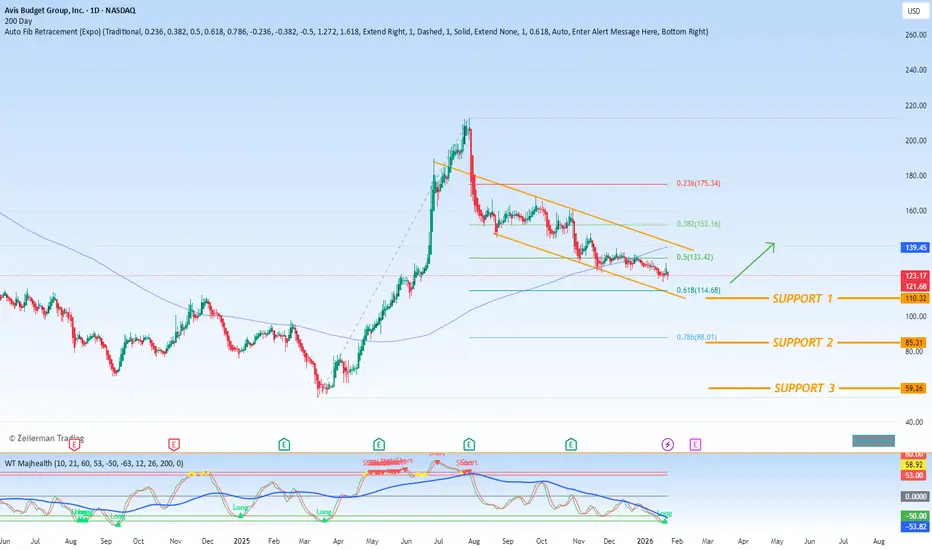
For traders monitoring the technical landscape, key Fibonacci retracement levels from prior major moves provide identifiable support zones where the stock might find temporary footing:
Primary Support: $114.68 – Corresponding to the 0.618 Fibonacci retracement level.
Secondary Support: $88.01 – Aligning with the 0.786 Fibonacci retracement level.
Tertiary/Strong Historical Support: $59.26 – A deeper level that represents a major historical benchmark.
Conclusion: Seeking Superior Alternatives
In summary, Avis Budget Group is not without its strengths, including powerful brand recognition and a vast global network. However, it currently fails to meet the criteria for a high-conviction investment. The triad of stagnant operational growth, declining returns on capital, and a strained financial position presents a compelling case for caution. The stock's fair valuation does not adequately compensate for these underlying risks. Consequently, investors are likely better served by directing capital toward companies with clearer growth runways, stronger cash flow generation, and more robust balance sheets within the industrials or consumer discretionary sectors. The upcoming earnings report on February 18th will be a crucial test, providing updated data on whether management can begin to reverse these concerning trends.
Avis Budget Group, Inc. (NASDAQ: CAR), a prominent global provider of mobility solutions through its Avis, Budget, and Zipcar brands, is scheduled to announce its Fourth Quarter 2025 financial results on February 18th. The company operates a vast network of approximately 10,250 rental locations across 180 countries, with a direct operational footprint in North America, Europe, and Australasia. Despite this global scale, the stock's recent performance has been deeply disappointing for shareholders. Over the past six months, Avis Budget Group’s shares have declined to $130.42, representing a significant 11.3% loss. This decline stands in stark contrast to the S&P 500's impressive 12.7% gain over the same period, prompting investors to critically reassess the company's investment thesis.
Three Core Reasons for a Cautious Stance on Avis Budget Group
While the recent share price decline may appear to offer a more favorable entry point, a deeper analysis reveals several fundamental concerns that suggest this stock may not be positioned for outperformance. Here are three critical factors contributing to a cautious outlook.
1. Stagnant Operational Growth Indicates Weak Underlying Demand
For a capital-intensive rental business, true growth is best measured by the expansion of its core operational volume. In this case, the key metric is "available rental days." Over the last two years, Avis Budget Group has demonstrated a notable inability to grow this fundamental volume metric. The figure remained stagnant, reported at 68.65 million days in the latest quarter. This lack of volume growth is a serious red flag, as it suggests the company is not expanding its serviceable market or effectively capturing increased demand. It implies potential market saturation, increasing competitive pressures, or a failure to innovate its service offerings. In such an environment, the company may be forced to compete on price or make significant investments to refresh its fleet and customer experience—actions that can compress profit margins and hinder near-term earnings.
2. Declining Capital Efficiency Signals Dwindling Profitable Opportunities
The effectiveness of a company's investments is captured by its Return on Invested Capital (ROIC). This metric reveals how profitably a company is deploying the capital provided by both debt and equity holders. While Avis Budget Group has historically generated reasonable returns, the trend has turned decisively negative in recent years, with ROIC declining significantly. This deteriorating trend is often more telling than the absolute level, as it indicates that new capital expenditures or strategic initiatives are failing to generate returns at historical rates. This suggests that the company’s most lucrative growth opportunities may be in the rearview mirror, and management is facing diminishing returns on new investments—a dynamic that typically limits future earnings power and justifies a lower valuation multiple.
3. A Precarious Financial Position and Short Cash Runway
From a long-term investor's perspective, the primary risk is the permanent loss of capital, often precipitated by financial distress. Avis Budget Group’s financial health is a major area of concern. Over the last twelve months, the company has been a substantial consumer of cash, burning through $972.3 million. More alarmingly, its balance sheet carries a heavy debt load of $6.06 billion, which towers over its cash reserves of just $564 million. This combination of consistent cash burn and high leverage creates a precarious financial runway. It exposes shareholders to significant risks, including the potential for dilutive equity raises during periods of weakness, restrictive debt covenants, and limited flexibility to navigate an economic downturn or invest in necessary growth initiatives. For risk-aware investors, this financial profile is often a deal-breaker.
Valuation and Technical Context
Following the recent price decline, the stock trades at approximately 15.9x forward price-to-earnings (P/E), or $130.42 per share. While this valuation multiple may appear reasonable or "fair" on the surface, it fails to offset the fundamental concerns regarding growth, profitability trends, and balance sheet risk. In essence, the stock may be fairly valued for the challenged business it has become, rather than offering a compelling discount on a high-quality asset.
For traders monitoring the technical landscape, key Fibonacci retracement levels from prior major moves provide identifiable support zones where the stock might find temporary footing:
Primary Support: $114.68 – Corresponding to the 0.618 Fibonacci retracement level.
Secondary Support: $88.01 – Aligning with the 0.786 Fibonacci retracement level.
Tertiary/Strong Historical Support: $59.26 – A deeper level that represents a major historical benchmark.
Conclusion: Seeking Superior Alternatives
In summary, Avis Budget Group is not without its strengths, including powerful brand recognition and a vast global network. However, it currently fails to meet the criteria for a high-conviction investment. The triad of stagnant operational growth, declining returns on capital, and a strained financial position presents a compelling case for caution. The stock's fair valuation does not adequately compensate for these underlying risks. Consequently, investors are likely better served by directing capital toward companies with clearer growth runways, stronger cash flow generation, and more robust balance sheets within the industrials or consumer discretionary sectors. The upcoming earnings report on February 18th will be a crucial test, providing updated data on whether management can begin to reverse these concerning trends.

免责声明
这些信息和出版物并非旨在提供,也不构成TradingView提供或认可的任何形式的财务、投资、交易或其他类型的建议或推荐。请阅读使用条款了解更多信息。