
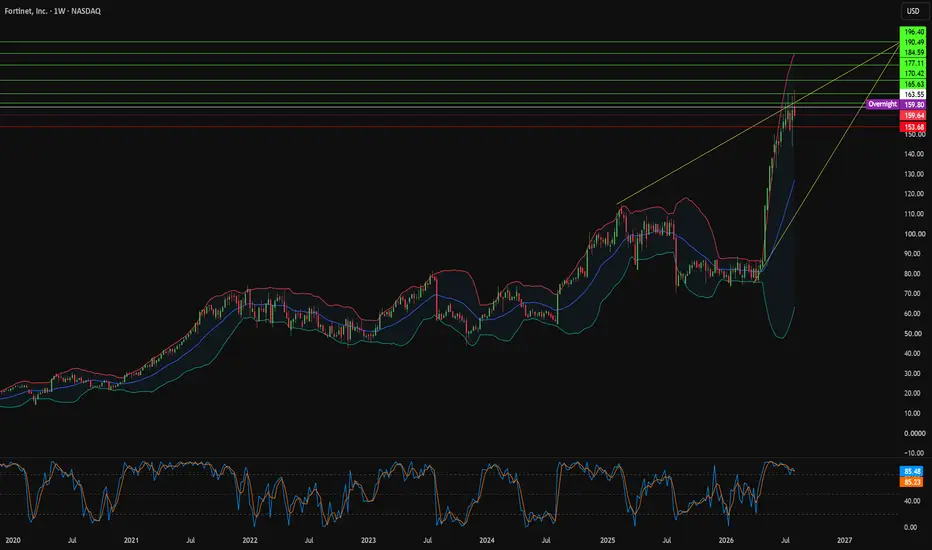
Fortinet closed the second quarter of 2026 with results that beat its own upper guidance. Total revenue reached $2.05 billion, a 26% year-over-year gain. Product revenue told the sharper story, climbing 52% to $773 million on higher FortiGate shipments and enterprise model upgrades. Billings rose 33% to $2.37 billion. Non-GAAP gross margin held at 80.9% while operating margin expanded 490 basis points to a record 38%. Adjusted free cash flow hit $996 million, a 49% margin. Management returned capital aggressively, repurchasing 12.5 million shares for $973 million year to date.
The strategic headline sits in silicon, not in the income statement. Intel Foundry will co-develop and manufacture Fortinet's sixth-generation SP6 firewall ASIC. Fortinet becomes the first external cybersecurity customer for Intel Foundry and the first external customer on the Intel 4 node. Production runs at Fab 34 in Ireland. That geography matters. Fortinet controls roughly 48% of global firewall appliance unit shipments, and protecting that volume requires supply continuity outside East Asian foundries. The SP6 also abandons the monolithic 7nm design of the SP5 for a disaggregated chiplet architecture, which improves yields and lowers unit costs.
Demand drivers are converging from three directions. Data sovereignty rules are pushing enterprises toward local inspection, which Fortinet addresses with FortiSASE Outpost, a customer-premises point of presence for restricted traffic. Labor scarcity is forcing automation, with 56% of leaders citing skill gaps as a breach cause and 60% struggling to hire AI security talent. Enterprise AI adoption is creating a new attack surface, which FortiAIGate targets using NVIDIA Blackwell and Hopper acceleration, the Dynamo inference framework, and Nemotron safety models for inline prompt monitoring. The segment numbers reflect it. SASE firewall billings grew 34% past $2 billion, OT security billings grew over 55%, and AI-driven SecOps billings rose 25%.
Guidance moved higher across the board. Full-year revenue is now targeted at $8.02 billion to $8.18 billion, billings at $9.35 billion to $9.55 billion, and non-GAAP EPS at $3.41 to $3.47. The main modeling caution is memory component pricing, which management flags as a high-single-digit billings headwind in the second half. Fortinet mitigates that through wallet share expansion inside existing accounts and higher selling prices on performance-heavy appliances. The combination of custom silicon, Western manufacturing, and AI security integration builds a moat that software-only competitors will find expensive to cross.
The strategic headline sits in silicon, not in the income statement. Intel Foundry will co-develop and manufacture Fortinet's sixth-generation SP6 firewall ASIC. Fortinet becomes the first external cybersecurity customer for Intel Foundry and the first external customer on the Intel 4 node. Production runs at Fab 34 in Ireland. That geography matters. Fortinet controls roughly 48% of global firewall appliance unit shipments, and protecting that volume requires supply continuity outside East Asian foundries. The SP6 also abandons the monolithic 7nm design of the SP5 for a disaggregated chiplet architecture, which improves yields and lowers unit costs.
Demand drivers are converging from three directions. Data sovereignty rules are pushing enterprises toward local inspection, which Fortinet addresses with FortiSASE Outpost, a customer-premises point of presence for restricted traffic. Labor scarcity is forcing automation, with 56% of leaders citing skill gaps as a breach cause and 60% struggling to hire AI security talent. Enterprise AI adoption is creating a new attack surface, which FortiAIGate targets using NVIDIA Blackwell and Hopper acceleration, the Dynamo inference framework, and Nemotron safety models for inline prompt monitoring. The segment numbers reflect it. SASE firewall billings grew 34% past $2 billion, OT security billings grew over 55%, and AI-driven SecOps billings rose 25%.
Guidance moved higher across the board. Full-year revenue is now targeted at $8.02 billion to $8.18 billion, billings at $9.35 billion to $9.55 billion, and non-GAAP EPS at $3.41 to $3.47. The main modeling caution is memory component pricing, which management flags as a high-single-digit billings headwind in the second half. Fortinet mitigates that through wallet share expansion inside existing accounts and higher selling prices on performance-heavy appliances. The combination of custom silicon, Western manufacturing, and AI security integration builds a moat that software-only competitors will find expensive to cross.

Connecting the dots to Decode the Invisible. This post is a summary. To understand the rigged game, you need the evidence. Access the Full Analysis + Raw Sources (Lab Reports, Patents, Academic Research & Cyber Intel). See the reality here ➜ udisview.com
免责声明
这些信息和出版物并非旨在提供,也不构成TradingView提供或认可的任何形式的财务、投资、交易或其他类型的建议或推荐。请阅读使用条款了解更多信息。
Connecting the dots to Decode the Invisible. This post is a summary. To understand the rigged game, you need the evidence. Access the Full Analysis + Raw Sources (Lab Reports, Patents, Academic Research & Cyber Intel). See the reality here ➜ udisview.com
免责声明
这些信息和出版物并非旨在提供,也不构成TradingView提供或认可的任何形式的财务、投资、交易或其他类型的建议或推荐。请阅读使用条款了解更多信息。