
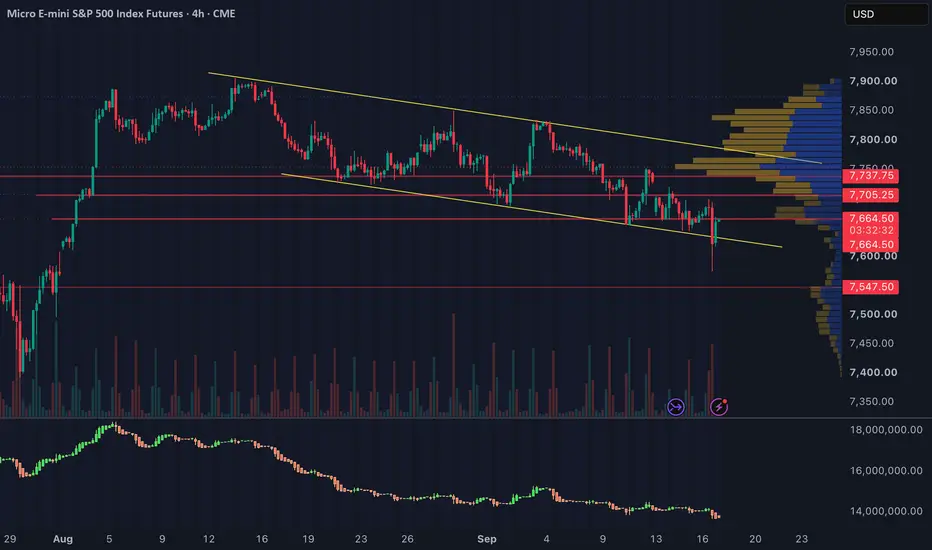
Post-FOMC Repricing Keeps MES in Tactical Risk-Off — Repair Rally Reaches Its First Test
Market Regime: Tactical Risk-Off / Hawkish Post-FOMC Price Discovery
Systemic Stress: Not confirmed
Confidence: High
Wednesday’s FOMC meeting produced a unanimous 25-basis-point rate increase, lifting the target range to 3.75%–4.00%. Policymakers’ projections also left another increase possible before year-end.
The market’s initial response was a sharp downside repricing followed by a meaningful after-hours recovery. That rebound has improved the immediate tape, but it has not repaired the broader structure.
MES is now pushing directly into its first major resistance area. Thursday’s question is whether buyers can convert the rebound into genuine acceptance—or whether former support becomes resistance again.
Index Structure and Breadth
SPY reacted cleanly around the 765, 761 and 757 areas, confirming that the market continues to respect established technical levels despite the FOMC volatility.
The broader structure remains mixed:
MES is trading below most of last week’s range.
RSP and SPY are approximately flat to slightly higher compared with similar levels from last week.
RSP is holding a major HVN/LVN decision area, but only narrowly.
RSP/SPY remains near an important support zone.
RTY and YM weakened materially.
ADD and VOLD finished negative, although not at capitulation readings.
Short- and intermediate-term S5 breadth gauges deteriorated sharply.
This is weak participation, but not yet an indiscriminate market breakdown. A decisive loss of the RSP HVN alongside further deterioration in RSP/SPY would provide much broader confirmation of downside continuation.
Volatility
Volatility delivered one of the session’s clearest warnings.
VIX strengthened, VIX1D was highly elevated around the event, and the front of the VX curve finished nearly flat—with VX1 and VX2 separated by very little.
That reflects strong immediate demand for protection. However, some of that demand may have been specific to the FOMC event.
Thursday’s confirmation test is whether volatility remains firm after the catalyst passes. If equities stabilize and VIX1D rapidly fades, the repair can continue. If MES rejects resistance while VIX and the front of the VX curve remain elevated, the bearish structure receives stronger confirmation.
Rates, Dollar and Inflation Pressure
The Treasury curve remains normally upward sloping, with the 30-year yield still the highest:
2-year: approximately 4.72%
5-year: approximately 4.85%
10-year: approximately 4.99%
30-year: approximately 5.33%
The concern is not curve inversion. It is the absolute level of rates and the continued weakness in longer-duration Treasuries.
DXY is simultaneously testing the major 100 level, while crude oil remains elevated around $102. Sustained dollar strength, long-end pressure and high oil prices would represent a difficult combination for equities by tightening financial conditions and keeping inflation concerns alive.
Leadership and Sector Structure
Leadership remains fragmented rather than completely abandoned.
Areas showing the greatest weakness include:
XLF and KRE, with regional banks remaining particularly vulnerable.
XLY, which continues to trade in a weak structure.
MSFT and AMZN after losing important support.
NVDA, which has not repaired its break below the major rising trendline.
Small caps and the Dow following their post-FOMC breakdowns.
Relative strength remains concentrated in selected names:
AAPL and META continue to act as relative leaders.
AMD and SMH showed better relative strength.
ORCL is attempting to stabilize.
AVGO and MU remain less convincing.
Semiconductors are mixed, and isolated megacap strength is not enough to establish a broad risk-on regime.
Credit, Funding and Futures Basis
Credit and funding remain the primary counterevidence against a systemic-stress call:
HYG/LQD softened but remained inside its established range.
Overnight reverse-repo usage remains minimal.
The Treasury General Account declined, providing a modest liquidity tailwind.
There is no confirmed transmission from equity weakness into credit disorder.
The displayed 3.90% IORB versus 3.63% EFFR and 3.64% SOFR primarily reflects a timing mismatch. IORB changes immediately with the new policy decision, while EFFR and SOFR remain backward-looking fixings until the next publication.
The sharp expansion in the December ES–SPX basis is worth monitoring, but higher policy rates mechanically increase futures carrying value. Without simultaneous funding or credit deterioration, the move currently resembles post-FOMC carry and roll repricing more than a market-plumbing failure.
Key MES Levels
Support:
7,628.50 — immediate downside decision level
Approximately 7,600 — major psychological and structural support
7,554.00 — next important lower shelf
Resistance:
7,660.75–7,680.75 — immediate repair and rejection zone
7,691.75–7,700.00 — stronger balance and acceptance test
7,716.25–7,724.25 — broader bullish structural repair
Thursday’s Primary Question
Can MES accept above 7,660–7,680 and then clear 7,700 with improving breadth, financials, semiconductors and declining volatility?
If yes, Wednesday’s FOMC breakdown may continue repairing.
If MES pushes into 7,660–7,680 or 7,692–7,700 and rejects while DXY holds near 100, volatility remains firm and banks continue weakening, that would create a strong SR rejection or Combination setup.
If MES instead loses 7,628.50 and accepts below 7,600, the path toward 7,554 becomes increasingly relevant.
For now, the after-hours move is a repair rally—not confirmation that the tactical risk-off regime has ended.
Market Regime: Tactical Risk-Off / Hawkish Post-FOMC Price Discovery
Systemic Stress: Not confirmed
Confidence: High
Wednesday’s FOMC meeting produced a unanimous 25-basis-point rate increase, lifting the target range to 3.75%–4.00%. Policymakers’ projections also left another increase possible before year-end.
The market’s initial response was a sharp downside repricing followed by a meaningful after-hours recovery. That rebound has improved the immediate tape, but it has not repaired the broader structure.
MES is now pushing directly into its first major resistance area. Thursday’s question is whether buyers can convert the rebound into genuine acceptance—or whether former support becomes resistance again.
Index Structure and Breadth
SPY reacted cleanly around the 765, 761 and 757 areas, confirming that the market continues to respect established technical levels despite the FOMC volatility.
The broader structure remains mixed:
MES is trading below most of last week’s range.
RSP and SPY are approximately flat to slightly higher compared with similar levels from last week.
RSP is holding a major HVN/LVN decision area, but only narrowly.
RSP/SPY remains near an important support zone.
RTY and YM weakened materially.
ADD and VOLD finished negative, although not at capitulation readings.
Short- and intermediate-term S5 breadth gauges deteriorated sharply.
This is weak participation, but not yet an indiscriminate market breakdown. A decisive loss of the RSP HVN alongside further deterioration in RSP/SPY would provide much broader confirmation of downside continuation.
Volatility
Volatility delivered one of the session’s clearest warnings.
VIX strengthened, VIX1D was highly elevated around the event, and the front of the VX curve finished nearly flat—with VX1 and VX2 separated by very little.
That reflects strong immediate demand for protection. However, some of that demand may have been specific to the FOMC event.
Thursday’s confirmation test is whether volatility remains firm after the catalyst passes. If equities stabilize and VIX1D rapidly fades, the repair can continue. If MES rejects resistance while VIX and the front of the VX curve remain elevated, the bearish structure receives stronger confirmation.
Rates, Dollar and Inflation Pressure
The Treasury curve remains normally upward sloping, with the 30-year yield still the highest:
2-year: approximately 4.72%
5-year: approximately 4.85%
10-year: approximately 4.99%
30-year: approximately 5.33%
The concern is not curve inversion. It is the absolute level of rates and the continued weakness in longer-duration Treasuries.
DXY is simultaneously testing the major 100 level, while crude oil remains elevated around $102. Sustained dollar strength, long-end pressure and high oil prices would represent a difficult combination for equities by tightening financial conditions and keeping inflation concerns alive.
Leadership and Sector Structure
Leadership remains fragmented rather than completely abandoned.
Areas showing the greatest weakness include:
XLF and KRE, with regional banks remaining particularly vulnerable.
XLY, which continues to trade in a weak structure.
MSFT and AMZN after losing important support.
NVDA, which has not repaired its break below the major rising trendline.
Small caps and the Dow following their post-FOMC breakdowns.
Relative strength remains concentrated in selected names:
AAPL and META continue to act as relative leaders.
AMD and SMH showed better relative strength.
ORCL is attempting to stabilize.
AVGO and MU remain less convincing.
Semiconductors are mixed, and isolated megacap strength is not enough to establish a broad risk-on regime.
Credit, Funding and Futures Basis
Credit and funding remain the primary counterevidence against a systemic-stress call:
HYG/LQD softened but remained inside its established range.
Overnight reverse-repo usage remains minimal.
The Treasury General Account declined, providing a modest liquidity tailwind.
There is no confirmed transmission from equity weakness into credit disorder.
The displayed 3.90% IORB versus 3.63% EFFR and 3.64% SOFR primarily reflects a timing mismatch. IORB changes immediately with the new policy decision, while EFFR and SOFR remain backward-looking fixings until the next publication.
The sharp expansion in the December ES–SPX basis is worth monitoring, but higher policy rates mechanically increase futures carrying value. Without simultaneous funding or credit deterioration, the move currently resembles post-FOMC carry and roll repricing more than a market-plumbing failure.
Key MES Levels
Support:
7,628.50 — immediate downside decision level
Approximately 7,600 — major psychological and structural support
7,554.00 — next important lower shelf
Resistance:
7,660.75–7,680.75 — immediate repair and rejection zone
7,691.75–7,700.00 — stronger balance and acceptance test
7,716.25–7,724.25 — broader bullish structural repair
Thursday’s Primary Question
Can MES accept above 7,660–7,680 and then clear 7,700 with improving breadth, financials, semiconductors and declining volatility?
If yes, Wednesday’s FOMC breakdown may continue repairing.
If MES pushes into 7,660–7,680 or 7,692–7,700 and rejects while DXY holds near 100, volatility remains firm and banks continue weakening, that would create a strong SR rejection or Combination setup.
If MES instead loses 7,628.50 and accepts below 7,600, the path toward 7,554 becomes increasingly relevant.
For now, the after-hours move is a repair rally—not confirmation that the tactical risk-off regime has ended.

免责声明
这些信息和出版物并非旨在提供,也不构成TradingView提供或认可的任何形式的财务、投资、交易或其他类型的建议或推荐。请阅读使用条款了解更多信息。