
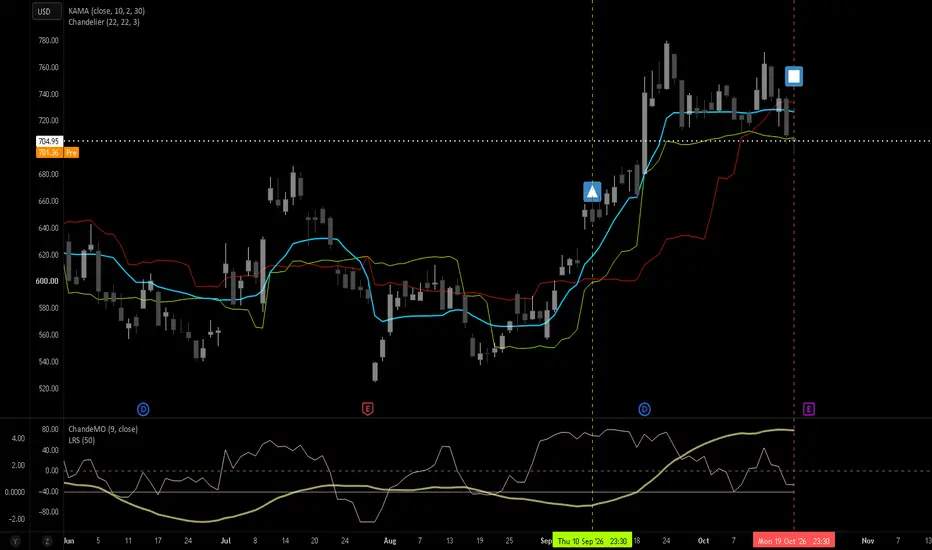
Adaptive Regression Trend Stack — A Multi-Indicator Approach to Trend Trading
I've been exploring a trend-following framework that combines adaptive trend identification, directional confirmation, momentum-based entries, and volatility-adjusted trade management.
Using META for background, the idea is simple: rather than relying on a single indicator, assign each component a specific role within the trading process.
The four components:
1. Kaufman Adaptive Moving Average (KAMA)
Used to identify the underlying trend while adapting its responsiveness to changing market conditions.
2. Linear Regression Slope
Provides directional confirmation by measuring the slope of the fitted price trend.
3. Chande Momentum Oscillator (CMO)
Used as an entry-timing component, helping identify shifts in directional momentum.
4. Chandelier Exit
Provides a volatility-adjusted trailing exit framework designed to accommodate sustained price movements.
The basic logic
Long bias: KAMA in cyan is rising and Linear Regression Slope in thick yellow is positive.
Long entry: CMO in beige crosses above zero while the bullish conditions remain intact.
Short bias: KAMA is falling and Linear Regression Slope is negative.
Short entry: CMO crosses below zero while the bearish conditions remain intact.
Trade management: Chandelier Exit defines the trailing stop. Green for longs, red for shorts.
Each indicator has a distinct job: trend, direction, timing, and risk management.
The objective is to build a framework in which the components complement one another rather than simply stacking multiple indicators that measure essentially the same thing.
This is a conceptual strategy framework, not a claim of verified profitability. The next step would be systematic testing across different market conditions, with transaction costs and slippage included.
Questions for the community:
Would you use a zero-line momentum trigger with an adaptive trend filter, or would you prefer momentum confirmation through a different mechanism?
I'm interested in hearing how others approach the balance between entry responsiveness and avoiding false signals in sideways markets.
#TradingView #TrendFollowing #TechnicalAnalysis #QuantitativeTrading #SystematicTrading

免责声明
这些信息和出版物并非旨在提供,也不构成TradingView提供或认可的任何形式的财务、投资、交易或其他类型的建议或推荐。请阅读使用条款了解更多信息。
免责声明
这些信息和出版物并非旨在提供,也不构成TradingView提供或认可的任何形式的财务、投资、交易或其他类型的建议或推荐。请阅读使用条款了解更多信息。