
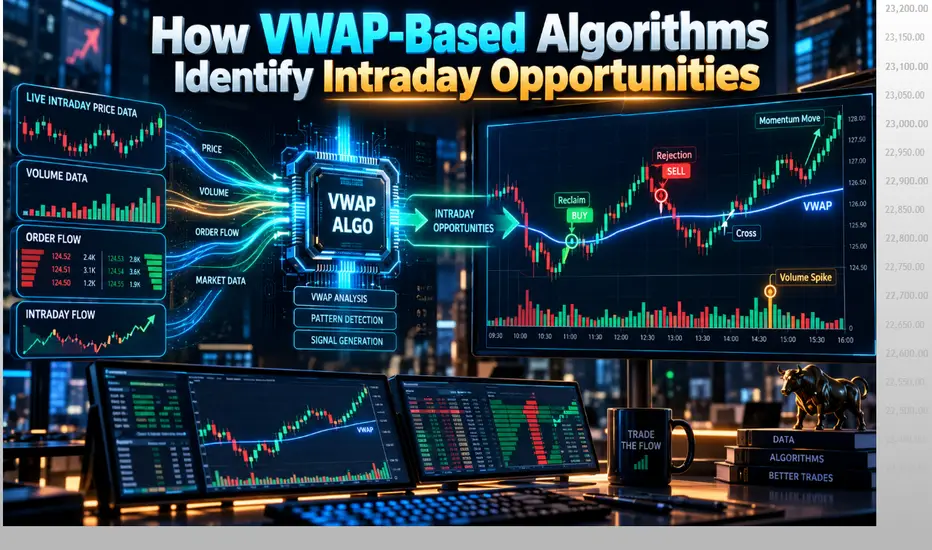
📊 How VWAP-Based Algorithms Identify Intraday Opportunities
VWAP is one of the most useful intraday benchmarks because it shows the market's **volume-weighted average price for the session**.
But a professional algorithm should not simply use:
Price Above VWAP = Buy
Price Below VWAP = Sell
The important question is:
**What is price doing around VWAP — and what type of session are we in?**
---------------------------------
📈 Price + VWAP Direction
A stronger bullish environment may show:
✅ Price above VWAP
✅ VWAP rising
✅ Pullbacks holding near VWAP
✅ Higher highs and higher lows
A stronger bearish environment may show:
✅ Price below VWAP
✅ VWAP falling
✅ Rallies failing near VWAP
✅ Lower highs and lower lows
But:
Flat VWAP + Repeated Crosses
= Possible Sideways Market
---------------------------------
🎯 VWAP Pullback Setup
One common algorithmic setup is:
**Trend → Pullback to VWAP → Confirmation → Continuation**
For a bullish trade, the system may require:
• VWAP rising
• Price pulls back toward VWAP
• Higher low forms
• Selling volume weakens
• Bullish candle confirms
• Recent swing high breaks
Only then:
**LONG SIGNAL**
This avoids chasing price far above VWAP.
---------------------------------
🔄 VWAP Reclaim
Another useful setup is:
Price below VWAP
→ Higher low
→ Close above VWAP
→ Retest holds
→ Swing high breaks
This can signal that intraday control is shifting from sellers toward buyers.
But one candle above VWAP is usually not enough.
Acceptance matters.
---------------------------------
⚠️ Trend Day vs Range Day
VWAP logic should change with the market regime.
Trend Day:
• VWAP clearly slopes
• Price stays mostly on one side
• Pullbacks hold
Better for trend continuation.
Range Day:
• VWAP flat
• Price crosses repeatedly
• Breakouts fail
Better to reduce trend trades or use separate mean-reversion logic.
---------------------------------
📊 Avoid Chasing Far From VWAP
A bullish setup can still be a poor entry if price is already highly extended.
The algorithm can measure:
• % distance from VWAP
• ATR distance
• VWAP deviation bands
If price is too stretched:
**WAIT**
Correct direction does not automatically mean good R:R.
---------------------------------
📊 Price Structure Still Matters
VWAP should provide context.
Price action should provide the trigger.
For longs:
• Higher low
• Resistance breakout
• Support hold
For shorts:
• Lower high
• Support breakdown
• Resistance rejection
Think:
**VWAP = Context**
**Structure = Trigger**
---------------------------------
📊 For Option Traders
Use both the underlying and the option premium.
Underlying:
✅ Above rising VWAP
✅ Structure bullish
✅ Resistance breaks
CE Premium:
✅ Above premium VWAP
✅ Fresh swing-high breakout
✅ Healthy liquidity
**Underlying gives direction.**
**Option premium confirms execution.**
---------------------------------
🛡️ Risk Still Comes First
A VWAP signal should still pass:
• Structural stop check
• Position-size check
• R:R check
• Daily risk limit
Do not use arbitrary fixed stops simply because VWAP generated the setup.
---------------------------------
📊 Simple Formula
Rising VWAP + Price Acceptance + Bullish Structure + Volume + Defined Risk
= Higher-Quality Intraday Long Setup
But:
Flat VWAP + Repeated Crosses + Weak Structure
= Chop / Whipsaw Risk
---------------------------------
📊 Finally, the important point to note is:
VWAP is not a magical buy/sell line.
It is a **session-value framework**.
A good algorithm asks:
“Where is price relative to VWAP?”
“Is VWAP rising, falling or flat?”
“Is price accepting or rejecting the area?”
“Does structure confirm the trade?”
The professional sequence is:
**VWAP Regime → Price Location → Structure → Volume → Risk → Execution**
---------------------------------
Educational Purpose Only.
VWAP is one of the most useful intraday benchmarks because it shows the market's **volume-weighted average price for the session**.
But a professional algorithm should not simply use:
Price Above VWAP = Buy
Price Below VWAP = Sell
The important question is:
**What is price doing around VWAP — and what type of session are we in?**
---------------------------------
📈 Price + VWAP Direction
A stronger bullish environment may show:
✅ Price above VWAP
✅ VWAP rising
✅ Pullbacks holding near VWAP
✅ Higher highs and higher lows
A stronger bearish environment may show:
✅ Price below VWAP
✅ VWAP falling
✅ Rallies failing near VWAP
✅ Lower highs and lower lows
But:
Flat VWAP + Repeated Crosses
= Possible Sideways Market
---------------------------------
🎯 VWAP Pullback Setup
One common algorithmic setup is:
**Trend → Pullback to VWAP → Confirmation → Continuation**
For a bullish trade, the system may require:
• VWAP rising
• Price pulls back toward VWAP
• Higher low forms
• Selling volume weakens
• Bullish candle confirms
• Recent swing high breaks
Only then:
**LONG SIGNAL**
This avoids chasing price far above VWAP.
---------------------------------
🔄 VWAP Reclaim
Another useful setup is:
Price below VWAP
→ Higher low
→ Close above VWAP
→ Retest holds
→ Swing high breaks
This can signal that intraday control is shifting from sellers toward buyers.
But one candle above VWAP is usually not enough.
Acceptance matters.
---------------------------------
⚠️ Trend Day vs Range Day
VWAP logic should change with the market regime.
Trend Day:
• VWAP clearly slopes
• Price stays mostly on one side
• Pullbacks hold
Better for trend continuation.
Range Day:
• VWAP flat
• Price crosses repeatedly
• Breakouts fail
Better to reduce trend trades or use separate mean-reversion logic.
---------------------------------
📊 Avoid Chasing Far From VWAP
A bullish setup can still be a poor entry if price is already highly extended.
The algorithm can measure:
• % distance from VWAP
• ATR distance
• VWAP deviation bands
If price is too stretched:
**WAIT**
Correct direction does not automatically mean good R:R.
---------------------------------
📊 Price Structure Still Matters
VWAP should provide context.
Price action should provide the trigger.
For longs:
• Higher low
• Resistance breakout
• Support hold
For shorts:
• Lower high
• Support breakdown
• Resistance rejection
Think:
**VWAP = Context**
**Structure = Trigger**
---------------------------------
📊 For Option Traders
Use both the underlying and the option premium.
Underlying:
✅ Above rising VWAP
✅ Structure bullish
✅ Resistance breaks
CE Premium:
✅ Above premium VWAP
✅ Fresh swing-high breakout
✅ Healthy liquidity
**Underlying gives direction.**
**Option premium confirms execution.**
---------------------------------
🛡️ Risk Still Comes First
A VWAP signal should still pass:
• Structural stop check
• Position-size check
• R:R check
• Daily risk limit
Do not use arbitrary fixed stops simply because VWAP generated the setup.
---------------------------------
📊 Simple Formula
Rising VWAP + Price Acceptance + Bullish Structure + Volume + Defined Risk
= Higher-Quality Intraday Long Setup
But:
Flat VWAP + Repeated Crosses + Weak Structure
= Chop / Whipsaw Risk
---------------------------------
📊 Finally, the important point to note is:
VWAP is not a magical buy/sell line.
It is a **session-value framework**.
A good algorithm asks:
“Where is price relative to VWAP?”
“Is VWAP rising, falling or flat?”
“Is price accepting or rejecting the area?”
“Does structure confirm the trade?”
The professional sequence is:
**VWAP Regime → Price Location → Structure → Volume → Risk → Execution**
---------------------------------
Educational Purpose Only.

⭐For Live Trading Courses And Trading Community 📈
Contact ⬇️
📱wa.me/919322295961
📱t.me/+UgF9lES_XxA0MTk9
⭐Advanced courses
⭐Fully Automated Algo Trading
⭐Daily F&O Trade tips
📱 t.me/+UgF9lES_XxA0MTk9
Contact ⬇️
📱wa.me/919322295961
📱t.me/+UgF9lES_XxA0MTk9
⭐Advanced courses
⭐Fully Automated Algo Trading
⭐Daily F&O Trade tips
📱 t.me/+UgF9lES_XxA0MTk9
相关出版物
免责声明
这些信息和出版物并非旨在提供,也不构成TradingView提供或认可的任何形式的财务、投资、交易或其他类型的建议或推荐。请阅读使用条款了解更多信息。
⭐For Live Trading Courses And Trading Community 📈
Contact ⬇️
📱wa.me/919322295961
📱t.me/+UgF9lES_XxA0MTk9
⭐Advanced courses
⭐Fully Automated Algo Trading
⭐Daily F&O Trade tips
📱 t.me/+UgF9lES_XxA0MTk9
Contact ⬇️
📱wa.me/919322295961
📱t.me/+UgF9lES_XxA0MTk9
⭐Advanced courses
⭐Fully Automated Algo Trading
⭐Daily F&O Trade tips
📱 t.me/+UgF9lES_XxA0MTk9
相关出版物
免责声明
这些信息和出版物并非旨在提供,也不构成TradingView提供或认可的任何形式的财务、投资、交易或其他类型的建议或推荐。请阅读使用条款了解更多信息。