
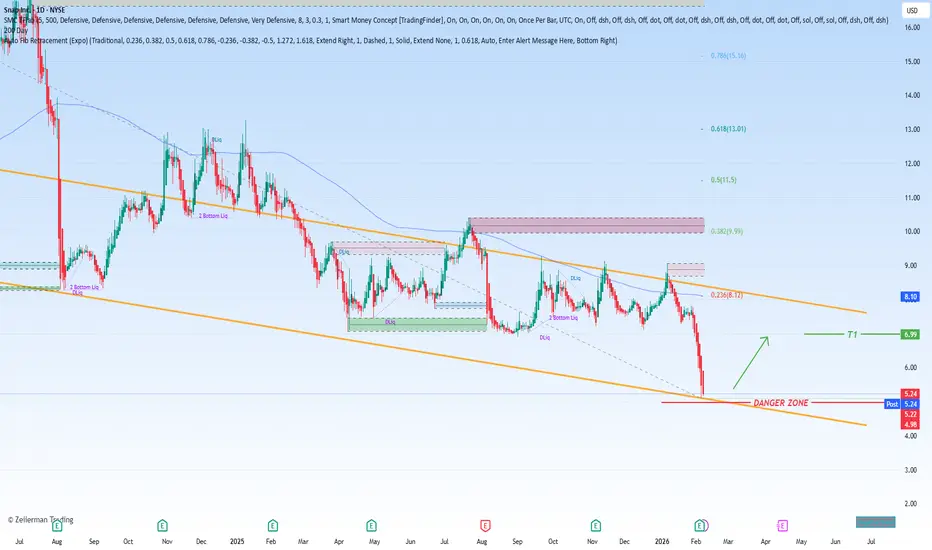
Stifel Upgrades Snap Inc. Amid Steep Sell-Off, Citing a Balanced Risk-Reward Profile
Investment firm Stifel has revised its rating on Snap Inc. (NYSE: SNAP) to “Hold” from a more cautious previous stance, signaling a shift in perspective driven primarily by the stock's substantial and rapid depreciation. The firm argues that the precipitous decline—approximately 37% year-to-date and 33% since late January—has largely balanced the scales between the company's well-documented operational challenges and its current valuation, creating a more neutral risk-reward scenario at present levels. Stifel maintained its price target of $5.50.
Context: From Downgrade to Upgrade
Stifel’s prior downgrade was rooted in a trio of fundamental concerns: a shrinking user base in the critical North American market, underutilized monetization features, and advertising tools that lag behind more sophisticated competitors like Meta and TikTok. These shortcomings were seen as limiting Snap's ability to effectively compete for digital marketing budgets. While the brokerage acknowledges these structural issues persist and have not been resolved, the analytical pivot hinges on the belief that the severity of the recent stock sell-off has now adequately discounted these ongoing pressures. The valuation, in their view, has reset to a point where the downside risk from these known headwinds is now more fairly balanced against any potential upside from operational improvements or strategic developments.
Persistent Fundamental Headwinds
Recent corporate updates have underscored the challenges that initially drove the negative sentiment. Snap's fourth-quarter earnings report revealed a sequential decline of 3 million global daily active users (DAUs), including a significant loss of 4 million users in North America. Compounding this, management announced a strategic reduction in spending on community growth marketing, a move intended to improve profitability but one that is expected to further pressure user engagement metrics in the near term.
On the monetization front, advertising growth remains anemic, failing to gain meaningful momentum in a competitive digital ad landscape. Furthermore, a significant source of potential revenue upside remains shrouded in uncertainty. The company's previously announced proposed partnership with AI firm Perplexity—which involved a $400 million placement fee for a one-year integration—has yet to be finalized for a broader rollout. Due to this lack of a definitive agreement, Snap did not include any contribution from this deal in its financial guidance, leaving a notable gap in its near-term revenue trajectory.
Glimmers of Offsetting Potential
Despite these challenges, Stifel identifies several factors that provide a counterbalance and support the upgraded "Hold" rating. The firm notes that a finalized agreement with Perplexity could serve as a tangible catalyst, improving market sentiment and allowing for the reintroduction of incremental revenue into forward estimates. Additionally, Stifel highlights the continued, albeit quieter, success of Snap's subscription business, Snapchat+. The service reached 24 million subscribers following strong net additions in Q4. This growing, high-margin revenue stream represents a durable and partially user-funded model that can help offset volatility in the advertising business and demonstrates a segment of the user base willing to pay for premium features.
Valuation Reset Creates a New Baseline
A central pillar of Stifel's analysis is the stock's dramatically reset valuation. At current trading levels, Snap now trades at approximately 1.4 times next-twelve-month sales, a multiple that sits well below its historical average. This compression suggests the market has aggressively de-risked the stock, stripping out previous premiums for growth that now appear unrealistic. This valuation reset provides a new, lower baseline from which the stock can potentially stabilize, as much of the negative news appears to be priced in.
Technical Framework for Trading
For market participants, the technical landscape following such a pronounced decline offers defined parameters:
Critical Danger Zone: $5.00 – A breach below this key psychological and technical level could indicate a breakdown of the current consolidation and signal a potential acceleration of the downtrend, invalidating the "balanced" risk-reward thesis.
Near-Term Take-Profit/Target: $7.00 – This level represents a significant area of resistance where the stock could face selling pressure. A move toward this target would correspond with a meaningful recovery from oversold conditions and likely align with positive developments, such as a finalized Perplexity deal or stabilization in user metrics.
Conclusion: A Neutral Stance on a Stabilizing Story
In summary, Stifel's upgrade to "Hold" is less an endorsement of Snap's near-term business momentum and more an acknowledgment that the stock's punishing decline has created a valuation floor. The investment case is now characterized by a standoff between persistent fundamental weaknesses in user growth and advertising against a discounted share price and potential catalysts from partnerships and subscriptions. The recommendation suggests that for existing shareholders, the risk of further material downside may be limited, while for new investors, the stock offers a speculative opportunity with defined technical levels—albeit one that requires patience and a clear understanding of the ongoing operational challenges the company must overcome.

免责声明
这些信息和出版物并非旨在提供,也不构成TradingView提供或认可的任何形式的财务、投资、交易或其他类型的建议或推荐。请阅读使用条款了解更多信息。