
Geopolitics has been very much at the forefront since the beginning of the war in Ukraine in 2022, and this has not prevented the global equity market from regularly reaching new all-time highs. The war in Ukraine has not had a systemic impact on the global economy, but the situation is considered very different with the current conflict in the Middle East due to the importance of the Strait of Hormuz for global energy supply, particularly for the major economic powers in Asia.
The chart below illustrates the weight of Asia in energy imports that pass through the Strait of Hormuz.

What is “systemic” risk?
Systemic risk is the possibility that a negative event affecting an institution, a market, or a major actor triggers a chain reaction that destabilizes the entire economic or financial system. Systemic risk is therefore the risk that an isolated shock triggers a domino effect that threatens the stability of an entire system.
In the current scenario, the blockage of the Strait of Hormuz represents the isolated shock that could lead to systemic risk if such a disruption were to persist over time.
Faced with this possibility, it can be useful to prepare by implementing a hedging strategy for one’s stock portfolio. Naturally, the best protection consists of not being invested in risky equities and therefore significantly increasing the share of cash and/or money-market investments within the portfolio.
However, being 100% in cash is not necessarily the best option.
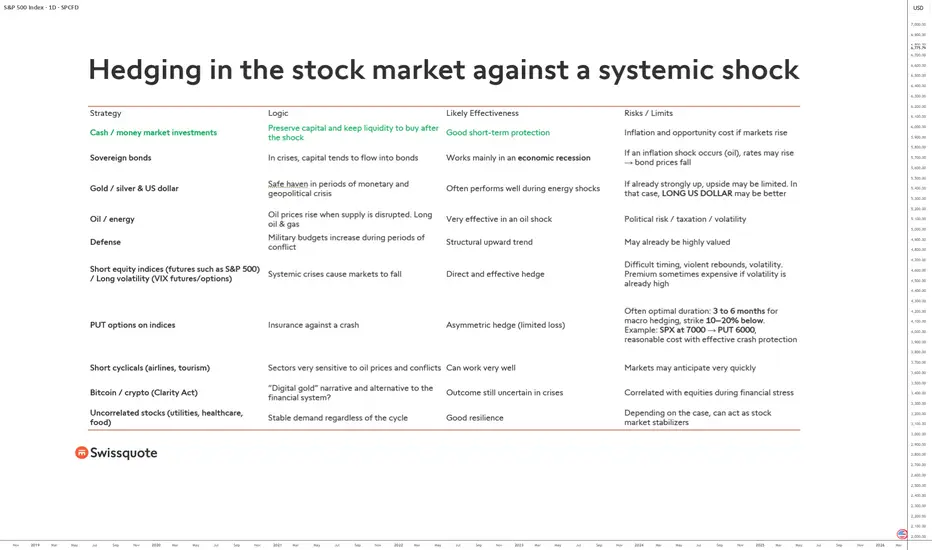
The table below provides a summary of the possible choices across all asset classes. A sound hedging strategy also involves diversifying among several hedging assets, as detailed in the table below.

Indeed, each hedging instrument follows a different logic and protects against specific market scenarios. Sovereign bonds, for example, have historically played the role of safe-haven assets during periods of economic slowdown or financial crisis, as investors tend to move toward the safest assets. However, this protection may be less effective in the context of an inflationary shock linked to energy, since rising interest rates can weigh on bond prices.
Commodities, and energy in particular, also represent a potential hedge in the specific case of a supply shock. If a lasting disruption of the Strait of Hormuz were to occur, oil and gas prices could rise sharply, which would benefit companies in the energy sector. In such a scenario, energy-related assets can act as a natural hedge against the initial shock.
Gold and, to some extent, the US dollar also often play the role of safe-haven assets during periods of geopolitical or financial uncertainty. These assets tend to attract capital flows when investors seek to reduce their exposure to risk. However, their potential largely depends on the entry point and on the level of valuation already reached at the time of the shock.
Finally, some investors choose to use more direct instruments such as short selling stock indices or buying PUT options in order to protect their portfolio against a sharp decline in the markets. These strategies can be particularly effective during phases of panic, but they require good timing and rigorous risk management.
In practice, an effective hedging strategy rarely relies on a single asset. Instead, it consists of combining several complementary instruments in order to reduce the overall vulnerability of the portfolio to a potential systemic shock.
DISCLAIMER:
This content is intended for individuals who are familiar with financial markets and instruments and is for information purposes only. The presented idea (including market commentary, market data and observations) is not a work product of any research department of Swissquote or its affiliates. This material is intended to highlight market action and does not constitute investment, legal or tax advice. If you are a retail investor or lack experience in trading complex financial products, it is advisable to seek professional advice from licensed advisor before making any financial decisions.
This content is not intended to manipulate the market or encourage any specific financial behavior.
Swissquote makes no representation or warranty as to the quality, completeness, accuracy, comprehensiveness or non-infringement of such content. The views expressed are those of the consultant and are provided for educational purposes only. Any information provided relating to a product or market should not be construed as recommending an investment strategy or transaction. Past performance is not a guarantee of future results.
Swissquote and its employees and representatives shall in no event be held liable for any damages or losses arising directly or indirectly from decisions made on the basis of this content.
The use of any third-party brands or trademarks is for information only and does not imply endorsement by Swissquote, or that the trademark owner has authorised Swissquote to promote its products or services.
Swissquote is the marketing brand for the activities of Swissquote Bank Ltd (Switzerland) regulated by FINMA, Swissquote Capital Markets Limited regulated by CySEC (Cyprus), Swissquote Bank Europe SA (Luxembourg) regulated by the CSSF, Swissquote Ltd (UK) regulated by the FCA, Swissquote Financial Services (Malta) Ltd regulated by the Malta Financial Services Authority, Swissquote MEA Ltd. (UAE) regulated by the Dubai Financial Services Authority, Swissquote Pte Ltd (Singapore) regulated by the Monetary Authority of Singapore, Swissquote Asia Limited (Hong Kong) licensed by the Hong Kong Securities and Futures Commission (SFC) and Swissquote South Africa (Pty) Ltd supervised by the FSCA.
Products and services of Swissquote are only intended for those permitted to receive them under local law.
All investments carry a degree of risk. The risk of loss in trading or holding financial instruments can be substantial. The value of financial instruments, including but not limited to stocks, bonds, cryptocurrencies, and other assets, can fluctuate both upwards and downwards. There is a significant risk of financial loss when buying, selling, holding, staking, or investing in these instruments. SQBE makes no recommendations regarding any specific investment, transaction, or the use of any particular investment strategy.
CFDs are complex instruments and come with a high risk of losing money rapidly due to leverage. The vast majority of retail client accounts suffer capital losses when trading in CFDs. You should consider whether you understand how CFDs work and whether you can afford to take the high risk of losing your money.
Digital Assets are unregulated in most countries and consumer protection rules may not apply. As highly volatile speculative investments, Digital Assets are not suitable for investors without a high-risk tolerance. Make sure you understand each Digital Asset before you trade.
Cryptocurrencies are not considered legal tender in some jurisdictions and are subject to regulatory uncertainties.
The use of Internet-based systems can involve high risks, including, but not limited to, fraud, cyber-attacks, network and communication failures, as well as identity theft and phishing attacks related to crypto-assets.
The chart below illustrates the weight of Asia in energy imports that pass through the Strait of Hormuz.
What is “systemic” risk?
Systemic risk is the possibility that a negative event affecting an institution, a market, or a major actor triggers a chain reaction that destabilizes the entire economic or financial system. Systemic risk is therefore the risk that an isolated shock triggers a domino effect that threatens the stability of an entire system.
In the current scenario, the blockage of the Strait of Hormuz represents the isolated shock that could lead to systemic risk if such a disruption were to persist over time.
Faced with this possibility, it can be useful to prepare by implementing a hedging strategy for one’s stock portfolio. Naturally, the best protection consists of not being invested in risky equities and therefore significantly increasing the share of cash and/or money-market investments within the portfolio.
However, being 100% in cash is not necessarily the best option.
The table below provides a summary of the possible choices across all asset classes. A sound hedging strategy also involves diversifying among several hedging assets, as detailed in the table below.
Indeed, each hedging instrument follows a different logic and protects against specific market scenarios. Sovereign bonds, for example, have historically played the role of safe-haven assets during periods of economic slowdown or financial crisis, as investors tend to move toward the safest assets. However, this protection may be less effective in the context of an inflationary shock linked to energy, since rising interest rates can weigh on bond prices.
Commodities, and energy in particular, also represent a potential hedge in the specific case of a supply shock. If a lasting disruption of the Strait of Hormuz were to occur, oil and gas prices could rise sharply, which would benefit companies in the energy sector. In such a scenario, energy-related assets can act as a natural hedge against the initial shock.
Gold and, to some extent, the US dollar also often play the role of safe-haven assets during periods of geopolitical or financial uncertainty. These assets tend to attract capital flows when investors seek to reduce their exposure to risk. However, their potential largely depends on the entry point and on the level of valuation already reached at the time of the shock.
Finally, some investors choose to use more direct instruments such as short selling stock indices or buying PUT options in order to protect their portfolio against a sharp decline in the markets. These strategies can be particularly effective during phases of panic, but they require good timing and rigorous risk management.
In practice, an effective hedging strategy rarely relies on a single asset. Instead, it consists of combining several complementary instruments in order to reduce the overall vulnerability of the portfolio to a potential systemic shock.
DISCLAIMER:
This content is intended for individuals who are familiar with financial markets and instruments and is for information purposes only. The presented idea (including market commentary, market data and observations) is not a work product of any research department of Swissquote or its affiliates. This material is intended to highlight market action and does not constitute investment, legal or tax advice. If you are a retail investor or lack experience in trading complex financial products, it is advisable to seek professional advice from licensed advisor before making any financial decisions.
This content is not intended to manipulate the market or encourage any specific financial behavior.
Swissquote makes no representation or warranty as to the quality, completeness, accuracy, comprehensiveness or non-infringement of such content. The views expressed are those of the consultant and are provided for educational purposes only. Any information provided relating to a product or market should not be construed as recommending an investment strategy or transaction. Past performance is not a guarantee of future results.
Swissquote and its employees and representatives shall in no event be held liable for any damages or losses arising directly or indirectly from decisions made on the basis of this content.
The use of any third-party brands or trademarks is for information only and does not imply endorsement by Swissquote, or that the trademark owner has authorised Swissquote to promote its products or services.
Swissquote is the marketing brand for the activities of Swissquote Bank Ltd (Switzerland) regulated by FINMA, Swissquote Capital Markets Limited regulated by CySEC (Cyprus), Swissquote Bank Europe SA (Luxembourg) regulated by the CSSF, Swissquote Ltd (UK) regulated by the FCA, Swissquote Financial Services (Malta) Ltd regulated by the Malta Financial Services Authority, Swissquote MEA Ltd. (UAE) regulated by the Dubai Financial Services Authority, Swissquote Pte Ltd (Singapore) regulated by the Monetary Authority of Singapore, Swissquote Asia Limited (Hong Kong) licensed by the Hong Kong Securities and Futures Commission (SFC) and Swissquote South Africa (Pty) Ltd supervised by the FSCA.
Products and services of Swissquote are only intended for those permitted to receive them under local law.
All investments carry a degree of risk. The risk of loss in trading or holding financial instruments can be substantial. The value of financial instruments, including but not limited to stocks, bonds, cryptocurrencies, and other assets, can fluctuate both upwards and downwards. There is a significant risk of financial loss when buying, selling, holding, staking, or investing in these instruments. SQBE makes no recommendations regarding any specific investment, transaction, or the use of any particular investment strategy.
CFDs are complex instruments and come with a high risk of losing money rapidly due to leverage. The vast majority of retail client accounts suffer capital losses when trading in CFDs. You should consider whether you understand how CFDs work and whether you can afford to take the high risk of losing your money.
Digital Assets are unregulated in most countries and consumer protection rules may not apply. As highly volatile speculative investments, Digital Assets are not suitable for investors without a high-risk tolerance. Make sure you understand each Digital Asset before you trade.
Cryptocurrencies are not considered legal tender in some jurisdictions and are subject to regulatory uncertainties.
The use of Internet-based systems can involve high risks, including, but not limited to, fraud, cyber-attacks, network and communication failures, as well as identity theft and phishing attacks related to crypto-assets.

This content is written by Vincent Ganne for Swissquote.
This content is intended for individuals who are familiar with financial markets and instruments and is for information purposes only and does not constitute investment, legal or tax advice.
This content is intended for individuals who are familiar with financial markets and instruments and is for information purposes only and does not constitute investment, legal or tax advice.
相关出版物
免责声明
这些信息和出版物并非旨在提供,也不构成TradingView提供或认可的任何形式的财务、投资、交易或其他类型的建议或推荐。请阅读使用条款了解更多信息。
This content is written by Vincent Ganne for Swissquote.
This content is intended for individuals who are familiar with financial markets and instruments and is for information purposes only and does not constitute investment, legal or tax advice.
This content is intended for individuals who are familiar with financial markets and instruments and is for information purposes only and does not constitute investment, legal or tax advice.
相关出版物
免责声明
这些信息和出版物并非旨在提供,也不构成TradingView提供或认可的任何形式的财务、投资、交易或其他类型的建议或推荐。请阅读使用条款了解更多信息。