
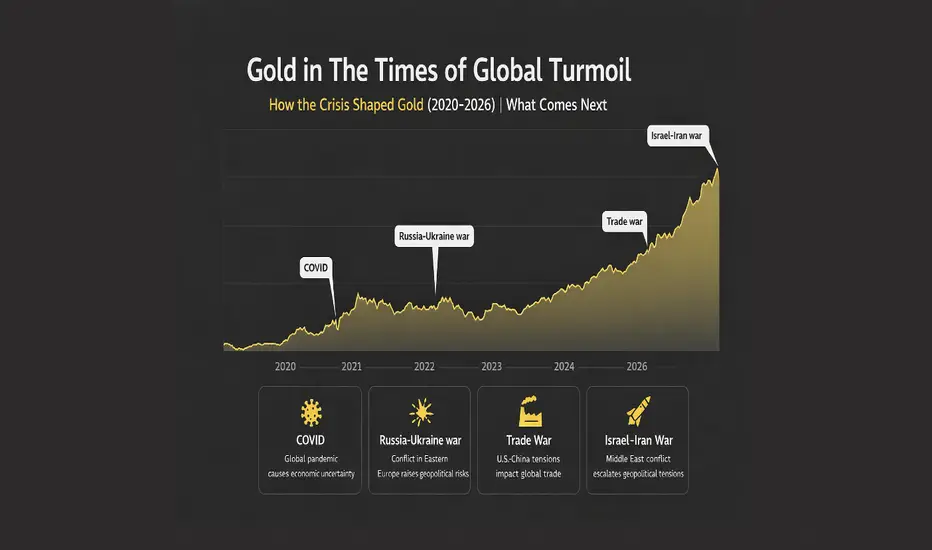
Gold has always been the world's instinctive response to fear. When people lose trust in governments, currencies, or financial systems, they buy gold. The years from 2020 to 2026 gave the world more reasons to be fearful than any period in recent memory — a pandemic, a land war, a global trade war, and an active military conflict in the Middle East. Through all of it, gold responded in a consistent and predictable way. This article traces that journey in plain terms.

1. The COVID-19 Pandemic (2020)
When COVID-19 brought the world to a standstill in early 2020. Financial markets panicked, stocks crashed, then gold- despite its safe haven reputation- also dipped initially, falling to $1,451 in March 2020, as investors sold everything just to raise cash.
But the real story came after. Governments worldwide unleashed trillions in emergency spending. Central banks slashed interest rates to bare minimum. With much new money flooding the system, every dollar in existence became worth a little less- and gold, which cannot be printed, became worth more.
By August 2020, gold had surged to a new all-time high of $2,075. A 43% gain from the panic low in just five months. Gold ended 2020 up 25% for the year- one of its best annual performances in over a decade.
➡Gold dips in the initial panic. The real surge comes afterwards.
2. The Russia-Ukraine War (2022–2024)
Russia's invasion of Ukraine in February 2022 sent gold sharply higher- it briefly touched $2,070 on fear alone. But then something unexpected slowed it down- the US Federal Reserve raised interest rates aggressively to fight post-COVID inflation. Higher rates make bonds attractive, which reduces demand for gold. Despite an active war in Europe, gold fell back to $1,614 by September 2022.
What supercharged Gold was de-dollarization because eventually the countries like China, India, Turkey, Poland, and Saudi Arabia began buying gold at record levels to reduce their dependence on the US dollar. This was a structural shift- not short-term fear, but long-term strategy.
Gold responded sharply and by October 2024, it had climbed to a new all-time high of $2,790. The year 2024 closed with a 28% annual gain.
➡Rising interest rates can slow gold even during a war. But when sovereign nations start replacing dollar reserves with gold, it creates a long-term floor under prices.
3. The US-China Trade War (2025)
Entering 2025, the US imposed sweeping tariffs on China and other major trading partners- in some cases over 100%. Retaliation followed and Global supply chains, still fragile from COVID, further fractured. Inflation fears returned. Growth forecasts were cut. The US dollar weakened as investors began questioning the stability of the dollar-centric global trading system.
For gold, this was a near-perfect environment. Economic uncertainty, a weaker dollar, rising inflation fears, and waning confidence in the existing financial order- all at once. Gold crossed $3,000 in March 2025 for the first time ever and reached $3,500 by April 2025. The trade war added a powerful new leg to an already strong bull market.
➡Trade wars weaken the dollar and raise inflation fears simultaneously — both are directly positive for gold.
4. The Israel-Iran War (February 2025 – Present)
Recently, the Israel-Iran turmoil entered into a direct armed conflict. The impact was immediate and severe. Oil prices surged, adding an energy shock on top of already elevated inflation from the trade war. Middle East instability and concerns about a wider regional conflict added a significant fear premium to gold.
Gold entered overdrive. Already at elevated levels from the trade war, it climbed through $4,000, $5,000, and peaked at $5,602 in January 2026- the highest price gold has ever traded at in nominal terms. In roughly one year, gold had risen 113% from the start of 2025.
As of mid-March 2026, gold has pulled back to approximately $4,502. A hotter inflationary environment is pushing back expectations for interest rate cuts, causing a short-term correction. This may be entirely normal. Every major gold rally in the discussed time period has included pullbacks along the way- before eventually moving higher.
➡Wars in oil-producing regions has brought uncertainty in gold too. Higher chances that the current pullback is potentially a correction, not a reversal.
What Happens Next? Possible Scenarios
The Israel-Iran war is still active. The trade war has not been resolved. Central banks are still buying gold. Interest rates are still expected to fall. Based on how gold has behaved through every crisis in this period, here are the three realistic paths from here:

Key Takeaways

Six years, four crises, one consistent story. Every time the world has been shaken- by a pandemic, by war, by trade conflict- gold has ultimately moved higher.
The current pullback from $5,602 to around $4,502 could be noise, not a long-term trend change. History from this very period shows that gold corrects and then resumes. As long as the underlying conditions remain in place, so does the gold bull market.
Disclaimer: This writeup is for informational/educational purposes only- neither from a gold expert nor from a global economist. It does not constitute any financial or investment advice. Always consult a qualified professional before making investment decisions.
1. The COVID-19 Pandemic (2020)
When COVID-19 brought the world to a standstill in early 2020. Financial markets panicked, stocks crashed, then gold- despite its safe haven reputation- also dipped initially, falling to $1,451 in March 2020, as investors sold everything just to raise cash.
But the real story came after. Governments worldwide unleashed trillions in emergency spending. Central banks slashed interest rates to bare minimum. With much new money flooding the system, every dollar in existence became worth a little less- and gold, which cannot be printed, became worth more.
By August 2020, gold had surged to a new all-time high of $2,075. A 43% gain from the panic low in just five months. Gold ended 2020 up 25% for the year- one of its best annual performances in over a decade.
➡Gold dips in the initial panic. The real surge comes afterwards.
2. The Russia-Ukraine War (2022–2024)
Russia's invasion of Ukraine in February 2022 sent gold sharply higher- it briefly touched $2,070 on fear alone. But then something unexpected slowed it down- the US Federal Reserve raised interest rates aggressively to fight post-COVID inflation. Higher rates make bonds attractive, which reduces demand for gold. Despite an active war in Europe, gold fell back to $1,614 by September 2022.
What supercharged Gold was de-dollarization because eventually the countries like China, India, Turkey, Poland, and Saudi Arabia began buying gold at record levels to reduce their dependence on the US dollar. This was a structural shift- not short-term fear, but long-term strategy.
Gold responded sharply and by October 2024, it had climbed to a new all-time high of $2,790. The year 2024 closed with a 28% annual gain.
➡Rising interest rates can slow gold even during a war. But when sovereign nations start replacing dollar reserves with gold, it creates a long-term floor under prices.
3. The US-China Trade War (2025)
Entering 2025, the US imposed sweeping tariffs on China and other major trading partners- in some cases over 100%. Retaliation followed and Global supply chains, still fragile from COVID, further fractured. Inflation fears returned. Growth forecasts were cut. The US dollar weakened as investors began questioning the stability of the dollar-centric global trading system.
For gold, this was a near-perfect environment. Economic uncertainty, a weaker dollar, rising inflation fears, and waning confidence in the existing financial order- all at once. Gold crossed $3,000 in March 2025 for the first time ever and reached $3,500 by April 2025. The trade war added a powerful new leg to an already strong bull market.
➡Trade wars weaken the dollar and raise inflation fears simultaneously — both are directly positive for gold.
4. The Israel-Iran War (February 2025 – Present)
Recently, the Israel-Iran turmoil entered into a direct armed conflict. The impact was immediate and severe. Oil prices surged, adding an energy shock on top of already elevated inflation from the trade war. Middle East instability and concerns about a wider regional conflict added a significant fear premium to gold.
Gold entered overdrive. Already at elevated levels from the trade war, it climbed through $4,000, $5,000, and peaked at $5,602 in January 2026- the highest price gold has ever traded at in nominal terms. In roughly one year, gold had risen 113% from the start of 2025.
As of mid-March 2026, gold has pulled back to approximately $4,502. A hotter inflationary environment is pushing back expectations for interest rate cuts, causing a short-term correction. This may be entirely normal. Every major gold rally in the discussed time period has included pullbacks along the way- before eventually moving higher.
➡Wars in oil-producing regions has brought uncertainty in gold too. Higher chances that the current pullback is potentially a correction, not a reversal.
What Happens Next? Possible Scenarios
The Israel-Iran war is still active. The trade war has not been resolved. Central banks are still buying gold. Interest rates are still expected to fall. Based on how gold has behaved through every crisis in this period, here are the three realistic paths from here:
Key Takeaways
Six years, four crises, one consistent story. Every time the world has been shaken- by a pandemic, by war, by trade conflict- gold has ultimately moved higher.
The current pullback from $5,602 to around $4,502 could be noise, not a long-term trend change. History from this very period shows that gold corrects and then resumes. As long as the underlying conditions remain in place, so does the gold bull market.
Disclaimer: This writeup is for informational/educational purposes only- neither from a gold expert nor from a global economist. It does not constitute any financial or investment advice. Always consult a qualified professional before making investment decisions.

JJ Singh
Trader/Investor
Moderator, TradingView
🚀Join t.me/jjsingh_2020 ,
A Free Education channel
🚀Tweet at twitter.com/JaySingh_2020
Trader/Investor
Moderator, TradingView
🚀Join t.me/jjsingh_2020 ,
A Free Education channel
🚀Tweet at twitter.com/JaySingh_2020
免责声明
这些信息和出版物并非旨在提供,也不构成TradingView提供或认可的任何形式的财务、投资、交易或其他类型的建议或推荐。请阅读使用条款了解更多信息。
JJ Singh
Trader/Investor
Moderator, TradingView
🚀Join t.me/jjsingh_2020 ,
A Free Education channel
🚀Tweet at twitter.com/JaySingh_2020
Trader/Investor
Moderator, TradingView
🚀Join t.me/jjsingh_2020 ,
A Free Education channel
🚀Tweet at twitter.com/JaySingh_2020
免责声明
这些信息和出版物并非旨在提供,也不构成TradingView提供或认可的任何形式的财务、投资、交易或其他类型的建议或推荐。请阅读使用条款了解更多信息。