
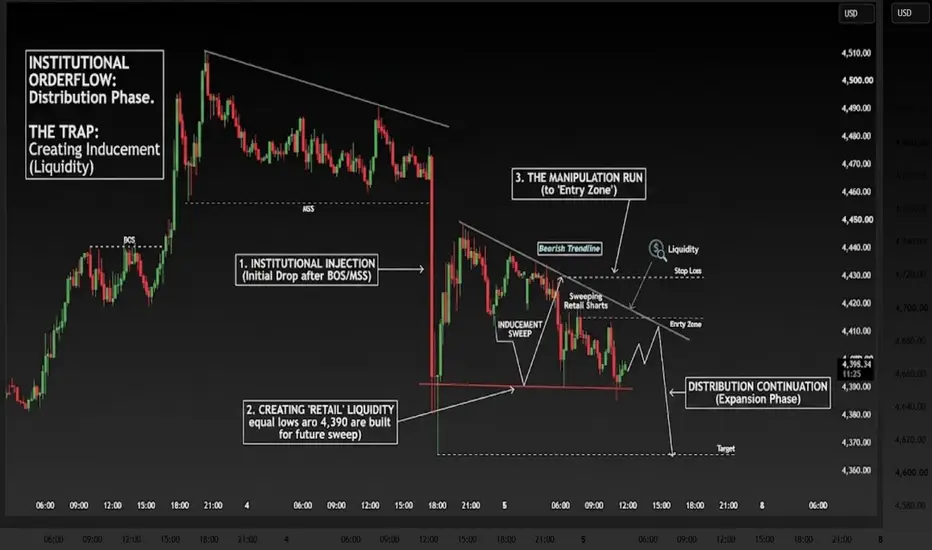
Institutional traders (banks, hedge funds, smart money) do not trade like retail traders. They operate with massive position sizes, which means they cannot simply press "Buy" or "Sell" without moving the market against themselves. To build their positions, they must engineer liquidity through Inducement and Manipulation.
Here is a full breakdown of how institutional order flow operates, using the Gold (XAUUSD) chart above as a real-time playbook.
1. Distribution Phase (Building Orders)
The Concept: Before a major decline, institutions accumulate short positions at premium prices.
The Reality: They cannot dump millions of contracts instantly without creating slippage. They push price into key supply/resistance zones to entice retail buyers (providing counterparty liquidity) before driving price down.
2. Institutional Injection & Market Structure Shift (MSS)
The Catalyst: A sudden, aggressive surge in volume (often fueled by high-impact news like NFP) causes price to displace rapidly lower.
The Break: This sharp drop forcefully breaks prior swing supports, confirming a Market Structure Shift (MSS). It signals that smart money has committed to a bearish direction.
3. Creating Inducement (The Retail Trap)
The Liquidity Pool: After an initial drop, price pauses and begins to form equal lows or a clean descending trendline. Retail traders start buying the "support" or shorting the "breakout."
The Trap: These obvious retail patterns create concentrated pools of Stop Losses above trendlines and below swing lows. To institutions, stop losses equal pure market execution liquidity.
4. The Manipulation Run (Sweeping Retest)
The Move: Price pushes back up into the Entry Zone (4,410 – 4,418) toward the bearish trendline.
The Goal: This corrective leg serves two purposes:
Sweeps retail short stop-losses above the trendline to fill remaining institutional sell orders.
Mitigates overhead supply / Fair Value Gaps (FVG) left behind during the aggressive sell-off.
5. Expansion Phase (The Real Move)
The Execution: Once liquidity is cleared and all institutional orders are filled at the premium retest zone, price expands rapidly toward the final target (4,367.00).
The Outcome: The low-liquidity target zone gets wiped out as retail stop-losses are triggered, completing the institutional distribution cycle.
💡 Key Takeaway for Retail Traders: Stop trying to predict tops and bottoms. Wait for the Market Structure Shift (MSS), identify where retail liquidity is trapped, and trade with the institutional retest—not against it.
What phase of institutional order flow do you focus on most? Drop your thoughts below! 👇
Disclaimer: Educational analysis only. Always manage your risk properly before taking any trades.
#SmartMoneyConcepts #TradingView #InstitutionalTrading #Forex #Gold #XAUUSD #PriceAction #OrderFlow

Gold Free Signals 🔔
t.me/+UamB2uCTUtkzMmQ0
Account Management?
Contact now 👉 t.me/traderrr57
BACKUP CHANNELS
t.me/goldoperator57
t.me/katefx57
t.me/Xausniperelite
t.me/+UamB2uCTUtkzMmQ0
Account Management?
Contact now 👉 t.me/traderrr57
BACKUP CHANNELS
t.me/goldoperator57
t.me/katefx57
t.me/Xausniperelite
免责声明
这些信息和出版物并非旨在提供,也不构成TradingView提供或认可的任何形式的财务、投资、交易或其他类型的建议或推荐。请阅读使用条款了解更多信息。