Adaptive Breakout Oscillator [SchizoQuant]
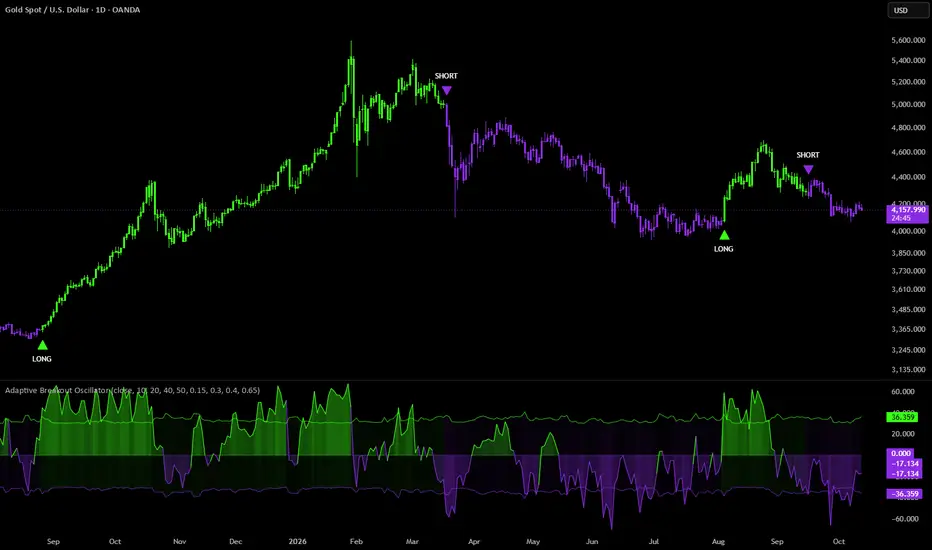
🟣Adaptive Breakout Oscillator is a multi-horizon directional-pressure indicator that combines completed price channels, compression-sensitive weighting, and adaptive confirmation thresholds to identify bullish and bearish trend regimes.
Instead of relying on a single breakout lookback or fixed threshold, the indicator evaluates short-, medium-, and long-term price structures and adjusts both their influence and the confirmation required for a directional reversal.
🟣How It Works
🟣Compression-Aware Weighting
🟣Adaptive Confirmation Threshold
🟣Signal Logic
🟣Visual Feedback
🟣User Controls
🟣What Makes It Different
🟣Intended Use
🟣Limitations
Instead of relying on a single breakout lookback or fixed threshold, the indicator evaluates short-, medium-, and long-term price structures and adjusts both their influence and the confirmation required for a directional reversal.
🟣How It Works
The indicator combines three completed price channels to measure directional pressure across different structural horizons.
Each channel evaluates price relative to its midpoint and boundaries, producing a normalized pressure measurement between -1 and +1.
• Positive pressure indicates bullish structural positioning.
• Negative pressure indicates bearish structural positioning.
• Stronger displacement beyond a channel increases pressure toward its directional limit.
The three measurements are combined into a weighted consensus and scaled to an oscillator between -100 and +100.
Unlike a conventional fixed-threshold oscillator, the model adapts its weighting to structural compression and its confirmation requirements to disagreement between the three horizons.
🟣Compression-Aware Weighting
Each structural horizon receives an adaptive weight based on relative channel compression and directional pressure magnitude.
Channels that are compressed relative to their historical width receive greater influence, while stronger directional pressure increases the urgency component.Pine Script®
The same calculation applies to the medium and long structures.
Minimum Weight prevents any horizon from losing all influence, while the final consensus normalizes their combined contributions.
This allows structurally compressed horizons to influence the oscillator without assigning permanently equal importance to every channel.
🟣Adaptive Confirmation Threshold
The indicator measures structural disagreement as the weighted deviation of each horizon's pressure from the combined consensus.
Greater disagreement increases the confirmation required for a regime reversal.Pine Script®
Base Threshold establishes the minimum confirmation requirement.
Disagreement Adaptation controls how strongly conflicting structures increase that requirement.
Maximum Threshold limits the upper confirmation boundary.
When the structural horizons agree, confirmation remains closer to its base level. When they conflict, the threshold can expand to demand stronger directional consensus.
🟣Signal Logic
LONG and SHORT markers identify changes in the indicator's persistent bullish or bearish breakout regime.
A reversal requires the oscillator to exceed the adaptive confirmation threshold in the opposing direction.Pine Script®
A LONG condition requires:
• The oscillator to exceed the bullish confirmation level
• The internal regime to change from bearish to bullish
A SHORT condition requires:
• The oscillator to fall below the bearish confirmation level
• The internal regime to change from bullish to bearish
The previous regime persists until sufficient opposing pressure develops.
LONG and SHORT markers appear only when the internal regime changes, preventing repeated signals during an uninterrupted directional regime.
🟣Visual Feedback
The indicator displays a normalized pressure oscillator, adaptive bullish and bearish confirmation levels, and an optional shaded threshold region.
Individual short-, medium-, and long-term pressure components can also be displayed for comparison.
Neon green represents positive pressure and bullish conditions, while purple represents negative pressure and bearish conditions.
The oscillator follows current directional pressure, while optional candle coloring follows the persistent trend regime.
LONG and SHORT markers appear directly on the main price chart.
Additional pressure, compression, weighting, disagreement, and threshold measurements are available through TradingView's Data Window.
🟣User Controls
Users can configure the three structural lengths, compression memory, minimum adaptive weight, base threshold, disagreement adaptation, and maximum threshold.
Visualization controls manage confirmation levels, threshold fill, individual structural components, signals, and candle coloring.
Separate TradingView alerts are provided for LONG and SHORT regime transitions.
The indicator can be applied across different markets and chart timeframes, with responsiveness determined by the selected structural and confirmation settings.
🟣What Makes It Different
Adaptive Breakout Oscillator uses two complementary adaptation mechanisms:
• Adaptive weighting changes how strongly each structural horizon contributes to directional consensus.
• Adaptive confirmation changes how much opposing pressure is required when those horizons disagree.
Combining completed price structure, compression-sensitive weighting, and disagreement-based thresholds creates a directional regime framework that responds to both structural importance and structural agreement.
This distinguishes the model from a simple average of breakout measurements or an oscillator using permanently fixed confirmation levels.
🟣Intended Use
Adaptive Breakout Oscillator is designed for directional-pressure monitoring, multi-horizon breakout analysis, and trend-regime filtering.
It can help identify bullish and bearish structural conditions, evaluate agreement between different price horizons, and monitor potential directional reversals.
The oscillator and its confirmation levels can also provide additional context when used alongside an existing trading methodology.
🟣Limitations
Adaptive Breakout Oscillator is a structural-pressure and trend-regime indicator, not a complete trading system. LONG and SHORT markers identify changes in its internal regime and do not imply guaranteed trading outcomes or future performance.
During sideways or irregular markets, conflicting structural pressures may reduce directional consensus or generate repeated regime changes.

🟣 Profitable Crypto Strategies | Free Trial — schizoquant.com
免责声明
这些信息和出版物并非旨在提供,也不构成TradingView提供或认可的任何形式的财务、投资、交易或其他类型的建议或推荐。请阅读使用条款了解更多信息。
🟣 Profitable Crypto Strategies | Free Trial — schizoquant.com
免责声明
这些信息和出版物并非旨在提供,也不构成TradingView提供或认可的任何形式的财务、投资、交易或其他类型的建议或推荐。请阅读使用条款了解更多信息。