Momentum Impulse Follow Through Map [Pineify]
Momentum Impulse Follow Through Map [Pineify]
Overview
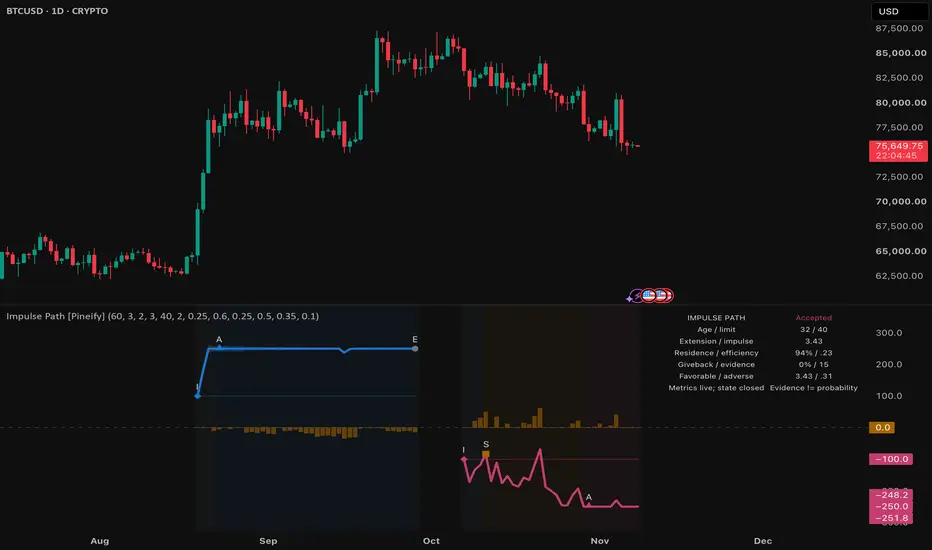
This momentum impulse indicator follows one confirmed shock through a finite observation period. A signed path shows retained movement; an evidence band separates aftermath acceptance from the initiating candle size.
Problem Definition
A large close-to-close move can be followed by steady extension, sideways holding or a return through its starting price. A ROC threshold identifies the move but says little about its aftermath. Including the impulse in subsequent path efficiency also gives that event an immediate head start. The design therefore freezes the event coordinates and counts follow-through evidence only after the impulse closes.
Design Rationale
Prior-window median/MAD resist outliers; a range floor limits scores when dispersion is tiny. Frozen coordinates prevent later volatility from changing the measuring stick. Residence measures time beyond the endpoint; efficiency penalizes zigzags. Excursion memory retains damage hidden by a recovered endpoint. Rolling ROC is simpler but moves the origin; frozen events instead retain old damage until termination. This delays reacceptance after a deep setback.
Key Features
One active event has pending/accepted/stalled/reversed states and close confirmation. Band, giveback columns, background, markers and summary have separate switches. No volume or external symbols are needed.
How It Works
The detector uses the preceding 60 changes by default, excluding the current move. Scale is the greatest of 1.4826 times their MAD, one quarter of prior median true range and one tick. A shock needs a residual score of 3, an absolute move of 2 scales and matching move/residual signs. A valid non-shock close must arm detection first.
At launch it freezes the previous close as origin, the impulse close as endpoint, amplitude and scale. Later closes supply forward displacement from that endpoint, maximum favorable/adverse close excursions, absolute travel and the fraction strictly beyond the endpoint. Signed efficiency is forward displacement divided by travel; zero travel gives zero. Giveback is favorable excursion minus current forward displacement, divided by amplitude plus favorable excursion.
Default acceptance needs age 3, extension of 0.25 impulses, residence 0.60, efficiency 0.25, giveback at most 0.50 and adverse excursion at most 0.35 impulses. Weaker retention gates reduce chattering. Other mature paths propose stall; closes 0.10 impulses beyond the origin propose reversal first. Two consecutive candidate closes confirm a change. Reversal ends the event; age 40 expires it separately. Invalid OHLC interrupts it.
How Multiple Indicators Work Together
The detector supplies fixed coordinates; post-event residence and efficiency test persistence; excursion memory and giveback constrain recovered paths. Without the endpoint split, the shock counts as its own acceptance. Band width multiplies capped progress, residence, positive efficiency and retained fractions after giveback and adverse damage.
Trading Ideas and Insights
Compare accepted and stalled paths of similar impulse size. Band width describes joint evidence, not a trade probability. Stall can mean sideways holding. Inspect the price chart when interpreting reversal: it describes closes beyond a historical origin, without modeling execution or forecasting a target.
Unique Aspects
Relative to a one-shot momentum threshold, impulse selection is separated from aftermath evaluation. Acceptance must be earned with new closes, while adverse damage survives a bounce. Busy events ignore later shocks, preventing reanchoring from selecting favorable fragments. Median/MAD and path efficiency are general methods, not proprietary formulas.
How to Use
Use standard candles on liquid 5m-1D charts. Zero is the origin; +/-100 is the impulse endpoint. The price-oriented path clips at +/-250; raw values remain in the Data Window. I/A/S/R/E mark launch, acceptance, stall, reversal and expiry. Set alerts once per bar close, including data interruption.
Customization
Baseline length spans 20-240 bars; impulse score and minimum move control event selection. Observation age, confirmation count and the five acceptance gates control patience and path quality; the reversal buffer controls origin penetration. Defaults are starting points. Longer confirmation delays recognition. Summary metrics are live, while the state wash describes the latest confirmed state.
Assumptions and Limitations
Baseline detection requires all prior slots, valid current OHLC and positive median range; nonstandard charts are blocked. Active events use frozen data, so later baseline loss alone does not end them. Excursions use closes, missing intrabar extremes. Session gaps count as adjacent observed closes, without synthetic bars. Live metrics and band can change intrabar; event memory, state and alerts commit at close. After termination a new non-shock close must rearm. Expiry makes no outcome claim. Thresholds are sensitive to symbol and timeframe; event selection ignores overlapping shocks. Input or feed revisions can recalculate history. No profitability, statistical confidence or execution quality is established.
Conclusion
Read the fixed event path, damage memory and confirmed state together. They distinguish post-impulse extension, insufficient evidence and origin reversal within a bounded observation period.

🚀🚀🚀 Pineify - pineify.app
Essential Toolkit for Every Trader
- AI Pine Script Generator
- Finance AI Agent
- AI Stock Picker
- Pine Script Visual Editor
- Invited indicators
- Strategy Optimizer
- Trading Journal
- Backtest Report
Essential Toolkit for Every Trader
- AI Pine Script Generator
- Finance AI Agent
- AI Stock Picker
- Pine Script Visual Editor
- Invited indicators
- Strategy Optimizer
- Trading Journal
- Backtest Report
免责声明
这些信息和出版物并非旨在提供,也不构成TradingView提供或认可的任何形式的财务、投资、交易或其他类型的建议或推荐。请阅读使用条款了解更多信息。