PINE LIBRARY
已更新 Public_Library_ChessAI

This library is the brain of the Chess script: a small chess opponent built on the ChessCore rules engine.
It is not a search engine. It is a ladder of ten rules that looks at one position, tries the rules in order, and plays the first that fires:
1. Mate in one
2. Opening book
3. Avoid checkmate
4. Defence
5. Win material
6. Safe check
7. Exchange when ahead
8. Endgame
9. Develop
10. Any other safe move
🟩 THE FORESEE
Before the ladder runs, a foresee stage takes every legal move and adds to its object its most likely material outcome. This score comes from the opponent's best replies to our move, and a few captures after that. We look at the opponent's best captures, his checks, his most menacing quiet threats, and what happens if we don't take. We also look briefly whether two checks in a row force mate. Deep thinking follows more replies and reads six half-moves.
The score works mostly as a veto. From the list of possible moves for a ladder stage, we reject the ones that end in us being checkmated. When every legal move walks into one, we toss a coin to decide between playing the least-bad move and resigning.
🟩 KEEPING A WON GAME WON
If we are winning we want to win, not draw. While ahead on material, the quiet rules refuse any move that recreates a position the game has already seen, so it can't shuffle a rook between two good squares forever. And the foresee prices a stalemate at minus the lead it would throw away, so the winning side sidesteps the trap while the losing side, correctly, steers toward it. The endgame rule gives the ladder actual technique (push passers, rook to the seventh, king up to escort) to try to win.
🟩 DETERMINISM
No `math.random()` call decides anything on its own. The first five rules always give the same answer for a position. The last five pick from their pools with a seed the consumer supplies, derived from the game record. Variety between games comes from the consumer script mixing a clock reading into the seed, not from the library.
🟩 PROCESS FLOW
The exported functions are called in a certian order for each position:
See the Chess script to play against this AI: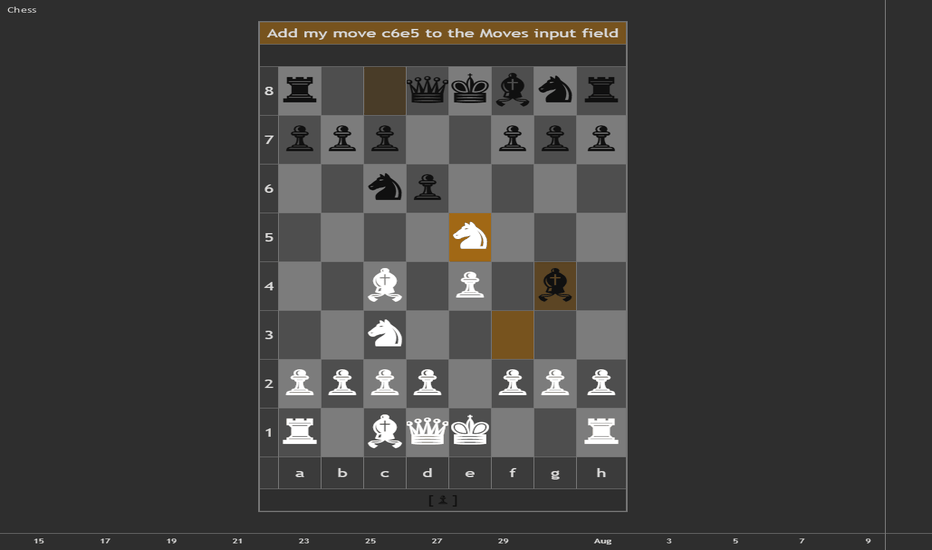
It is not a search engine. It is a ladder of ten rules that looks at one position, tries the rules in order, and plays the first that fires:
1. Mate in one
2. Opening book
3. Avoid checkmate
4. Defence
5. Win material
6. Safe check
7. Exchange when ahead
8. Endgame
9. Develop
10. Any other safe move
🟩 THE FORESEE
Before the ladder runs, a foresee stage takes every legal move and adds to its object its most likely material outcome. This score comes from the opponent's best replies to our move, and a few captures after that. We look at the opponent's best captures, his checks, his most menacing quiet threats, and what happens if we don't take. We also look briefly whether two checks in a row force mate. Deep thinking follows more replies and reads six half-moves.
The score works mostly as a veto. From the list of possible moves for a ladder stage, we reject the ones that end in us being checkmated. When every legal move walks into one, we toss a coin to decide between playing the least-bad move and resigning.
🟩 KEEPING A WON GAME WON
If we are winning we want to win, not draw. While ahead on material, the quiet rules refuse any move that recreates a position the game has already seen, so it can't shuffle a rook between two good squares forever. And the foresee prices a stalemate at minus the lead it would throw away, so the winning side sidesteps the trap while the losing side, correctly, steers toward it. The endgame rule gives the ladder actual technique (push passers, rook to the seventh, king up to escort) to try to win.
🟩 DETERMINISM
No `math.random()` call decides anything on its own. The first five rules always give the same answer for a position. The last five pick from their pools with a seed the consumer supplies, derived from the game record. Variety between games comes from the consumer script mixing a clock reading into the seed, not from the library.
🟩 PROCESS FLOW
The exported functions are called in a certian order for each position:
- ChessCore generates the legal moves.
- `annotateMoves()` counts the attackers and defenders on every move's landing square, and notes the cheapest attacker. Every safety test the rules make reads these three numbers.
- `filterPromotions()` and `classifyMoves()` trim pointless pawn promotions and flag moves that make the king's cover worse or that just undo the previous move.
- The foresee adds a score to each candidate move: `foreseePrepare()` starts the story, `foreseeFinishCaptures()` follows the capture lines, and `foreseeFinishRest()` follows the checks and quiet threats. The consuming script spreads these calls across chart bars so no single bar works too hard.
- The ladder rules run in order, `ruleMateInOne()` down to `ruleFallback()`, and the first one that returns a move wins.
See the Chess script to play against this AI:
版本注释
v2Imports v2 of ChessCore
Pine脚本库
秉承TradingView的精神,作者已将此Pine代码作为开源库发布,以便我们社区的其他Pine程序员可以重用它。向作者致敬!您可以私下或在其他开源出版物中使用此库,但在出版物中重用此代码须遵守网站规则。

🔥 Beyond Market Structure Paid Space is now live! is.gd/beyondMS
🆓 All my free scripts: is.gd/simplefree
🆓 All my free scripts: is.gd/simplefree
免责声明
这些信息和出版物并非旨在提供,也不构成TradingView提供或认可的任何形式的财务、投资、交易或其他类型的建议或推荐。请阅读使用条款了解更多信息。
Pine脚本库
秉承TradingView的精神,作者已将此Pine代码作为开源库发布,以便我们社区的其他Pine程序员可以重用它。向作者致敬!您可以私下或在其他开源出版物中使用此库,但在出版物中重用此代码须遵守网站规则。
🔥 Beyond Market Structure Paid Space is now live! is.gd/beyondMS
🆓 All my free scripts: is.gd/simplefree
🆓 All my free scripts: is.gd/simplefree
免责声明
这些信息和出版物并非旨在提供,也不构成TradingView提供或认可的任何形式的财务、投资、交易或其他类型的建议或推荐。请阅读使用条款了解更多信息。