OPEN-SOURCE SCRIPT
MSX Liquidity Lines
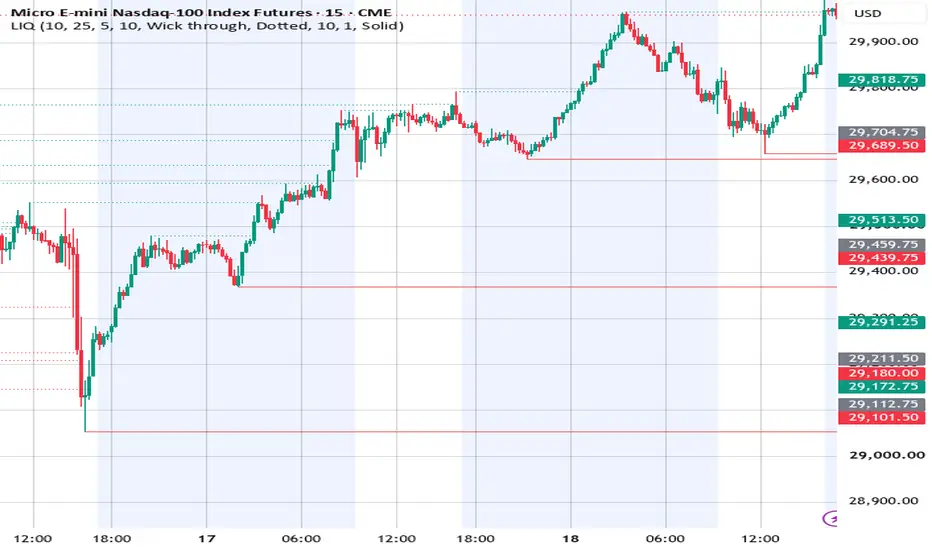
Liquidity Lines
Marks resting liquidity at confirmed swing highs and lows, and shows you when it gets taken.
Every confirmed pivot high and pivot low gets a horizontal line that extends to the right and stays there until price trades through it. When a level is swept, the line dims and stops at the bar that took it — so at any moment the bright lines are the liquidity still sitting on the chart, and the faded ones are the history of what's already been run.
How the levels are placed
Three details that determine whether a level sits where orders actually rest:
Levels are drawn on the wick, not the close. Stops sit above the high and below the low, so that's where the line goes.
Each line starts at its own pivot bar. A pivot can only be confirmed some bars after it forms, and drawing the line from the confirmation bar misplaces it in time. This walks each line back to the swing it belongs to.
Equal highs and equal lows merge. A new pivot that forms within tolerance of a live level joins that level instead of drawing a second line a few ticks away, and the line thickens with each touch. A double or triple top reads as one heavy line rather than three thin ones stacked together — one pool of orders, drawn as one level, weighted by how many times price has left stops there.
Settings
Swing length — the main control. Higher values return fewer, more significant levels; lower values surface the minor intraday pools. 10 is a balanced default.
Merge tolerance — how close two pivots must be to count as the same pool, measured as a percentage of ATR so it scales across instruments and timeframes.
Break trigger — wick-through treats a level as taken the moment price trades past it; close-through only counts a body close beyond it.
Stop line at the break — on, swept lines terminate where they were taken. Off, they keep extending in a dimmed state.
Dim amount, colors, widths and line styles are all adjustable, including separate styling for live and swept levels.
Notes
Levels confirm after the pivot completes, which means a level appears on the chart some bars after the swing that formed it. The line is drawn back to the correct bar, but it cannot exist before the pivot is confirmed.
This is a levels tool. It does not generate entries, exits, or directional signals, and it makes no claim about what price will do when a level is reached.
Marks resting liquidity at confirmed swing highs and lows, and shows you when it gets taken.
Every confirmed pivot high and pivot low gets a horizontal line that extends to the right and stays there until price trades through it. When a level is swept, the line dims and stops at the bar that took it — so at any moment the bright lines are the liquidity still sitting on the chart, and the faded ones are the history of what's already been run.
How the levels are placed
Three details that determine whether a level sits where orders actually rest:
Levels are drawn on the wick, not the close. Stops sit above the high and below the low, so that's where the line goes.
Each line starts at its own pivot bar. A pivot can only be confirmed some bars after it forms, and drawing the line from the confirmation bar misplaces it in time. This walks each line back to the swing it belongs to.
Equal highs and equal lows merge. A new pivot that forms within tolerance of a live level joins that level instead of drawing a second line a few ticks away, and the line thickens with each touch. A double or triple top reads as one heavy line rather than three thin ones stacked together — one pool of orders, drawn as one level, weighted by how many times price has left stops there.
Settings
Swing length — the main control. Higher values return fewer, more significant levels; lower values surface the minor intraday pools. 10 is a balanced default.
Merge tolerance — how close two pivots must be to count as the same pool, measured as a percentage of ATR so it scales across instruments and timeframes.
Break trigger — wick-through treats a level as taken the moment price trades past it; close-through only counts a body close beyond it.
Stop line at the break — on, swept lines terminate where they were taken. Off, they keep extending in a dimmed state.
Dim amount, colors, widths and line styles are all adjustable, including separate styling for live and swept levels.
Notes
Levels confirm after the pivot completes, which means a level appears on the chart some bars after the swing that formed it. The line is drawn back to the correct bar, but it cannot exist before the pivot is confirmed.
This is a levels tool. It does not generate entries, exits, or directional signals, and it makes no claim about what price will do when a level is reached.
开源脚本
秉承TradingView的精神,该脚本的作者将其开源,以便交易者可以查看和验证其功能。向作者致敬!您可以免费使用该脚本,但请记住,重新发布代码须遵守我们的网站规则。

免责声明
这些信息和出版物并非旨在提供,也不构成TradingView提供或认可的任何形式的财务、投资、交易或其他类型的建议或推荐。请阅读使用条款了解更多信息。
免责声明
这些信息和出版物并非旨在提供,也不构成TradingView提供或认可的任何形式的财务、投资、交易或其他类型的建议或推荐。请阅读使用条款了解更多信息。