Apex Trail | Trend Agreement Scalper with ATR Trailing Stop
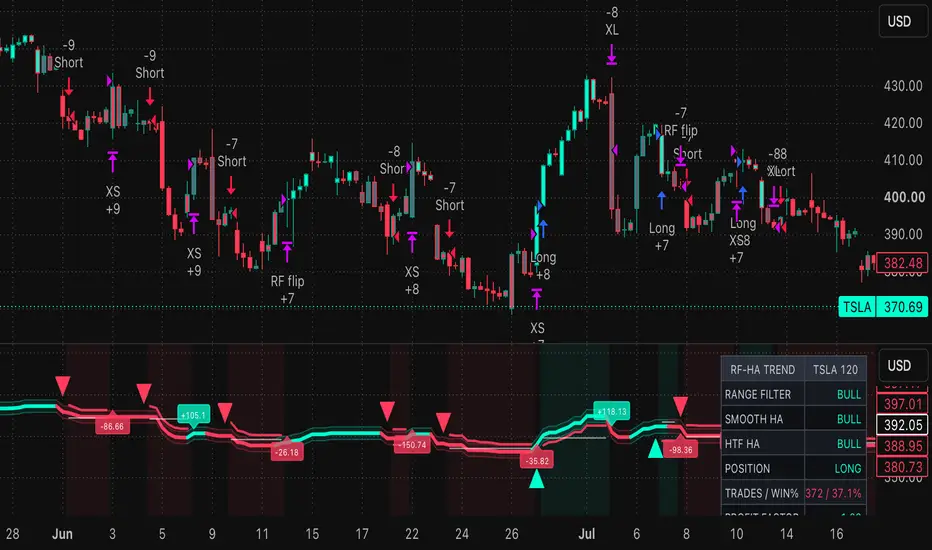
A simple trend-following strategy for scalping and intraday trading. It waits until three independent trend readings agree, enters on the first bar of that agreement, and then rides the move with an ATR trailing stop. There is no tight fixed target, so winners are not cut short.
How it works
1. Range Filter (trend regime). An adaptive step filter that only moves when price travels beyond a volatility-based range, so small noise is ignored. A rising filter means bullish and a falling one means bearish.
2. Smoothed Heikin-Ashi (momentum bias). Price is smoothed with EMAs, converted to Heikin-Ashi candles, then smoothed again, giving a clean bullish or bearish candle direction.
3. Higher-timeframe HA (context). The same smoothed HA is read on a higher timeframe (default 1h) using the last closed bar, so it does not repaint. The strategy avoids trading against the bigger trend.
4. SMI anti-chase filter. A Stochastic Momentum Index stops entries when the move is already stretched. Longs are skipped if SMI is above +60 and shorts if it is below -60 (adjustable).
Entry: a long needs all three trend readings bullish on the same bar, entered when the agreement first appears. A short is the mirror image.
Exit: an ATR trailing stop that only moves in your favour. You can also exit when the Range Filter flips against the trade, and add an optional take-profit as a multiple of initial risk.
Features
Tips
Warnings
How it works
1. Range Filter (trend regime). An adaptive step filter that only moves when price travels beyond a volatility-based range, so small noise is ignored. A rising filter means bullish and a falling one means bearish.
2. Smoothed Heikin-Ashi (momentum bias). Price is smoothed with EMAs, converted to Heikin-Ashi candles, then smoothed again, giving a clean bullish or bearish candle direction.
3. Higher-timeframe HA (context). The same smoothed HA is read on a higher timeframe (default 1h) using the last closed bar, so it does not repaint. The strategy avoids trading against the bigger trend.
4. SMI anti-chase filter. A Stochastic Momentum Index stops entries when the move is already stretched. Longs are skipped if SMI is above +60 and shorts if it is below -60 (adjustable).
Entry: a long needs all three trend readings bullish on the same bar, entered when the agreement first appears. A short is the mirror image.
Exit: an ATR trailing stop that only moves in your favour. You can also exit when the Range Filter flips against the trade, and add an optional take-profit as a multiple of initial risk.
Features
- Three-layer trend agreement (chart-timeframe Range Filter, smoothed HA, higher-timeframe HA)
- Non-repainting higher-timeframe data (last closed bar only)
- ATR trailing stop with optional R-multiple take-profit and Range Filter flip exit
- Risk-based position sizing (default 1% of equity per trade) with a leverage cap
- Cooldown after exits to reduce re-entry whipsaw
- Long-only, short-only or both directions
- Colour-coded Range Filter line and bands, trend-coloured bars, entry markers and in-trade background tint
- Visible trailing stop, entry and take-profit lines
- Win/loss result labels at each exit
- On-chart dashboard (trend states, position, trade count, win rate, profit factor, net P/L)
Tips
- Expect a win rate below 50%. Trailing-stop trend systems rely on a few large winners, so judge results by profit factor and average win versus average loss.
- Too many whipsaws? Raise Range Multiplier (try 3.0) or Trailing Stop (try 3.0 ATR).
- Too few trades? Lower Range Multiplier (try 1.5), widen the SMI limit, or turn off the higher-timeframe filter.
- Set commission and slippage in the strategy Properties tab to match your broker and market. Results that only look good with zero costs are not reliable.
- Test several symbols and date ranges. Look for a reasonable trade count (ideally 100 or more) and a drawdown you could live with.
- It suits trending, liquid markets. Tight sideways ranges are its weakest condition.
Warnings
- This is for educational and informational purposes only and is not financial advice.
- Backtests assume ideal fills and do not predict future results. Real trading adds slippage, spreads, latency, gaps and outages.
- Intrabar order fills in the strategy tester are approximations.
- Default settings are starting points and have not been optimised. Over-optimising on past data produces misleading results.
- Leverage and position sizing can magnify losses. Never risk money you cannot afford to lose, and forward-test on a demo account first.

免责声明
这些信息和出版物并非旨在提供,也不构成TradingView提供或认可的任何形式的财务、投资、交易或其他类型的建议或推荐。请阅读使用条款了解更多信息。
免责声明
这些信息和出版物并非旨在提供,也不构成TradingView提供或认可的任何形式的财务、投资、交易或其他类型的建议或推荐。请阅读使用条款了解更多信息。