OPEN-SOURCE SCRIPT
PDHLC Previous Day High, Low, and Close
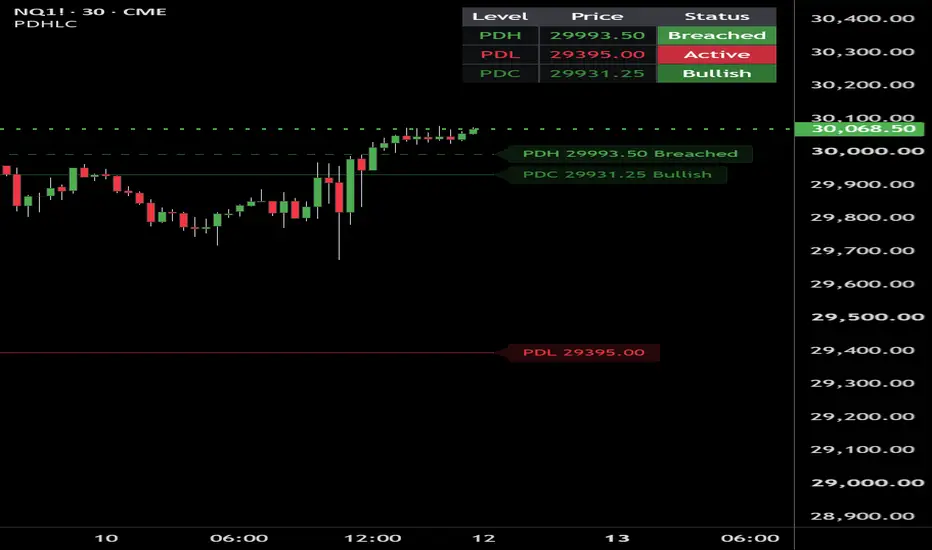
## PDHLC — Previous Day High, Low, and Close
PDHLC is a customizable market-reference indicator that displays the previous trading day’s high, low, and close.
It was designed primarily for futures traders, but the user-defined trading-day start time allows it to be adapted to different instruments, sessions, and trading methodologies.
The indicator tracks three key reference levels:
* **PDH — Previous Day High**
* **PDL — Previous Day Low**
* **PDC — Previous Day Close**
## Key Features
### Custom Trading-Day Start Time
Users can define exactly when a new trading day begins using Eastern Time.
The default setting is:
* **6:00 PM ET**
* **18:00 using the 24-hour clock**
This matches the standard futures-session rollover used by many CME futures markets.
The start hour and minute can be changed independently, allowing the indicator to support:
* Different futures sessions
* Regular trading hours
* Overnight sessions
* Custom trading plans
* Non-futures instruments
The new trading day begins on the first chart bar at or after the selected start time.
### Previous Day High and Low
PDHLC calculates and displays the completed prior trading day’s:
* Highest traded price
* Lowest traded price
* Closing price
Each line begins at the opening bar of the current user-defined trading day.
### Confirmed PDH and PDL Breaches
PDH and PDL are not considered breached merely because price trades through them intrabar.
A confirmed breach requires:
* A candle close above PDH
* A candle close below PDL
Once a breach is confirmed, the corresponding line automatically changes to a dashed style for the remainder of the trading day.
This creates an immediate visual distinction between:
* Active, unbreached liquidity levels
* Levels that have already been closed through
The breach status resets when the next user-defined trading day begins.
### Directional PDC Coloring
The Previous Day Close dynamically changes color based on the current price relationship to PDC:
* **Bullish:** Price is above PDC
* **Bearish:** Price is below PDC
* **Neutral:** Price is equal to PDC
Bullish, bearish, and neutral PDC colors can be configured independently.
The original PDC directional logic remains separate from the PDH and PDL breach logic.
### Customizable Labels
Users can control:
* Label visibility
* Label size
* Label offset from the current bar
Available label sizes include:
* Small
* Normal
* Large
### Customizable Information Table
The built-in information table displays the current value and status of each level:
* **PDH:** Active or Breached
* **PDL:** Active or Breached
* **PDC:** Bullish, Bearish, or Neutral
## Why PDHLC Is Unique
Many previous-day indicators rely on fixed calendar days, automatically extend lines across the chart, or treat any temporary move beyond a level as a confirmed breakout.
PDHLC is different because it combines:
* A fully customizable trading-day start time
* A futures-compatible default of 6:00 PM ET
* Candle-close confirmation for PDH and PDL breaches
* Automatic dashed styling after confirmed breaches
* Separate directional logic for PDC
* Lines that begin at the current trading-day open
* Lines that end exactly at their labels
* Adjustable label distance from current price
* Fully customizable table size and location
This makes PDHLC useful for traders who incorporate previous-day liquidity, session structure, breakout confirmation, directional bias, and daily reference levels into their analysis.
## Intended Use
PDHLC can be used to identify:
* Previous-day liquidity targets
* Potential support and resistance
* Confirmed high or low breaks
* Current price location relative to the prior close
* Daily directional context
* Untouched versus breached prior-day levels
This indicator does not generate trade-entry signals and does not guarantee future results. It is intended as a market-structure, session-reference, and discretionary trading-analysis tool.
PDHLC is a customizable market-reference indicator that displays the previous trading day’s high, low, and close.
It was designed primarily for futures traders, but the user-defined trading-day start time allows it to be adapted to different instruments, sessions, and trading methodologies.
The indicator tracks three key reference levels:
* **PDH — Previous Day High**
* **PDL — Previous Day Low**
* **PDC — Previous Day Close**
## Key Features
### Custom Trading-Day Start Time
Users can define exactly when a new trading day begins using Eastern Time.
The default setting is:
* **6:00 PM ET**
* **18:00 using the 24-hour clock**
This matches the standard futures-session rollover used by many CME futures markets.
The start hour and minute can be changed independently, allowing the indicator to support:
* Different futures sessions
* Regular trading hours
* Overnight sessions
* Custom trading plans
* Non-futures instruments
The new trading day begins on the first chart bar at or after the selected start time.
### Previous Day High and Low
PDHLC calculates and displays the completed prior trading day’s:
* Highest traded price
* Lowest traded price
* Closing price
Each line begins at the opening bar of the current user-defined trading day.
### Confirmed PDH and PDL Breaches
PDH and PDL are not considered breached merely because price trades through them intrabar.
A confirmed breach requires:
* A candle close above PDH
* A candle close below PDL
Once a breach is confirmed, the corresponding line automatically changes to a dashed style for the remainder of the trading day.
This creates an immediate visual distinction between:
* Active, unbreached liquidity levels
* Levels that have already been closed through
The breach status resets when the next user-defined trading day begins.
### Directional PDC Coloring
The Previous Day Close dynamically changes color based on the current price relationship to PDC:
* **Bullish:** Price is above PDC
* **Bearish:** Price is below PDC
* **Neutral:** Price is equal to PDC
Bullish, bearish, and neutral PDC colors can be configured independently.
The original PDC directional logic remains separate from the PDH and PDL breach logic.
### Customizable Labels
Users can control:
* Label visibility
* Label size
* Label offset from the current bar
Available label sizes include:
* Small
* Normal
* Large
### Customizable Information Table
The built-in information table displays the current value and status of each level:
* **PDH:** Active or Breached
* **PDL:** Active or Breached
* **PDC:** Bullish, Bearish, or Neutral
## Why PDHLC Is Unique
Many previous-day indicators rely on fixed calendar days, automatically extend lines across the chart, or treat any temporary move beyond a level as a confirmed breakout.
PDHLC is different because it combines:
* A fully customizable trading-day start time
* A futures-compatible default of 6:00 PM ET
* Candle-close confirmation for PDH and PDL breaches
* Automatic dashed styling after confirmed breaches
* Separate directional logic for PDC
* Lines that begin at the current trading-day open
* Lines that end exactly at their labels
* Adjustable label distance from current price
* Fully customizable table size and location
This makes PDHLC useful for traders who incorporate previous-day liquidity, session structure, breakout confirmation, directional bias, and daily reference levels into their analysis.
## Intended Use
PDHLC can be used to identify:
* Previous-day liquidity targets
* Potential support and resistance
* Confirmed high or low breaks
* Current price location relative to the prior close
* Daily directional context
* Untouched versus breached prior-day levels
This indicator does not generate trade-entry signals and does not guarantee future results. It is intended as a market-structure, session-reference, and discretionary trading-analysis tool.
开源脚本
秉承TradingView的精神,该脚本的作者将其开源,以便交易者可以查看和验证其功能。向作者致敬!您可以免费使用该脚本,但请记住,重新发布代码须遵守我们的网站规则。

免责声明
这些信息和出版物并非旨在提供,也不构成TradingView提供或认可的任何形式的财务、投资、交易或其他类型的建议或推荐。请阅读使用条款了解更多信息。
开源脚本
秉承TradingView的精神,该脚本的作者将其开源,以便交易者可以查看和验证其功能。向作者致敬!您可以免费使用该脚本,但请记住,重新发布代码须遵守我们的网站规则。
免责声明
这些信息和出版物并非旨在提供,也不构成TradingView提供或认可的任何形式的财务、投资、交易或其他类型的建议或推荐。请阅读使用条款了解更多信息。