已更新
1-2-3 Reversal Map [AGPro Series]
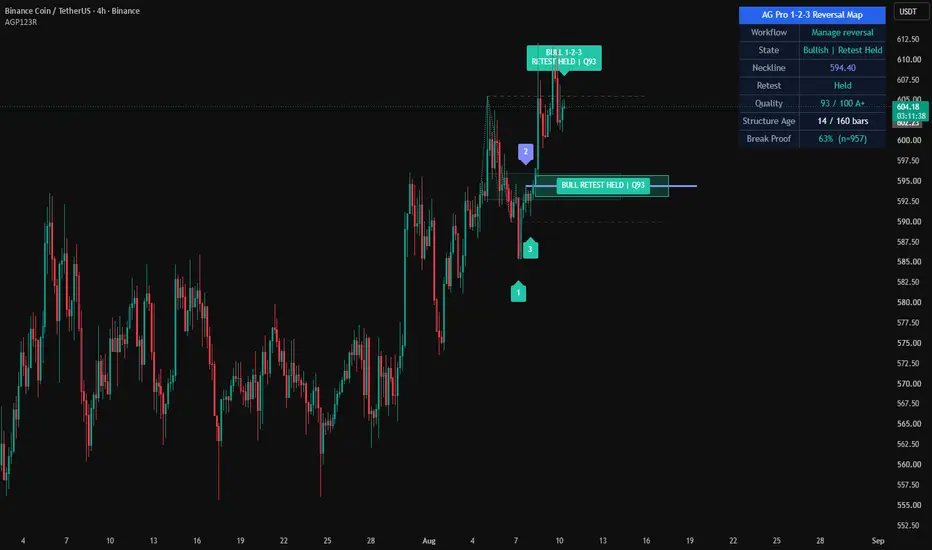
1-2-3 Reversal Map [AGPro Series]
🔹 OVERVIEW
1-2-3 Reversal Map [AGPro Series] is a focused TradingView overlay built for traders who want a clean, structured way to follow one of the most recognizable reversal formations in price action: the confirmed 1-2-3 reversal.
This tool maps the full life cycle of a 1-2-3 structure. It identifies the confirmed swing sequence, marks Point 1, Point 2, and Point 3, projects the neckline from Point 2, evaluates the neckline break, and highlights the retest pocket after confirmation. The goal is not to fill the chart with generic reversal signals. The goal is to make the actual 1-2-3 process easier to see, compare, and track.
The script is designed around visual clarity. The latest active structure stays readable through numbered swing labels, restrained guide lines, a clearly identified neckline, and a concept-specific retest pocket. The panel then summarizes the current stage, neckline status, retest status, and reversal score in a compact AG Pro layout.
🔹 WHAT MAKES IT DIFFERENT
Most reversal tools try to do too many things at once. They mix candle patterns, double tops, double bottoms, head and shoulders structures, failed breakouts, generic support and resistance zones, trend filters, and broad reversal markers into one crowded chart.
1-2-3 Reversal Map [AGPro Series] takes a more disciplined approach. It stays inside one lane: the confirmed 1-2-3 reversal sequence.
The script does not mark every possible turning point. It waits for a defined swing chain:
1. Point 1 establishes the original swing extreme.
2. Point 2 forms the neckline reference.
3. Point 3 confirms that price has created a structurally relevant retracement.
4. The neckline break turns the structure from a setup into a confirmed map.
5. The retest pocket shows where the broken neckline can be evaluated again.
This creates a cleaner workflow than broad reversal scanners. Instead of asking the chart to show everything, the script asks one focused question: has a valid 1-2-3 structure progressed from swing formation to neckline break and retest behavior?
🧭 WHY THIS DOES NOT OVERLAP WITH OTHER AGPRO TOOLS
This script was intentionally built to avoid overlapping with other AGPro public tools.
It is not a broad reversal pattern scanner. It does not combine double top, double bottom, head and shoulders, inverse head and shoulders, wedge, or candle-pattern logic. It focuses only on the 1-2-3 reversal sequence.
It is not a Turtle Soup or failed-breakout tool. It does not begin with a failed range break or liquidity sweep. Its starting point is a confirmed three-point swing structure.
It is not a wedge reversal tool. It does not evaluate converging trendlines, compression geometry, or wedge breakout behavior.
It is not a generic support and resistance map. The rectangle is not a general zone engine. It is a neckline retest pocket that appears only after a valid 1-2-3 neckline break.
It is not a breakout dashboard. Breakout logic exists only as one stage inside the 1-2-3 reversal process.
This makes the script narrow enough for a differentiated AGPro release while still being visually useful and searchable for traders who specifically look for 1-2-3 reversal structure, neckline break, and retest confirmation workflows.
⚙️ METHODOLOGY
The script uses confirmed pivot structure to define each 1-2-3 sequence.
For a bullish 1-2-3 structure:
- Point 1 is a confirmed swing low.
- Point 2 is the recovery swing high and neckline reference.
- Point 3 is a higher low that holds above Point 1.
- The neckline break requires price to close beyond Point 2 with a configurable ATR buffer.
- The retest pocket is projected around the broken neckline after confirmation.
For a bearish 1-2-3 structure:
- Point 1 is a confirmed swing high.
- Point 2 is the reaction swing low and neckline reference.
- Point 3 is a lower high that holds below Point 1.
- The neckline break requires price to close beyond Point 2 with a configurable ATR buffer.
- The retest pocket is projected around the broken neckline after confirmation.
The reversal score is structure-native. It evaluates:
- P1-P2 leg size relative to ATR
- Point 3 hold quality
- P3 retracement balance
- Timing symmetry between structure legs
- Break distance beyond the neckline
- Break candle body quality
- Close location inside the break candle
- Optional volume participation
The score is not designed as a prediction model. It is a ranking layer for comparing the quality of structures that meet the script's own rules.
📊 PANEL
The AG Pro panel is built to keep the structure status readable without forcing the user to interpret every chart object manually.
Panel rows:
- Stage: shows whether the structure is waiting, armed, broken, retested, expired, or invalidated.
- Neckline Break: shows whether the neckline has been confirmed.
- Retest: shows whether the retest pocket is inactive, being watched, or held.
- Reversal Score: shows the current 0-100 score and quality grade.
The panel uses the AGPro standard format:
- One merged blue header row
- Only the script name in the first row
- Adjustable panel location
- Adjustable panel theme
- Adjustable panel font size
🎛️ KEY INPUTS
Pivot Left Bars / Pivot Right Bars:
Controls how mature the swing points must be before the 1-2-3 structure can form. Higher values create fewer and cleaner structures. Lower values make the script more responsive.
Minimum P1-P2 Leg ATR:
Filters out small structures by requiring a minimum distance between Point 1 and Point 2.
Minimum Point 3 Hold ATR:
Defines how much Point 3 must hold relative to Point 1. This helps separate valid structural retracements from weak retests of the original extreme.
Minimum / Maximum P3 Retracement:
Controls the acceptable retracement range for Point 3. This prevents both shallow noise and near-failed structures from being accepted too easily.
Neckline Break Buffer ATR:
Adds a configurable buffer beyond the neckline before the break is accepted.
Retest Pocket Width ATR:
Controls the height of the retest pocket around the broken neckline.
Retest Pocket Projection Bars:
Controls how far the pocket is projected forward.
Show Context Tags:
Adds compact labels such as Neckline and Retest Pocket so the visual elements are easier to identify.
Show Recent Structure Traces:
Keeps a small rolling set of recent structure lines and pockets while keeping numbered swing labels focused on the latest active setup.
Label Font Size:
Controls all chart labels, including swing numbers, context tags, and optional event labels.
Panel Font Size:
Controls the AG Pro panel text size separately from chart labels.
🔍 HOW TO READ IT
Start with the numbered swing labels.
Point 1 marks the original structural extreme. Point 2 marks the neckline reference. Point 3 marks the retracement that must hold for the 1-2-3 structure to remain valid.
Next, watch the neckline.
The neckline is the main confirmation level. Before it breaks, the panel shows the structure as armed or waiting. After it breaks, the structure becomes a confirmed 1-2-3 map.
Then watch the retest pocket.
The retest pocket appears around the broken neckline after confirmation. This is the script's key context zone. It helps the user observe whether price can return to the neckline area and hold the structure instead of treating every move after the break as equally important.
Finally, use the panel score as a quality filter.
A high score means the structure has stronger internal balance according to the script's rules. A lower score means the 1-2-3 sequence may still exist, but its structure quality is weaker.
🧩 BEST USE CASES
This script is best suited for:
- Traders who use classic 1-2-3 reversal logic
- Swing traders who want confirmed pivot structure
- Price-action traders who track neckline breaks
- Traders who prefer breakout-retest workflows
- Users who want fewer, clearer chart objects instead of broad reversal scanners
- Multi-timeframe chart review where structure clarity matters
- Public chart sharing where visual cleanliness is important
It can be useful on crypto, forex, indices, equities, and commodities, especially on charts where swing structure and neckline behavior are visually meaningful.
🧠 VISUAL DESIGN PHILOSOPHY
The design goal is clarity through restraint.
The script avoids a crowded signal-board style. It uses numbered labels only for the current active swing structure. It separates the neckline from the retest pocket with distinct visual language. Recent traces are kept limited and softened so they provide context without dominating the chart.
The active neckline is drawn with a stronger accent color. The retest pocket is shown as a clean rectangle around the broken neckline. Structure legs are dotted and restrained, helping the user understand the geometry without overpowering price.
The chart should feel premium, readable, and publication-ready. The indicator is built to support a clean TradingView screenshot rather than create visual noise.
🔔 ALERTS
The script includes alerts for the main 1-2-3 lifecycle events:
- 1-2-3 structure armed
- Bullish 1-2-3 neckline break
- Bearish 1-2-3 neckline break
- 1-2-3 retest pocket held
- 1-2-3 structure invalidated
These alerts are designed around structure progression, not generic reversal marking.
🔹 LIMITATIONS AND TRANSPARENCY
The script uses confirmed pivots, which means swing points appear only after the required right-side confirmation bars. This is intentional. It prioritizes confirmed structure over instant but unstable markings.
The script does not attempt to identify every possible reversal pattern. It does not evaluate macro trend, fundamentals, order flow, news, or external liquidity conditions.
The reversal score is a structured quality model, not a certainty model. It helps compare 1-2-3 structures inside this script's framework, but it does not forecast outcomes.
Retest pockets are contextual areas around the broken neckline. They are not universal support or resistance zones, and they are not designed to replace broader market analysis.
✅ IDEAL USER
This script is ideal for traders who:
- Understand classic 1-2-3 reversal structure
- Prefer confirmed market structure over early noise
- Want a clean neckline and retest workflow
- Value visual clarity and chart discipline
- Use TradingView for structured price-action review
- Want a focused public-free AGPro tool that does one concept well
1-2-3 Reversal Map [AGPro Series] is built for users who want a focused reversal map, not a crowded reversal scanner.
🔹 RELEASE NOTES
- Initial public release of 1-2-3 Reversal Map [AGPro Series].
- Added confirmed Point 1, Point 2, and Point 3 swing mapping.
- Added neckline projection with close-based break confirmation.
- Added breakout retest pocket around the broken neckline.
- Added context tags for Neckline and Retest Pocket.
- Added AG Pro panel with Stage, Neckline Break, Retest, and Reversal Score.
- Added adjustable panel location, panel theme, label size, and panel font size.
- Added recent structure traces with softened historical visuals.
- Added alerts for armed structures, neckline breaks, retest holds, and invalidations.
版本注释
UPDATE NOTES - v2.0This update focuses on empirical transparency and decision clarity. The core purpose of the script is unchanged: it remains an analytical structure-mapping tool, not a prediction engine.
------------------------
What Changed
------------------------
* Break Edge engine (cumulative, non-repaint)
Every confirmed 1-2-3 neckline break now opens one tracking episode, with the break close, ATR, and the Point 3 invalidation level frozen at the break bar. The episode resolves as a hit when price travels the Break Edge Target distance in the break direction, and as a miss when the frozen invalidation is closed through first or the window expires. The panel reports the cumulative Break Edge rate with its sample size for this chart and timeframe, so the neckline-break concept is no longer just drawn - it is measured.
* Honest sample gating
The Break Edge rate is color-coded only once the sample reaches n >= 8 confirmed breaks; below that it stays neutral, so a small sample never implies confidence. Episodes open and resolve on confirmed bars only, which means the statistic never changes after the fact. The invalidation reference is the same Point 3 rule the script already uses, so the statistic measures exactly what the chart shows.
* Next-action line
The panel now closes with one clear action that always matches the active stage: watch the neckline while armed, watch the retest pocket after a break, manage the reversal after a held retest, or stand down after invalidation or expiry.
* New inputs and alert
Break Edge Target ATR and Break Edge Window are exposed in the Breakout And Retest group, so the measured claim is fully transparent and adjustable. A new "1-2-3 break target hit" alert fires when a tracked break reaches its target.
------------------------
Interface
------------------------
* The panel was restructured: structure rows first, then the Break Proof block, closing with the action line. Numbered swings, legs, necklines, pockets, and existing alerts behave exactly as before.
* After a neckline break, the right-edge tag now switches from Neckline to Retest Pocket instead of stacking both labels at the same price.
------------------------
Limitations & Risk
------------------------
Break Edge statistics are measured on the current chart, timeframe, and settings only and will differ elsewhere. Read rates together with their n value.
This script is for educational and analytical purposes only. It does not provide financial advice or guaranteed outcomes. Users remain responsible for their own decisions.
版本注释
Version 2.1 – Close-Confirmed Reversal WorkflowThis release preserves the established 1-2-3 structure and Break Proof engines while making the active reversal plan clearer, more stable, and easier to interpret across intraday and higher-timeframe charts.
• Pivot intake, neckline breaks, retest decisions, and invalidations now change state only on confirmed bars.
• The retest-pocket badge is centered horizontally and vertically inside the visible zone and updates from WATCH to HELD with direction and quality.
• One live active-plan badge summarizes side, lifecycle, and quality near current price without creating historical label clutter.
• Terminal structures are archived with their correct directional color before active objects are released.
• The panel now uses a tighter workflow-first layout with neckline price, structure age, quality, and Break Proof in one merged-header table.
• The original scoring formulas, structure filters, ATR logic, volume contribution, Break Proof model, and six alert conditions remain intact.

免责声明
这些信息和出版物并非旨在提供,也不构成TradingView提供或认可的任何形式的财务、投资、交易或其他类型的建议或推荐。请阅读使用条款了解更多信息。
免责声明
这些信息和出版物并非旨在提供,也不构成TradingView提供或认可的任何形式的财务、投资、交易或其他类型的建议或推荐。请阅读使用条款了解更多信息。