OPEN-SOURCE SCRIPT
Apex Edge - Liquidity Atlas
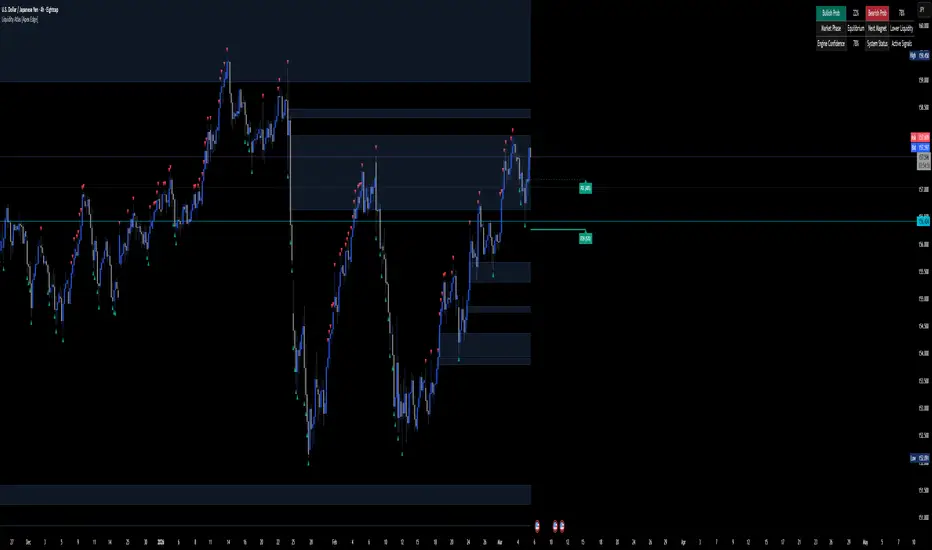
Liquidity Atlas maps where price is most likely to travel next by scoring liquidity magnets inside an internal volume profile.
Description
Liquidity Atlas is a probability-driven liquidity mapping tool designed to highlight where price is most likely to move next.
Instead of simply marking liquidity zones, the engine evaluates multiple liquidity structures and ranks them based on their probability of being targeted by price.
The indicator activates only when price interacts with structural liquidity bins, filtering out mid-range noise and focusing on true decision zones.
Key Concepts
Liquidity Atlas evaluates:
• High-volume liquidity shelves
• Equal highs / equal lows (EQH / EQL)
• Daily liquidity levels
• Liquidity sweeps
• Path efficiency (vacuum vs resistance)
• Shelf strength and repeated touches
• Distance weighting from current price
These elements are combined into a scoring engine that estimates the most probable liquidity destination.
Visual Guide
Solid line
= Primary liquidity magnet
Dashed line
= Secondary liquidity zone
HUD panel displays:
• Bullish / Bearish probability
• Market phase (Compression / Equilibrium / Expansion)
• Engine confidence
• Next liquidity magnet direction
How To Use
1. Wait for System Status: Active Signals
2. Observe the primary projection line
3. Trade toward the projected liquidity magnet
4. Use secondary zones as potential reaction areas
Best results occur when price interacts with structural bins, as this is where liquidity decisions occur.
Important Notes
Liquidity Atlas does not predict price with certainty.
It estimates the most efficient liquidity path based on current market structure.
Markets can still deviate if new liquidity forms or structural conditions change.
Description
Liquidity Atlas is a probability-driven liquidity mapping tool designed to highlight where price is most likely to move next.
Instead of simply marking liquidity zones, the engine evaluates multiple liquidity structures and ranks them based on their probability of being targeted by price.
The indicator activates only when price interacts with structural liquidity bins, filtering out mid-range noise and focusing on true decision zones.
Key Concepts
Liquidity Atlas evaluates:
• High-volume liquidity shelves
• Equal highs / equal lows (EQH / EQL)
• Daily liquidity levels
• Liquidity sweeps
• Path efficiency (vacuum vs resistance)
• Shelf strength and repeated touches
• Distance weighting from current price
These elements are combined into a scoring engine that estimates the most probable liquidity destination.
Visual Guide
Solid line
= Primary liquidity magnet
Dashed line
= Secondary liquidity zone
HUD panel displays:
• Bullish / Bearish probability
• Market phase (Compression / Equilibrium / Expansion)
• Engine confidence
• Next liquidity magnet direction
How To Use
1. Wait for System Status: Active Signals
2. Observe the primary projection line
3. Trade toward the projected liquidity magnet
4. Use secondary zones as potential reaction areas
Best results occur when price interacts with structural bins, as this is where liquidity decisions occur.
Important Notes
Liquidity Atlas does not predict price with certainty.
It estimates the most efficient liquidity path based on current market structure.
Markets can still deviate if new liquidity forms or structural conditions change.
开源脚本
秉承TradingView的精神,该脚本的作者将其开源,以便交易者可以查看和验证其功能。向作者致敬!您可以免费使用该脚本,但请记住,重新发布代码须遵守我们的网站规则。

免责声明
这些信息和出版物并非旨在提供,也不构成TradingView提供或认可的任何形式的财务、投资、交易或其他类型的建议或推荐。请阅读使用条款了解更多信息。
免责声明
这些信息和出版物并非旨在提供,也不构成TradingView提供或认可的任何形式的财务、投资、交易或其他类型的建议或推荐。请阅读使用条款了解更多信息。