Prism Breakout Atlas [NalnAlgo]
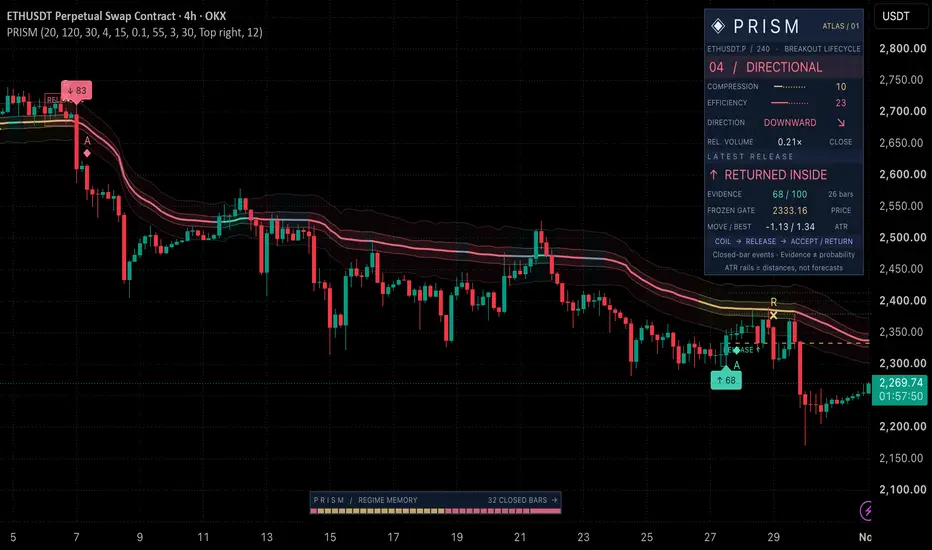
PRISM separates breakout preparation, a qualifying close and the outcome that follows. It helps define triggers, invalidation and planned risk/reward; it does not establish that a setup will be profitable.
The design connects an efficiency-adjusted ribbon to a chamber state machine: one consumption per chamber, preceding boundaries for releases, and frozen gate/ATR references afterward. Only chart OHLCV is used.
1. Read the environment before looking for an entry
Mint ribbon means upward direction, coral downward direction, gold compression and gray-blue balance. The dashboard's upper section describes the current environment; LATEST RELEASE describes a separate, possibly older event. The bottom strip records 32 confirmed bar states, oldest left and newest right. These displays provide context, not buy/sell orders.
Figure 1 - Full layout on standard four-hour candles. Both sustained movement and a later failed upward release are visible. This is a display example, not a performance report.

2. Preparation: identify compression and mark its boundaries
Defaults require four consecutive compression bars to create COIL, using that segment's highs/lows. Boundaries can expand on confirmed closes. Quiet conditions alone are not an entry: wait for an eligible release rather than guessing direction.
Figure 2 - One-hour close-up. The enlarged COIL box shows the price boundaries; the gold ribbon and COMPRESSION state identify relative contraction. The old release record in the dashboard is not a signal from this new box.

Selected source lines:
Pine Script®
The code ranks closing-price dispersion against recent history; default rank <=30 qualifies. COMPRESSION is 100 minus rank, not stored energy or expected profit. Long wicks can still create a wide chamber.
3. Trigger: require a confirmed escape with sufficient evidence
These selected lines run inside the confirmed-close engine. They are excerpts, not standalone scripts:
Pine Script®
The close must exceed the preceding boundary plus/minus the buffer and meet the score threshold. Testing precedes updating the chamber with that bar. Release can occur during compression. After compression ends, ARMED eligibility includes the first non-compressed bar.
Evidence weights are close position 30%, absolute body proportion 20%, axis-slope alignment 20%, true-range expansion 15% and relative volume 15%. Expansion reaches full contribution at 1.8 ATR; volume at twice its previous-window average. Missing usable volume removes that term and renormalizes the others. Body size is unsigned, alignment is not a mandatory trend filter, and inputs overlap. A score of 83 is not an 83% success probability. A below-threshold escape consumes the chamber as UNQUALIFIED; later candles cannot become its first breakout.
4. Confirmation: distinguish a release from acceptance
An A diamond means consecutive closes strictly outside the frozen gate. Default three includes the release close, so two more qualifying closes are needed. Acceptance does not require reaching +1 ATR or continued expansion. Waiting for A is one possible discretionary filter: it delays action and can produce a worse entry; improved profitability has not been established.
Figure 3 - Historical four-hour downward release, score 83, followed by a coral A and subsequent downward movement. The earlier R belongs to a preceding event. The dashboard remains the latest-event record, not the record for this historical short. Later candles are shown for explanation; this is not a replay or evidence of attainable fills.

Reference values are frozen on release:
Pine Script®
The +1 / +2 ATR rails measure distance from release, not automatic targets. Trade risk R instead depends on actual entry and the chosen protective stop.
5. Failure: acceptance can still be followed by return
Figure 4 - Enlarged upward release 68, then A, then a gold R. The return illustrates why confirmation is not permanent validation and why an exit rule is needed before entry.

The key holding test is:
Pine Script®
For a long release, a close at or below the gate triggers RETURNED INSIDE; for a short, at or above it. A wick alone does not. Tracking stops on return or at the observation limit. A new release replaces the tracked event. Unused setups can expire or be superseded by new compression.
R is a closed-bar observation, not an executable stop order. A protective stop may need to act intrabar; waiting for R can permit a larger loss. Stops can also fill worse than planned during gaps or fast markets.
6. An example trading process: define risk before seeking reward
The following is an educational discretionary template, not an automated or validated strategy:
Illustration for simple linear units, excluding costs: an account of 10,000 with a hypothetical 0.5% risk budget allocates 50 of planned risk. Entry 100 and stop 98 risk 2 per unit, allowing at most 25 units. An exit at 104 is 2R before costs. This arithmetic is not a recommendation or a forecast. Contract multipliers, inverse contracts, leverage/liquidation, fees, spread and slippage require instrument-specific adjustments. A planned risk budget is not a guaranteed maximum loss.
7. Settings and alerts
Defaults: Structure length 20; Volatility memory 120; Compression percentile 30; Minimum compression bars 4; Breakout window 15; Buffer 0.10 ATR; Minimum evidence 55; Closes outside to accept 3; Observation 30 bars. All windows use chart bars. The default event engine needs bar index 140 or later and a valid volatility rank. Higher evidence thresholds are more selective, not proven more profitable.
Four alerts are available: upward release, downward release, acceptance and return inside. Use Once Per Bar Close; recreate alerts after script/settings changes. PRISM places no orders and does not calculate trade position size, a protective stop or realized trading returns.
8. Display behavior and limitations
Live preview is off by default: open-bar ribbon/tint holds confirmed values, and the dashboard uses confirmed data. Enabling preview permits intrabar reading changes; events still require a close. Backfill is off by default; enabling it draws the chamber left edge backward despite later confirmation. Developing boxes can expand/change status, and final historical boxes must not be treated as information known earlier.
The dashboard tracks only the latest release. MOVE / BEST is signed close movement / maximum later favorable excursion, measured in frozen release ATR; it excludes the release bar's excursion and stops updating when observation ends. It is not current or realized P&L. Historical boxes/labels have retention limits. EFFICIENCY measures net displacement relative to travel, not confidence.
No future bars or higher-timeframe requests are used. Settings, timeframe, feed revisions and available history can change recalculations; the axis depends on initialization history. Volume is feed-specific. Breakouts fail and confirmation delays action. Higher profits, lower drawdown or a calibrated win rate have not been demonstrated; such claims require out-of-sample tests with realistic execution and costs.
The design connects an efficiency-adjusted ribbon to a chamber state machine: one consumption per chamber, preceding boundaries for releases, and frozen gate/ATR references afterward. Only chart OHLCV is used.
1. Read the environment before looking for an entry
Mint ribbon means upward direction, coral downward direction, gold compression and gray-blue balance. The dashboard's upper section describes the current environment; LATEST RELEASE describes a separate, possibly older event. The bottom strip records 32 confirmed bar states, oldest left and newest right. These displays provide context, not buy/sell orders.
Figure 1 - Full layout on standard four-hour candles. Both sustained movement and a later failed upward release are visible. This is a display example, not a performance report.
2. Preparation: identify compression and mark its boundaries
Defaults require four consecutive compression bars to create COIL, using that segment's highs/lows. Boundaries can expand on confirmed closes. Quiet conditions alone are not an entry: wait for an eligible release rather than guessing direction.
Figure 2 - One-hour close-up. The enlarged COIL box shows the price boundaries; the gold ribbon and COMPRESSION state identify relative contraction. The old release record in the dashboard is not a signal from this new box.
Selected source lines:
The code ranks closing-price dispersion against recent history; default rank <=30 qualifies. COMPRESSION is 100 minus rank, not stored energy or expected profit. Long wicks can still create a wide chamber.
3. Trigger: require a confirmed escape with sufficient evidence
These selected lines run inside the confirmed-close engine. They are excerpts, not standalone scripts:
The close must exceed the preceding boundary plus/minus the buffer and meet the score threshold. Testing precedes updating the chamber with that bar. Release can occur during compression. After compression ends, ARMED eligibility includes the first non-compressed bar.
Evidence weights are close position 30%, absolute body proportion 20%, axis-slope alignment 20%, true-range expansion 15% and relative volume 15%. Expansion reaches full contribution at 1.8 ATR; volume at twice its previous-window average. Missing usable volume removes that term and renormalizes the others. Body size is unsigned, alignment is not a mandatory trend filter, and inputs overlap. A score of 83 is not an 83% success probability. A below-threshold escape consumes the chamber as UNQUALIFIED; later candles cannot become its first breakout.
4. Confirmation: distinguish a release from acceptance
An A diamond means consecutive closes strictly outside the frozen gate. Default three includes the release close, so two more qualifying closes are needed. Acceptance does not require reaching +1 ATR or continued expansion. Waiting for A is one possible discretionary filter: it delays action and can produce a worse entry; improved profitability has not been established.
Figure 3 - Historical four-hour downward release, score 83, followed by a coral A and subsequent downward movement. The earlier R belongs to a preceding event. The dashboard remains the latest-event record, not the record for this historical short. Later candles are shown for explanation; this is not a replay or evidence of attainable fills.
Reference values are frozen on release:
The +1 / +2 ATR rails measure distance from release, not automatic targets. Trade risk R instead depends on actual entry and the chosen protective stop.
5. Failure: acceptance can still be followed by return
Figure 4 - Enlarged upward release 68, then A, then a gold R. The return illustrates why confirmation is not permanent validation and why an exit rule is needed before entry.
The key holding test is:
For a long release, a close at or below the gate triggers RETURNED INSIDE; for a short, at or above it. A wick alone does not. Tracking stops on return or at the observation limit. A new release replaces the tracked event. Unused setups can expire or be superseded by new compression.
R is a closed-bar observation, not an executable stop order. A protective stop may need to act intrabar; waiting for R can permit a larger loss. Stops can also fill worse than planned during gaps or fast markets.
6. An example trading process: define risk before seeking reward
The following is an educational discretionary template, not an automated or validated strategy:
- Prepare: use standard candles, identify a mature chamber and mark both boundaries. Compression alone has no direction.
- Select: optionally require upward context for longs and downward context for shorts. This is a manual filter, not an engine requirement.
- Time entry: choose RELEASE confirmation or wait for A, optionally adding a retest. Act after that close using an attainable subsequent fill, not an assumed signal-close fill. Skip if price is too far from the planned stop.
- Define invalidation before entry: choose a structural protective stop and any buffer. The observation gate is not automatically a suitable stop. Mirror the logic for shorts.
- Size from stop distance and a fixed risk budget. Reduce size or skip a wide-stop setup; do not widen the stop after entry merely to avoid a loss.
- Plan reward: compare room to opposing structure against initial risk; skip insufficient room. One testable plan is a partial exit at a chosen R multiple, with the remainder managed behind confirmed swings. No exit multiple, fraction or trailing method has been optimized or automated here.
Illustration for simple linear units, excluding costs: an account of 10,000 with a hypothetical 0.5% risk budget allocates 50 of planned risk. Entry 100 and stop 98 risk 2 per unit, allowing at most 25 units. An exit at 104 is 2R before costs. This arithmetic is not a recommendation or a forecast. Contract multipliers, inverse contracts, leverage/liquidation, fees, spread and slippage require instrument-specific adjustments. A planned risk budget is not a guaranteed maximum loss.
7. Settings and alerts
Defaults: Structure length 20; Volatility memory 120; Compression percentile 30; Minimum compression bars 4; Breakout window 15; Buffer 0.10 ATR; Minimum evidence 55; Closes outside to accept 3; Observation 30 bars. All windows use chart bars. The default event engine needs bar index 140 or later and a valid volatility rank. Higher evidence thresholds are more selective, not proven more profitable.
Four alerts are available: upward release, downward release, acceptance and return inside. Use Once Per Bar Close; recreate alerts after script/settings changes. PRISM places no orders and does not calculate trade position size, a protective stop or realized trading returns.
8. Display behavior and limitations
Live preview is off by default: open-bar ribbon/tint holds confirmed values, and the dashboard uses confirmed data. Enabling preview permits intrabar reading changes; events still require a close. Backfill is off by default; enabling it draws the chamber left edge backward despite later confirmation. Developing boxes can expand/change status, and final historical boxes must not be treated as information known earlier.
The dashboard tracks only the latest release. MOVE / BEST is signed close movement / maximum later favorable excursion, measured in frozen release ATR; it excludes the release bar's excursion and stops updating when observation ends. It is not current or realized P&L. Historical boxes/labels have retention limits. EFFICIENCY measures net displacement relative to travel, not confidence.
No future bars or higher-timeframe requests are used. Settings, timeframe, feed revisions and available history can change recalculations; the axis depends on initialization history. Volume is feed-specific. Breakouts fail and confirmation delays action. Higher profits, lower drawdown or a calibrated win rate have not been demonstrated; such claims require out-of-sample tests with realistic execution and costs.

🧭 NalnAlgo | Experience. Strategy. Growth.
10+ years in the markets. Continuously refined strategies.
Pursuing steady, long-term returns together.
🌐 nalnalgo.com — Explore our strategies.
10+ years in the markets. Continuously refined strategies.
Pursuing steady, long-term returns together.
🌐 nalnalgo.com — Explore our strategies.
免责声明
这些信息和出版物并非旨在提供,也不构成TradingView提供或认可的任何形式的财务、投资、交易或其他类型的建议或推荐。请阅读使用条款了解更多信息。
🧭 NalnAlgo | Experience. Strategy. Growth.
10+ years in the markets. Continuously refined strategies.
Pursuing steady, long-term returns together.
🌐 nalnalgo.com — Explore our strategies.
10+ years in the markets. Continuously refined strategies.
Pursuing steady, long-term returns together.
🌐 nalnalgo.com — Explore our strategies.
免责声明
这些信息和出版物并非旨在提供,也不构成TradingView提供或认可的任何形式的财务、投资、交易或其他类型的建议或推荐。请阅读使用条款了解更多信息。