
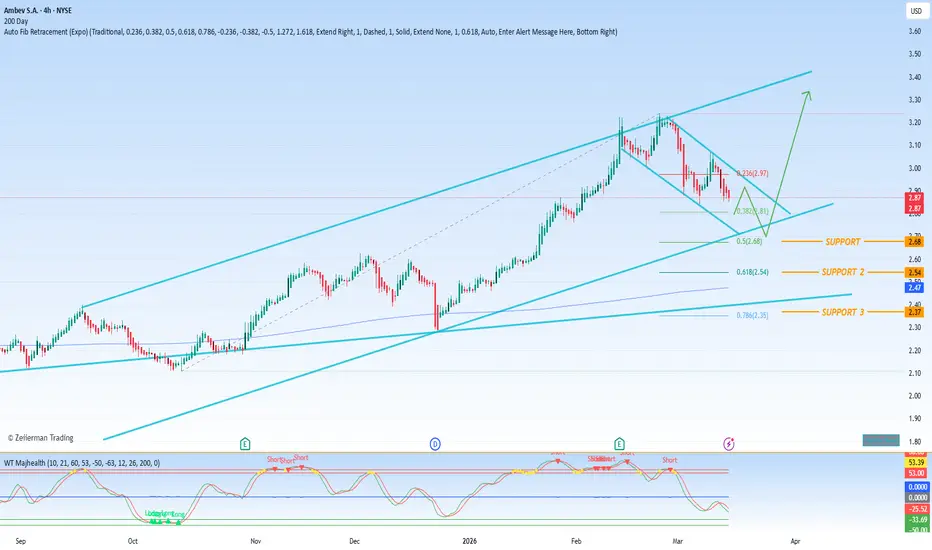
Ambev S.A. (NYSE: ABEV), the Latin American beverage giant and subsidiary of global brewing leader Anheuser-Busch InBev, reported its fourth-quarter and full-year 2025 financial results on February 12, revealing a tale of two narratives: robust digital transformation and resilient profitability overshadowed by persistent volume pressures and macroeconomic challenges.
The company, which through its subsidiaries produces, distributes, and sells a vast portfolio of beer, draft beer, soft drinks, malt-based beverages, and other non-alcoholic drinks across Brazil, Central America and the Caribbean, Latin America South, and Canada, achieved a stated net income of nearly 16 billion Brazilian Reais for the full year. This bottom-line strength translated into earnings per share growth of 8.2% compared to the prior year, demonstrating the company's ability to protect profitability even in a challenging operating environment. Quarterly revenue reached approximately $4.76 billion, reflecting a modest year-over-year increase of 2.31%.
Digital Ecosystem Emerges as a Bright Spot
Perhaps the most compelling aspect of Ambev's 2025 performance lies in the rapid expansion of its digital ecosystem. The company's business-to-business (B2B) marketplace, a platform designed to connect retailers and distributors with Ambev's product portfolio, experienced explosive growth, with gross merchandise volume (GMV) surging by an impressive 70% year-over-year. This growth underscores the success of Ambev's strategy to digitize its supply chain and deepen its relationships with millions of small and medium-sized retailers across its operating regions.
Simultaneously, the company's direct-to-consumer delivery channels also demonstrated strength. GMV from consumer delivery services rose by 13%, reaching 4.7 billion BRL. This growth, while more moderate than the B2B segment, reflects sustained consumer adoption of e-commerce and delivery platforms for beverage purchases, a trend that has remained sticky since the pandemic era. Together, these digital initiatives are transforming Ambev from a traditional beverage manufacturer into a more technology-enabled, data-driven consumer goods company with multiple touchpoints to its end users.
Volume Pressures and the Weather Factor
Despite these financial and digital achievements, Ambev was not immune to significant operational headwinds throughout 2025. The company's core beer segment faced considerable pressure due to a confluence of external factors. In Brazil, the company's most important market, unfavorable weather conditions—particularly the lingering effects of the La Niña phenomenon—disrupted traditional out-of-home socialization patterns. When consumers stay home due to extreme weather, consumption in bars, restaurants, and other on-premise locations suffers, directly impacting Ambev's higher-margin sales channels.
Adding to the complexity, Argentina, another key market for Ambev, experienced a slower-than-expected recovery in consumer consumption amid the country's ongoing macroeconomic instability. These volume pressures, combined with the weather-related disruptions, contributed to a 1.6 billion BRL decrease in operating cash flow compared to the previous year, a notable drain on liquidity despite the strong net income figure.
Persistent Cost Pressures and Financial Expenses
Ambev also contended with a challenging cost environment throughout 2025. Input cost inflation remained a persistent theme, particularly for key commodities like aluminum used in can manufacturing and other raw materials essential to production. The impact was clearly visible in the company's cost of goods sold: Brazilian beer cash COGS per hectoliter increased by 6.1%, reflecting the pass-through of these higher input costs.
On the financial side, the company recorded net financial expenses approaching 4 billion BRL. These expenses were primarily driven by foreign exchange variation losses, a common challenge for multinational corporations operating with a complex web of currency exposures across Latin America. The strengthening of the U.S. dollar against several regional currencies during parts of the year contributed to these translation and transaction losses.
Looking Ahead to 2026: Normalizing Conditions and Strategic Focus
In his commentary accompanying the results, Ambev's CEO offered a cautiously optimistic outlook for 2026. While acknowledging that early 2025 was negatively impacted by the La Niña weather pattern, management noted that weather conditions began to neutralize by January of this year. This normalization, if sustained, could remove a significant headwind that has weighed on the beer segment's performance.
Looking forward, Ambev is expected to maintain its focus on three strategic priorities: continuing to scale its digital ecosystem (both B2B and consumer delivery), managing input costs through hedging and operational efficiency, and navigating the complex macroeconomic landscape of its key markets, particularly Brazil and Argentina. With a strong net income result already in hand and early signs of weather stabilization, the company appears well-positioned to defend its leadership position in the region's beverage industry while capitalizing on the long-term shift toward digital commerce.
The company, which through its subsidiaries produces, distributes, and sells a vast portfolio of beer, draft beer, soft drinks, malt-based beverages, and other non-alcoholic drinks across Brazil, Central America and the Caribbean, Latin America South, and Canada, achieved a stated net income of nearly 16 billion Brazilian Reais for the full year. This bottom-line strength translated into earnings per share growth of 8.2% compared to the prior year, demonstrating the company's ability to protect profitability even in a challenging operating environment. Quarterly revenue reached approximately $4.76 billion, reflecting a modest year-over-year increase of 2.31%.
Digital Ecosystem Emerges as a Bright Spot
Perhaps the most compelling aspect of Ambev's 2025 performance lies in the rapid expansion of its digital ecosystem. The company's business-to-business (B2B) marketplace, a platform designed to connect retailers and distributors with Ambev's product portfolio, experienced explosive growth, with gross merchandise volume (GMV) surging by an impressive 70% year-over-year. This growth underscores the success of Ambev's strategy to digitize its supply chain and deepen its relationships with millions of small and medium-sized retailers across its operating regions.
Simultaneously, the company's direct-to-consumer delivery channels also demonstrated strength. GMV from consumer delivery services rose by 13%, reaching 4.7 billion BRL. This growth, while more moderate than the B2B segment, reflects sustained consumer adoption of e-commerce and delivery platforms for beverage purchases, a trend that has remained sticky since the pandemic era. Together, these digital initiatives are transforming Ambev from a traditional beverage manufacturer into a more technology-enabled, data-driven consumer goods company with multiple touchpoints to its end users.
Volume Pressures and the Weather Factor
Despite these financial and digital achievements, Ambev was not immune to significant operational headwinds throughout 2025. The company's core beer segment faced considerable pressure due to a confluence of external factors. In Brazil, the company's most important market, unfavorable weather conditions—particularly the lingering effects of the La Niña phenomenon—disrupted traditional out-of-home socialization patterns. When consumers stay home due to extreme weather, consumption in bars, restaurants, and other on-premise locations suffers, directly impacting Ambev's higher-margin sales channels.
Adding to the complexity, Argentina, another key market for Ambev, experienced a slower-than-expected recovery in consumer consumption amid the country's ongoing macroeconomic instability. These volume pressures, combined with the weather-related disruptions, contributed to a 1.6 billion BRL decrease in operating cash flow compared to the previous year, a notable drain on liquidity despite the strong net income figure.
Persistent Cost Pressures and Financial Expenses
Ambev also contended with a challenging cost environment throughout 2025. Input cost inflation remained a persistent theme, particularly for key commodities like aluminum used in can manufacturing and other raw materials essential to production. The impact was clearly visible in the company's cost of goods sold: Brazilian beer cash COGS per hectoliter increased by 6.1%, reflecting the pass-through of these higher input costs.
On the financial side, the company recorded net financial expenses approaching 4 billion BRL. These expenses were primarily driven by foreign exchange variation losses, a common challenge for multinational corporations operating with a complex web of currency exposures across Latin America. The strengthening of the U.S. dollar against several regional currencies during parts of the year contributed to these translation and transaction losses.
Looking Ahead to 2026: Normalizing Conditions and Strategic Focus
In his commentary accompanying the results, Ambev's CEO offered a cautiously optimistic outlook for 2026. While acknowledging that early 2025 was negatively impacted by the La Niña weather pattern, management noted that weather conditions began to neutralize by January of this year. This normalization, if sustained, could remove a significant headwind that has weighed on the beer segment's performance.
Looking forward, Ambev is expected to maintain its focus on three strategic priorities: continuing to scale its digital ecosystem (both B2B and consumer delivery), managing input costs through hedging and operational efficiency, and navigating the complex macroeconomic landscape of its key markets, particularly Brazil and Argentina. With a strong net income result already in hand and early signs of weather stabilization, the company appears well-positioned to defend its leadership position in the region's beverage industry while capitalizing on the long-term shift toward digital commerce.

Haftungsausschluss
Die Informationen und Veröffentlichungen sind nicht als Finanz-, Anlage-, Handels- oder andere Arten von Ratschlägen oder Empfehlungen gedacht, die von TradingView bereitgestellt oder gebilligt werden, und stellen diese nicht dar. Lesen Sie mehr in den Nutzungsbedingungen.
Haftungsausschluss
Die Informationen und Veröffentlichungen sind nicht als Finanz-, Anlage-, Handels- oder andere Arten von Ratschlägen oder Empfehlungen gedacht, die von TradingView bereitgestellt oder gebilligt werden, und stellen diese nicht dar. Lesen Sie mehr in den Nutzungsbedingungen.