
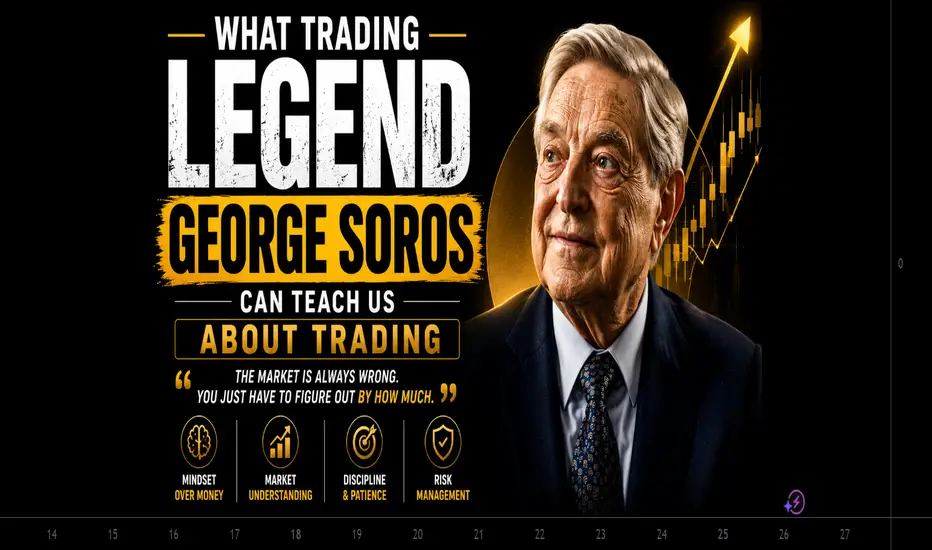
George Soros. The man who broke the Bank of England. If you are a trader and you have never studied him, you are leaving a lot of valuable lessons on the table. Let us get into what made him one of the greatest traders of all time and what you can actually take from his approach and apply to your own trading.
Who Is George Soros?
In 1992, Soros made over a billion dollars by shorting the British pound. He is the co-founder of the Quantum Endowment Fund, a hedge fund managing over $27 billion in assets. He grew up as a young Jewish boy in Nazi-occupied Hungary, later moved to England to study at the London School of Economics, and eventually settled in the US in 1956 to work as a stockbroker. His journey from survival to becoming one of the world's greatest traders is worth paying attention to.

His Trading Philosophy
Soros is a short-term speculator at heart. He makes large, highly leveraged bets on currency rates, commodities, stocks, and other assets based on macroeconomic analysis. His approach is known as global macro strategy, essentially reading the bigger picture of the world economy and placing concentrated bets on where things are heading.
What Can We Learn From Him?
This is probably the most important trading lesson there is. You do not need to win the majority of your trades to be profitable. What you need is proper risk to reward. If you are consistently making two times your risk on winning trades, you can lose more than half your trades and still come out ahead. Most traders never understand this and that is exactly why most traders fail.
Soros was not recklessly contrarian. He followed trends but kept his eyes on major inflection points where trends could reverse. That is where the real opportunity sits. Trading with the trend is smart. But knowing when a trend is exhausted is what separates average traders from great ones.
This aligns with what many trading greats have said. You can have the best analysis in the world and still be wrong. The market has too many variables for anyone to predict with certainty. What you can control is your entry, your stop loss, your target, and your own behavior. Everything else is out of your hands. The sooner you accept this, the better you will trade.
Being contrarian does not mean blindly trading against the trend. It means thinking differently from the majority. It means waiting for pullbacks instead of chasing extended moves. It means being patient when everyone else is emotional. Soros understood this better than almost anyone.
More indicators do not mean better trades. More complexity does not mean more accuracy. The traders who last are usually the ones who strip everything back and focus on what actually matters. Simple works. Always has.
Having money on the line forces focus. But there is a line between being focused and being obsessed. Risk should make you alert, not anxious. If every open trade keeps you up at night, that is a sign your position sizing is off, not a sign that you need to watch the charts more closely. If you cannot handle the discomfort of financial risk, trading will grind you down.
If your trading feels exciting with big emotional highs and lows, you are probably gambling, not trading. Consistent profitable trading is routine. You follow your plan, you take your setups, you manage your risk, and you move on. The drama comes from poor discipline, not from the market itself. Learn to be comfortable with boring. Boring means you are doing it right.
When a trend is changing, weaker traders panic and exit. The traders who entered late with little conviction are the first to get shaken out. For a price action trader, this volatility is actually useful. It signals that something is shifting. Learning to read that is a genuine edge.
He did not hold losing positions out of ego. When he was wrong, he admitted it and got out. That alone sets him apart from most traders. The ability to take a loss without hesitation is not weakness. It is one of the most important skills in trading. You are going to be wrong a lot, especially early on. The question is whether you learn from it or keep paying for it.
Final Thought
Soros built his wealth by thinking clearly, managing risk honestly, and never letting emotion drive his decisions. He was contrarian but not reckless. He was confident but always aware he could be wrong. That combination is rare, and it is exactly what every serious trader should be working toward.
Disclaimer: This article is for educational purposes only and should not be considered financial advice. Always do your own analysis and use proper risk management.
Thank you for reading. I hope this article helped you better understand market behavior, trading psychology, and risk management during volatile conditions.
For more trading education, chart analysis, and market insights, follow:
Trade-Technique on TradingView
Who Is George Soros?
In 1992, Soros made over a billion dollars by shorting the British pound. He is the co-founder of the Quantum Endowment Fund, a hedge fund managing over $27 billion in assets. He grew up as a young Jewish boy in Nazi-occupied Hungary, later moved to England to study at the London School of Economics, and eventually settled in the US in 1956 to work as a stockbroker. His journey from survival to becoming one of the world's greatest traders is worth paying attention to.
His Trading Philosophy
Soros is a short-term speculator at heart. He makes large, highly leveraged bets on currency rates, commodities, stocks, and other assets based on macroeconomic analysis. His approach is known as global macro strategy, essentially reading the bigger picture of the world economy and placing concentrated bets on where things are heading.
What Can We Learn From Him?
"It is not whether you are right or wrong that is important, but how much money you make when you are right and how much you lose when you are wrong."
This is probably the most important trading lesson there is. You do not need to win the majority of your trades to be profitable. What you need is proper risk to reward. If you are consistently making two times your risk on winning trades, you can lose more than half your trades and still come out ahead. Most traders never understand this and that is exactly why most traders fail.
"Most of the time we are punished if we go against the trend. Only at inflection points are we rewarded."
Soros was not recklessly contrarian. He followed trends but kept his eyes on major inflection points where trends could reverse. That is where the real opportunity sits. Trading with the trend is smart. But knowing when a trend is exhausted is what separates average traders from great ones.
"The whole thrust of my approach is that the course of events is indeterminate."
This aligns with what many trading greats have said. You can have the best analysis in the world and still be wrong. The market has too many variables for anyone to predict with certainty. What you can control is your entry, your stop loss, your target, and your own behavior. Everything else is out of your hands. The sooner you accept this, the better you will trade.
"Being so critical, I am often considered a contrarian. But I am very cautious about going against the herd. Most of the time I am a trend follower, but all the time I am aware that I am a member of the herd and I am on the lookout for inflection points."
Being contrarian does not mean blindly trading against the trend. It means thinking differently from the majority. It means waiting for pullbacks instead of chasing extended moves. It means being patient when everyone else is emotional. Soros understood this better than almost anyone.
"The market is a mathematical hypothesis. The best solutions to it are the elegant and the simple."
More indicators do not mean better trades. More complexity does not mean more accuracy. The traders who last are usually the ones who strip everything back and focus on what actually matters. Simple works. Always has.
"Risk taking is painful. Either you are willing to bear the pain yourself or you try to pass it on to others. There is nothing like danger to focus the mind."
Having money on the line forces focus. But there is a line between being focused and being obsessed. Risk should make you alert, not anxious. If every open trade keeps you up at night, that is a sign your position sizing is off, not a sign that you need to watch the charts more closely. If you cannot handle the discomfort of financial risk, trading will grind you down.
"If investing is entertaining, if you are having fun, you are probably not making any money. Good investing is boring."
If your trading feels exciting with big emotional highs and lows, you are probably gambling, not trading. Consistent profitable trading is routine. You follow your plan, you take your setups, you manage your risk, and you move on. The drama comes from poor discipline, not from the market itself. Learn to be comfortable with boring. Boring means you are doing it right.
"Short term volatility is greatest at turning points and diminishes as a trend becomes established."
When a trend is changing, weaker traders panic and exit. The traders who entered late with little conviction are the first to get shaken out. For a price action trader, this volatility is actually useful. It signals that something is shifting. Learning to read that is a genuine edge.
"I am only rich because I know when I am wrong. I have basically survived by recognizing my mistakes."
He did not hold losing positions out of ego. When he was wrong, he admitted it and got out. That alone sets him apart from most traders. The ability to take a loss without hesitation is not weakness. It is one of the most important skills in trading. You are going to be wrong a lot, especially early on. The question is whether you learn from it or keep paying for it.
Final Thought
Soros built his wealth by thinking clearly, managing risk honestly, and never letting emotion drive his decisions. He was contrarian but not reckless. He was confident but always aware he could be wrong. That combination is rare, and it is exactly what every serious trader should be working toward.
Disclaimer: This article is for educational purposes only and should not be considered financial advice. Always do your own analysis and use proper risk management.
Thank you for reading. I hope this article helped you better understand market behavior, trading psychology, and risk management during volatile conditions.
For more trading education, chart analysis, and market insights, follow:
Trade-Technique on TradingView

Verbundene Veröffentlichungen
Haftungsausschluss
Die Informationen und Veröffentlichungen sind nicht als Finanz-, Anlage-, Handels- oder andere Arten von Ratschlägen oder Empfehlungen gedacht, die von TradingView bereitgestellt oder gebilligt werden, und stellen diese nicht dar. Lesen Sie mehr in den Nutzungsbedingungen.
Verbundene Veröffentlichungen
Haftungsausschluss
Die Informationen und Veröffentlichungen sind nicht als Finanz-, Anlage-, Handels- oder andere Arten von Ratschlägen oder Empfehlungen gedacht, die von TradingView bereitgestellt oder gebilligt werden, und stellen diese nicht dar. Lesen Sie mehr in den Nutzungsbedingungen.